
Seven Ways to Use a Metronome for Better Practice

What do you call a dwarf who rides the subways of Paris?
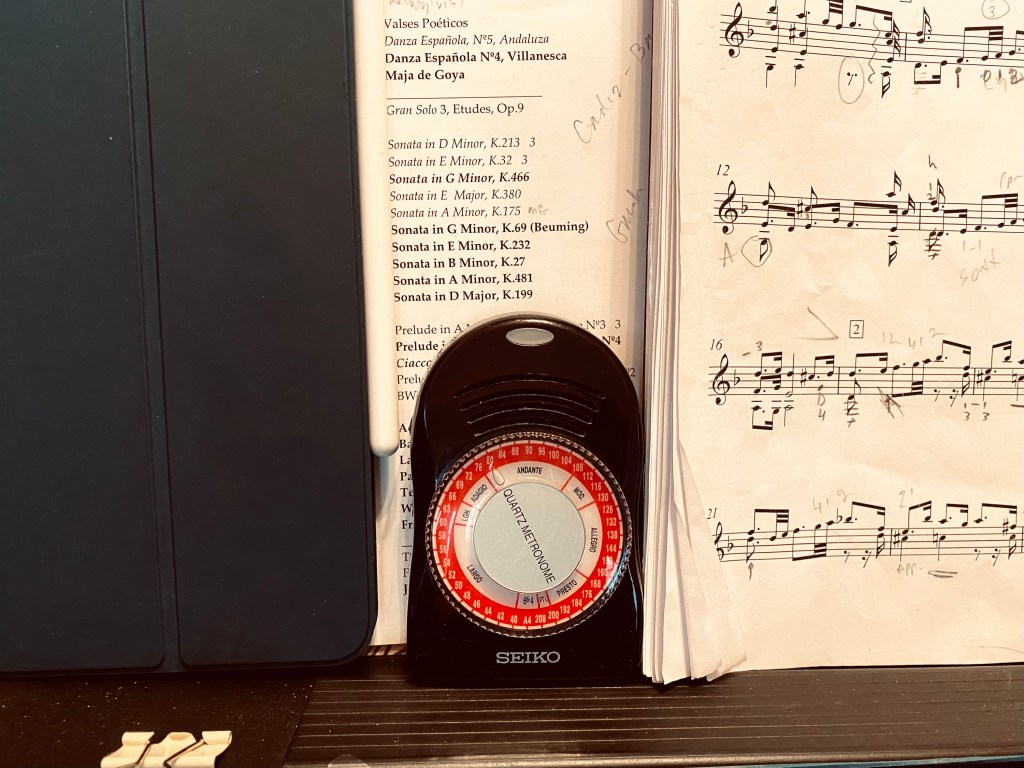
A metronome should be your ally in the practice room. While it may seem like a cold, unforgiving taskmaster, it’s one of the most powerful tools you have for becoming a better guitarist and musician. Beyond simply keeping you in time, the metronome develops your internal pulse and reveals where your playing might be rushing or dragging. There is a lot of fun you can have with the metronome. Here are my favorite ways to use it when I’m practicing:


1. Gradual Tempo Building (“Clicking Up”)

Start at a comfortable tempo where you can play the passage cleanly. Slowly increase the tempo in small increments (2-10 bpm at a time) until you reach or even slightly surpass your target tempo. This method builds accuracy first, then speed.


2. Fewer Clicks, Longer Phrases

Keep the metronome at the same speed but reduce the number of clicks per bar—for example, setting it to click only on beats 1 and 3, or just on beat 1. This approach forces you to internalize the pulse and feel longer phrases instead of relying on every beat.


Metronome-Off Challenge

Set the metronome, play along to establish the tempo, then turn it off and continue playing. After a few bars or phrases, turn it back on to see if you stayed in time. This practice is excellent for developing your internal pulse.


4. Offbeat & Subdivision Clicks

Instead of clicking on the downbeats, have the metronome click on the upbeats (the “and” of each beat) or on subdivisions (e.g., sixteenth notes in a fast passage). For perpetual motion pieces, such as a Bach Allegro, this approach keeps you honest and aids in maintaining rhythmic stability and precision.


Half-Time or Double-Time Feel

Set the metronome to half the tempo so it clicks only once every two beats (or every bar). Alternatively, set it to double the tempo so it clicks on every subdivision. Both methods challenge you to maintain a steady groove and avoid rushing.


Random Dropout Practice (Advanced)

Some modern metronome apps allow the click to drop out randomly. This feature forces you to maintain steady timing when the click disappears, which helps train your internal rhythm consistency.


Polyrhythmic Practice

Set the metronome to a different pulse than the meter you’re playing—for example, a 3:2 feel (triplets against duplets). This develops rhythmic independence and makes you far more rhythmically flexible.


Recommended Metronomes

My favorite old-school quartz metronome is the Seiko Quartz SQ50-V but here are a few more that I’ve used in the past.

  • Tonal Energy Tuner (App)—combines metronome, tuner, and advanced rhythmic tools.
  • Dr. Beat DB-90 (Boss)—classic, reliable, and feature-rich with multiple patterns.
  • Metronome+ (App) is a helpful tool I have on my iPad because you can set tempo increases automatically. It is excellent for technique practice.

This post includes affiliate links. If you decide to use it, thank you—it helps keep this blog up and running.
Three Indispensable Practice Resources

Over the years, I’ve explored countless practice resources—but these three consistently rise to the top. If you’re looking to deepen your progress on the classical guitar, these are well worth your time.

Molly Gebrian

The catchy title of Molly Gebrian’s book, Learn Faster, Perform Better, lays out science-backed methods of practicing that will help you become better at your instrument. Gebrian holds degrees in neuroscience and music, is a phenomenal violist, and is a faculty member at one of my alma maters, the New England Conservatory. Her book goes through the concepts of spaced practice, mental practice, attentional focus, variable practice, structured practice planning, and other topics that, if you have not learned in music school, you’ll be grateful to learn here.

Her YouTube channel is an invaluable resource. The videos are short, insightful, and actionable—perfect for classical guitar students looking to level up their technique and musical memory. You’ll find clear explanations, real-world examples, and bite-sized challenges that make her ideas easy to apply right away.

Tonebase

Tonebase has been publishing a wide variety of videos that I’ve found helpful. The videos by Eliot Fisk, Nigel North, and Paul O’Dette discussing various Bach suites are excellent. The videos where Marco Tamayo explains his approach to technique or where Rene Izquierdo goes through repertoire are so insightful that you’ll gain great nuggets of information to inspire you. However, what I found most useful this year were the videos Lukasz Kuropacsewski did on practicing. These are absolute gold because he not only answered many questions I’ve asked myself over the years, but the enthusiasm with which he delivers the advice makes you want to grab your guitar. If you have not seen these, the price of a subscription to Tonebase is well worth it. Use this code SSJ-30 for 30% off.

The Bulletproof Musician

The Bulletproof Musician, created by performance psychologist and Juilliard-trained violinist Dr. Noa Kageyama, is one of the most respected resources on the mental side of music performance. The site is packed with research-based articles, podcasts, and practical advice on topics like overcoming performance anxiety, effective practice techniques, building confidence, and performing under pressure. Drawing from psychology, neuroscience, and decades of performance experience, Dr. Kageyama translates complex ideas into clear, actionable strategies that musicians of all instruments and levels can apply.

While it isn’t guitar-specific, the insights are universally applicable to classical guitarists—especially given the instrument’s intimate, exposed nature and the mental demands of solo performance. Students can benefit greatly from articles on focus, memory, and managing nerves on stage.

This post includes an affiliate link. If you decide to use it, thank you—it helps keep this blog up and running.

NEW PUBLICATION!

Agustín Barrios Mangoré

NEW PUBLICATION! I finally published a study score of Agustín Barrios Mangoré’s tremolo masterpiece Un Sueño en la Floresta. I love a compact score! I’ve reduced what editors usually publish in editions of 12+ pages to 4. It is easier to see structure, to manage page turns, and to mark sections for work. There are detailed fingerings for the left hand, optional fingerings, and smaller indications about barring and guide fingers. I have found that these fingerings work best for me and my students. This edition is available through the Six String Journal Payhip store and is 50% off for the remainder of July!

Stay tuned : ) for more!

More products related to tremolo technique:

Mastering Tremolo

Una Limosna por el Amor de Diós study score

Recuerdos de la Alhambra study score

Here’s a link to additional posts about tremolo technique.