More Scales to Master – Modes Part 1

In the last post related to scale development, I provided closed (or moveable) scale forms for major, harmonic minor, and melodic minor scales. In this post I’ll do the same except with modes. Though my understanding of modes is at best primitive, studying them to develop a better aural sense of what is happening both harmonically and melodically in the music we play, especially when the music has popular or folkloric roots (flamenco!), augments our musical knowledge. If you’ve been practicing only major and minor scales for years on end, your ear will welcome these forms to your practice. And, for those looking to gain a deeper understanding, there are bazillion jazz, improvisation, and composition sites to explore out there. But for the basics on modes go to wikipedia.

I’ve left out Ionian and Aeolian as their intervals correspond to major and natural minor.

C Dorian Scale 3rd string dorian diaScale 4th string dorian diaScale 5th string dorian dia.jpg

C PhrygianScale 3rd string phrygian diaScale 4th string phrygian diaScale 5th string phrygian dia

C LydianScale 3rd string lydian diaScale 4th string lydian diaScale 5th string lydian dia


Stay tuned for the remaining modes (mixolydian and locrian) and some other scale goodies…

The Best of YouTube

YouTube is both a blessing and a curse. Among thousands of videos not worth watching, there are a few gems waiting for discovery. I’m hoping to add video tutorials on the elementary pieces that my students enjoy playing after they’ve finished the KinderGuitar curriculum. In the meantime, I’ll share some great videos I’ve discovered after being trapped in the YouTube world a few weeks ago. If you are still developing your technique, watch them over and over. If you are far along, there are still wonderful moments of insight to extract. I watched most of them in one sitting at 1.5x speed, taking notes, and sipping coffee. These videos come from Russian guitarist Andrey Parfinovich. He’s done the guitar world a great service when he decided to film his lessons with the masters!

Pepe Romero on left hand technique:

Pepe Romero on rest stroke technique:

Pepe Romero on tremolo:

Pepe Romero on rasgueado:


More soon….


Three Basic Scale Forms to Master

I just returned from a vacation that went by way too fast. As always, I was over ambitious when it came to planning out which pieces to learn but I did manage to re-work most of the Chaconne and will have many posts exploring what I’ve come across this time around.

In the meantime, the next post to help you develop a scale practice is here. Here are three moveable scale forms (major, harmonic minor, and melodic minor) covering three octaves starting on three different strings.

In general, focus on developing the skills you have worked on from the previous preparatory post in the more musical and sophisticated setting of scales: rest stroke, free stroke, string crossing, and very accurate transitioning from finger to finger. Use a metronome to track your progress and don’t be afraid to live in slow tempo world if it means you are becoming better and more consistent with your sound from note to note.

Rest-stroke fingerings: im, mi, ma, am, ia, ai, p, ami, ima, imam, amim, aimi

Free-stroke fingerings: im, mi, ma, am, ia, ai, pi, pm, pa, ami, ima, imam, amim, aimi, pmi, pami.

C Major Scale 3rd string major dia.jpgScale 4th string major dia.jpgScale 5th string major dia.jpg


C Harmonic MinorScale 3rd string har minor dia.jpgScale 4th string har minor dia.jpgScale 5th string har minor dia.jpg


C Melodic MinorScale 3rd string mel minor dia.jpgScale 4th string mel minor dia.jpgScale 5th string mel minor dia.jpg


Stay tuned (!) for the 3rd installment related to developing your scale practice where I’ll go through other scale forms.


Preparatory Work for Scales

During the summer months when it seems like there are extra hours in the day, I like to augment my practice by spending a lot more time with some intensive technique exploration and then learning new repertoire where I can experience the fruits of my labor. I remember coming across a sentence in Philip Hii’s writings essentially claiming that break-throughs rarely occur in the first few hours of practice. I agree wholeheartedly! And, as many of you could probably attest after practicing between the hours of 11 PM to 4 AM when the world is silent, break-throughs are not so often sought as just magically appear. So in this spirit, set aside a chunk of hours, grab some tea or coffee, and explore the next sequence of preparatory movements for scales.

Focus on the following key points:

1) Practice perfect alternation – As the finger performing the stroke moves towards its resting point, the next finger should release from its resting point to prepare the next stroke.

2) Keep everything relaxed – The only energy used is in the stroke, once this is performed the finger should release all energy and tension. In the best case scenario, the tension of the finger is released as the alternating finger exerts energy on the next stroke.

3) If you are still developing a technical base, spend more time on the basics – im, ma, ia and finger alternation with p are the more important fingerings to develop as all the others contain these basic movements.

Spend as much time within each step or rhythm to achieve improved tone consistency, stroke efficiency, rhythmic precision, and perhaps, speed. Use the 3rd string as a starting point before exploring other strings. If your nails wear easily, protect them with packing tape or keep most of your practice relegated to the first three strings. And, don’t forget to use your friend the metronome!

Rest Stroke or Apoyando

Step 1

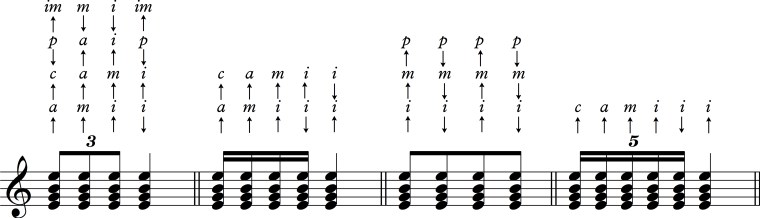
Develop rest-stroke fingerings: im, mi, ma, am, ia, ai, p, ami, ima, imam, amim, aimi.

Scale 3 rh scale prep 1a small.jpg

Step 2

Develop string-crossing: im, mi, ma, am, ia, ai.

a)Scale 3 rh scale prep 1a1small.jpg
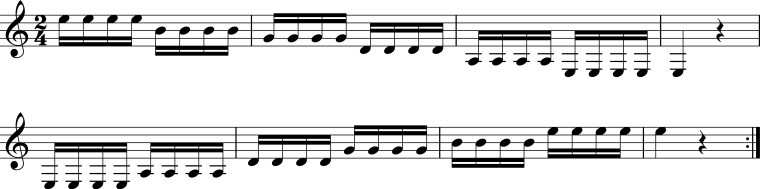
b)Scale 3 rh scale prep 1a2small.jpg

Step 3

Apply fingerings to simple coordination movements.

Scale 3 rh scale prep 3 small.jpg

Free Stroke or Tirando

Step 1

Develop free-stroke fingerings: im, mi, ma, am, ia, ai, pi, pm, pa, ami, ima, imam, amim, aimi, pmi, pami.

Scale 3 rh scale prep 1a small.jpg

Step 2

Develop string crossing: im, mi, ma, am, ia, ai, pi, pm, pa.

a)Scale 3 rh scale prep 1a1small.jpg
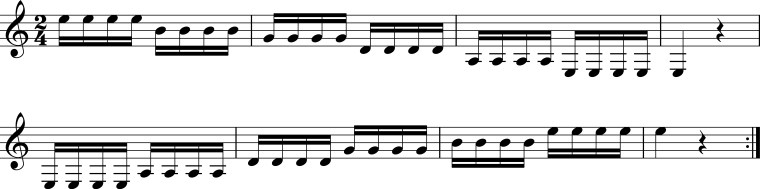
b)Scale 3 rh scale prep 1a2small.jpg

Step 3

Apply fingerings to simple coordination movements.

Scale 3 rh scale prep 3 small.jpg

Bring It All Together

 With a good chunk of time spent on the sequences above, you may be excited to test out the well-oiled machinery of your hands on scale forms and your repertoire. If you are looking for scale forms, stay tuned, as I plan to explore this in the next few posts.


This is Classical Guitar and Aural Refocus

As I plan out the next stages/posts for the blog I thought I’d give a shout out to Canadian classical guitarist, Bradford Werner’s great site www.thisisclassicalguitar.com. He covers so much: from reviews to lessons to a great selection of videos. He published a recent article I wrote on a concept I’ve found to really help me break through practice plateaus. Check it out: Aural Refocus Article.


Right Hand Technical Workout Part 2

Here is the second installment of our right hand technique series. After a solid warmup of the larger muscle groups and gross motor skills in our right hand through chords and rasgueado (see Part 1), we’ll start building movements in the right hand from two finger movements up to four finger movements.

To start we’ll use movements involving the thumb with one other finger (pi, pm, pa) and movements involving the thumb with two other finger movements (pim, pmi, pma, pam, pia, pai). The primary goals with the following drills are to develop a strong sense of how the fingers fall across the strings which will reinforce our default right hand position and to develop a strong sense of independence from finger to finger (i.e. the movement of one finger or stroke should not displace the hand from this default position).

Step 1 – Thumb with one finger movements (pi, pm, pa)

The fingers of the right hand not involved in the movement should passively rest by very lightly touching their respective string. If this is too difficult at first, have them float as close as possible above their respective string (p=4, i=3, m=2, a=1).

right hand pi 2.jpg

right hand pm 2.jpg

right hand pa 2.jpg

Step 2 – Proceed to alternation

right hand pi 2.jpg

right hand pm 1.jpg

right hand pa 1.jpg

Step 3 – Proceed to work on the following thumb with two finger movements (pim, pmi, pma, pam, pia, pai). Note that each line contains six different movements to develop.

right hand pim 1.jpg

right hand pma 1.jpg

right hand pia 1.jpg

That should keep you all busy! Stay tuned to Part 3.

Right Hand Technical Workout Part 1

Just like in our Left Hand Technical Workout, I’m going to break this post into a few parts. This first part focuses on developing the macro movement of the hand as a unit.

Right Hand Movements

For all of the following movements, begin with the right hand positioned over strings 4, 3, 2, 1 with fingers p, i, m, a, respectively. Later, to expand into tremolo movements, p can remain on a different string and i, m, a can be used on the same string.

This part of the workout for the right hand involvies larger gross-motor skill requiring movements: chords and rasgueados.

Go through all fingerings for each movement.

Step 1

Chordal Movements – pima, pim a, pi ma, pma i, pm ia, pia m, pa im

Groups of fingers that are underlined move together and alternate with the next finger/fingers. Below is an example of pim a. I tend to use a simple scale of thirds or if you are craving dissonance, a diminished 7th chord (think Villa Lobos) as I ascend and descend the fretboard.

right hand chord 1.jpg

Focus on keeping the right hand relaxed but still. All movement must originate from the knuckles as if lightly closing your fist. I really have to get some short videos demos of this stuff…

Step 2

Rasgueado movements – cami, amii, pai, camii, im mi

For the movements below, rest the thumb (p) on string 5 when not using it in the pattern. Movement should originate from the knuckles outwards. Time to develop those flexors. Don’t overdo it though!

right hand rasgueado.jpg

Stay tuned for part 2!

Conde Claros, Scales, and String-Crossing

I’ve been reworking the music of the great Spanish composer Luys de Narváez. His Seis Libros del Delphín were published in the early 1500s in Granada. The six volumes contain music that is profoundly beautiful and exquisitely crafted while evoking a time that was ripe with wonder. After all, the music was published a few decades after Christopher Columbus’ great voyage to the New World. Narváez’s Diferencias are some of the earliest know sets of variations and his Canción del Emperador was possibly a favorite of King Charles V. Fortunately for guitarists, conjuring that time period is potentially within our grasp as the music translates well to the modern guitar. Because of the tuning of the vihuela, the slight adjustment of tuning the 3rd string to f-sharp makes the pieces more playable. I prefer placing a capo on the 2nd fret but placing it on the 3rd fret will transpose the piece to the original key.

This post is not a history lesson about the guitar, however. It’s another post about fingering for the right hand as this music is full of scale runs. So I thought I’d list a few rules every aspiring guitarist should use when working out right hand fingerings to perhaps help make conjuring your favorite time period easier. These rules assume you have a functioning technique. If that is not the case, they can still help, but you may want to spend extra hours in the tool shed working on developing a base for your technique (more on this coming!). This way you will get the most out of these rules when applying them.

Rule 1 

When crossing from a lower string to an adjacent higher string (i.e. string 3 to string 2):

  • im is preferable to mi
  • ia is likely preferable to ai
  • pi is preferable to ip
  • ma is preferable to am

conde claros ex. 2.jpgRule 2

When crossing from a lower string to a higher string with a string  or more between them (i.e. string 4 to string 2 or string 5 to string 1)

  • ia is preferable to ai and im
  • pm is likely preferable to pi
  • pa is likely preferable to pm

Rule 3

Try to maintain the rules 1 and 2 throughout scales and right hand cross-stringed fingerings. If you are unable to maintain efficient crossing you can use the following methods to insure rules 1 and 2 are maintained.

Method 1

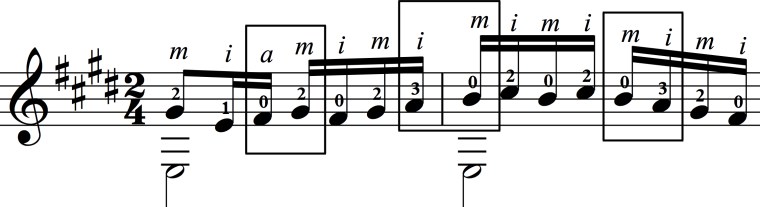
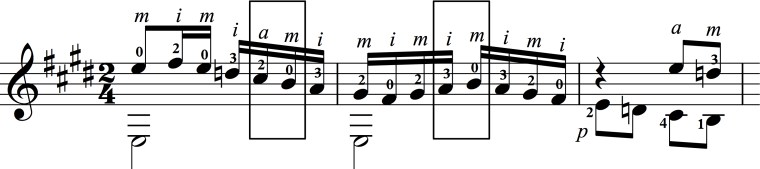
When playing im scale runs, insert a (ring finger) to change the direction of the fingers. Notice the use of a in the first box to facilitate the string crossing in the next box/boxes.

conde claros ex. 1.jpg

conde claros ex. 3.jpg

Method 2

When playing im scale runs, insert a slur to change the direction of the fingers.

Rule 4

Do not use a slur if it is does not reflect your musical intent.

Preludio Criollo

If you have not heard Venezuelan composer Rodrigo Riera’s Preludio Criollo, you have missed out on one of the most beautiful pieces written for the guitar. The play between 6/8 and 3/4, the subtle baroque-like harmonic movement, the clever way in which the tune makes its appearance, all while evoking the spirit of Venezuela, create magic as they come together.

This said, it can be a tricky piece for students because many times, students approach it as a series of chord changes, i.e. preparing the entire harmony or chord before playing. This approach makes it infinitely more difficult to play in time and to maintain the rhythmic integrity of the piece. Further, it creates a sense of panic to quickly place fingers and as a result the right hand inevitably grabs the beginning of each chord change creating unintentional accents throughout the piece.

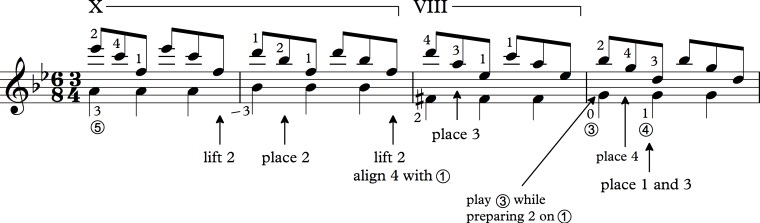
In studying this piece, as well as other pieces with perpetual movement and arpeggios like Heitor Villa-Lobos’ Etude Nº1 or Agustin Barrios’ Estudio de concierto, the main point to get across to students is that they have to prioritize what left hand fingers need to place first in a harmonic change in order to maintain rhythmic continuity as they play. It is important to realize that all fingers of the new harmony do not  need to place before the right hand starts playing the arpeggio. Instead, prepare only what is necessary and then sequentially place the rest of the fingers as the notes are needed. It also works to understand this before arriving to a chord: certain fingers can begin to relax before the change in order to make a relaxed transition. Here are some examples from Preludio Criollo to explore these ideas.

Preludio Criollo Example 1.jpg

When making harmonic changes try the following solutions to help make the transitions musical and smooth.

  1. Practice the transition without the shift first. This gives us a clear feeling of what is required if the shift component is removed from the equation. Most harmonic changes that involve shifts are actually two technical problems lumped into one moment. It helps to know which of the technical problems is creating the challenge. It may be only the shift or it may be the left hand finger placement. It is rarely both.
  2. A slight rallentando before the shift could provide just enough time to make the shift work. This also helps relax the hands so that the placement in the new position is calm.
  3. If there is a bass note to play along with a melodic note, roll them slightly by playing the bass note first. This creates the sense that you are in time even though the rest of the beat has not yet been heard. Don’t overdo this as it can start diffusing the rhythmic momentum of the piece.
  4. Practice the transition in the air above the frets. Sometimes this helps to soften the movement and to bring awareness as to how little is happening physically in the left hand and that the relative distance between the positions is smaller than we perceive.
  5. Beware of accenting the first notes after a shift that is too hasty. Accent ONLY if the music warrants it.

Hope this helps!


Right Hand Alone

At a certain point, every aspiring guitarist tackling difficult repertoire discovers the value of practicing the right hand of a musical passage, phrase, or entire piece entirely by itself. Understanding exactly what the right hand is doing in terms of musical inflection, rhythm, and string crossing is an absolute must for mastering challenging repertoire.

The most compelling argument is that most guitarists tend to fret over the left hand and often let the right hand only play up to the left hand’s standard. Essentially, the process dumbs down the right hand, which under little practice could probably out-execute the left hand. So instead of dumbing down the right hand, enable the right hand to exceed itself by practicing its part alone and eventually the left hand will rise to the occasion of matching the right hand’s ability.

Another argument for practicing the right hand alone is that by writing out the passage as open strings, we can better see  where the string crossing happens and as a result can insure that the right hand remains efficient (crossing to higher strings with m instead of i, for example) and if there is an inefficiency, that it is a conscious decision to have it that way.

Practice writing out several difficult passages of your repertoire as open strings, investigate whether or not the right hand fingering decisions make sense to optimize string crossing, and then practice the right hand alone on open strings striving to make it musical, rhythmic, and automatic. Then, invite the left hand back into the game to assess the difference.

At some point, after having practiced enough material in this fashion, you’ll find yourself able to visualize the best choice for the right hand without writing it out and you’ll even be able to play the right hand alone by looking at your score.

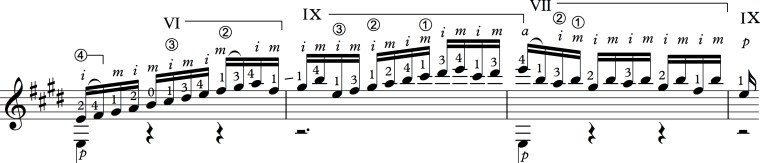
Here is an example of a passage and what it looks like after writing it out on open strings. Notice the rhythm is different to account for slurs. Also, notice all of the string crossing situations are efficient except for one situation which I’ve left for consistency in the right hand.

Excerpt from J. S. Bach’s Prelude in E Major, BWV 1006a

Bach Right Hand Example 1

Passage in open strings (string crossing in boxes):

Bach Right Hand Example 2.jpg