I love getting to the point when a student is ready to tackle Heitor Villa-Lobos’ Etude Nº1. There are so many angles to explore and it takes a lot of dedication to master it. There was a time when I was preparing to perform all 12 etudes that I decided the best use of my warm up time was to spend at least 30 minutes on Etude Nº1, 30 minutes on Etude Nº2, and 30 minutes on Etude Nº3. After which my hands always seemed to work well as I worked on other material.
Over the course of months I may have played those etudes at least a thousand times in many, many different ways. I tried everything I could think of to make them better.
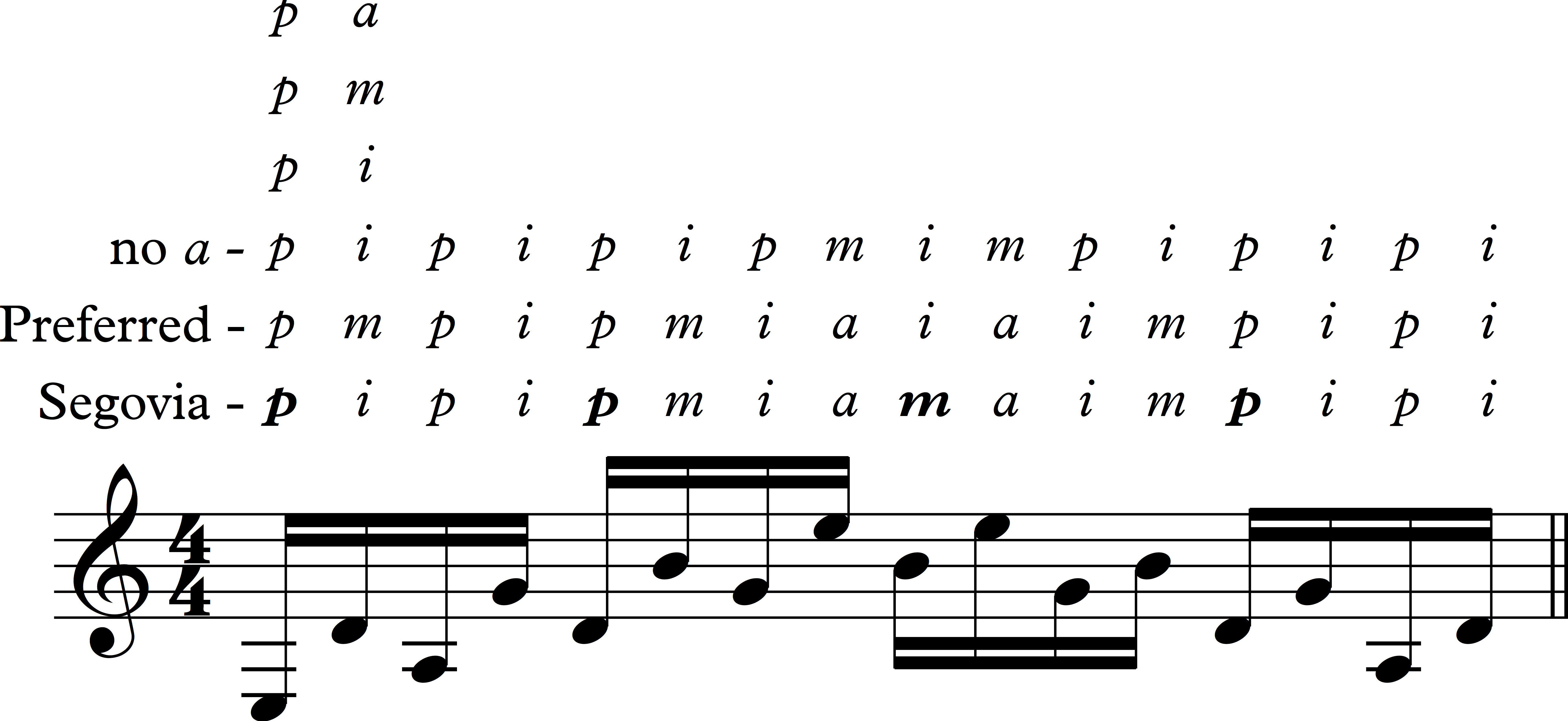
The first step in this great journey is to develop the right hand’s ability to play the entire arpeggio comfortably. The great Andrés Segovia suggested a solution that is still used by the majority of students and the one I used for years. However, as we develop our abilities we find that our hands have an easier time with certain movements and we find ways to use those movements to harness our strengths.
So, I always suggest putting in your time with Segovia’s solution until you can perform the Etude with that pattern. I find that the weakest part of the solution is moving from m to a making the 3rd quarter note beat (half note of the measure) sound articulate which helps to delineate the rhythmic structure of the Etude, so I have come to prefer substituting m with i. However, it wasn’t until working on the piece for many years that I slowly came to prefer it. Explore the possibilities in the practice room by adding in a few alternate fingerings to start the exploratory process. I’ve watched my mentor, Eliot Fisk, play it through in hundreds of ways just as an exercise to develop string crossing – I think I remember him even doing the whole arpeggio with m and pinky!
Here are some important ways to practice it. Stay tuned for Part 2 and we’ll go deeper.
Make a one-time donation
Make a monthly donation
Make a yearly donation
Choose an amount
Or enter a custom amount
Your contribution is appreciated.
Your contribution is appreciated.
Your contribution is appreciated.
DonateDonate monthlyDonate yearly


 Six String Journal