Yuri Liberzon – Technique


Yuri and I recently got together in my studio to play guitars, talk shop, and brainstorm advice to share with Six String Journal readers. Originally, we were going to post a list of tips and common mistakes guitarists of all levels should watch out for but there is so much valuable insight in what I recorded – from the warm up exercises below, to learning new repertoire, and more – that I’m simply going to post it as an interview next time. Perhaps a formal podcast is up next but in the meantime this will certainly keep everyone’s fingers busy.

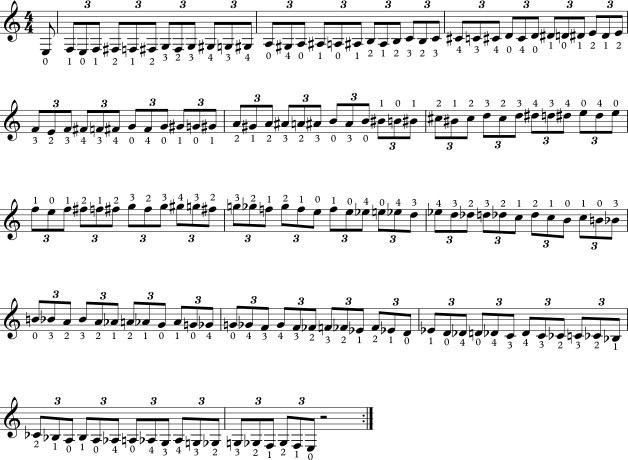
Here is Yuri demonstrating one of his favorite warm up exercises (and the music) with videos of him playing it in various ways.

Yuri's Warm Up Scale Pattern.jpg

This next video, he demonstrates what he likes to do before building up to the exercise above. Notice that he plays through the scale with i, m, a, and c, before moving onto im and am. 

Here is true gold, Yuri works on extensors and ami, too.

And, finally, here is Yuri commenting on balance and tone.

Hope that inspires everyone!

Villa Lobos Etude Nº2, Part 2

I was going to write about a warm up sequence that builds right hand endurance, speed, pulse, and legato. It was going to be a good one. But, I walked past my music stand and Heitor Villa-Lobos’s Etude Nº2 was taunting me.
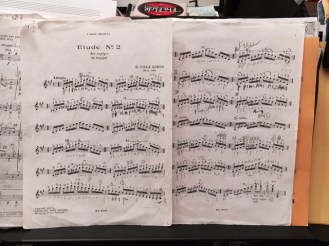
FullSizeRender.jpg

So here are a few more thoughts and approaches I’ve found helpful while working on this over the last few weeks.

Right Hand Alone

We all know the value in practicing the right hand alone. It allows us to focus on what might be a potential lack of understanding as to where the trouble in a passage lies. Focusing on the right hand also allows us to feel the rhythm correctly without the hindrance of a faulty left hand or a left hand that cannot keep up. In this particular etude, there are two movements that recur often. Practice these movements or if necessary, build them up to comfortably play them at your target tempo (120+ bpm).                .

Sweeping with p:
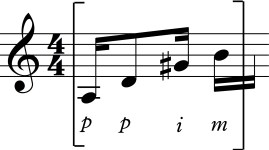
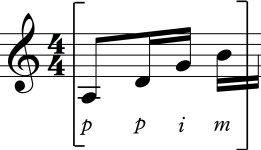
villa lobos 2 open string 1b.jpgvilla lobos 2 open string 1a.jpg

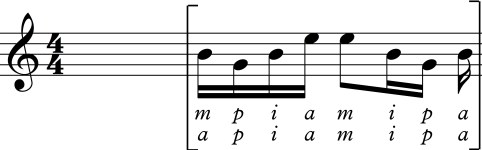
Cross-string arpeggio with various fingerings:
villa lobos 2 open string 1c.jpg

Slow and progressive warm up on these two movements helps develop a more ‘in the pocket’ feel and if you can retain the feel when incorporating the left hand, forces the left hand to behave more reliably. Remind yourself that if you cannot play those movements well at your target tempo, you will simply not be able to play the piece at that speed. So, set that metronome and get to work.

Left Hand Without Shifts

Though shifting in this piece does not present too many challenges, there are a few. Practicing a passage without a shift allows us to deconstruct a movement with two potential problems: the change in hand position and the shift. Try playing the first measure with no shift and focus on how it feels. Then, once that feels fluid, incorporate the shift while retaining the fluidity.

Resting the Right Hand Thumb

Do you know when and on what strings your thumb rests when not using it? Instead of randomly placing it for stability, find spots to rest it that coincide with the next note it will play. Not always possible but it certainly helps when you can get away with it.

Hope that helps. Stay tuned for the super warm up exercise and another Artist Spotlight…


Three Fingering Tips for Villa Lobos’s Etude Nº2

If you all were inspired (or recovered) from watching Ekachai Jearakul whip off Heitor Villa-Lobos’ Etude Nº2, you may find this post helpful. While I was a student at the New England Conservatory, the second half of one of my degree recitals was simply Villa-Lobos’ Twelve Etudes. While some of the etudes are manageable, others require relentless and careful practice, and they all have moments that can fill endless practice hours with frustration. To add to the matter, I was studying with the great Eliot Fisk and despite all of his valuable advice and help, watching him display what was possible on a regular basis conjured both extreme inspiration and a sense of hopelessness at achieving such a level of comfort with these pieces. Needless to say, the year preceding that recital, I was immersed in a figurative amazonian finger jungle and found my own way of surviving.

For those working on this particular etude, there are a few spots where I found less obvious fingerings less problematic. These solutions are personal but if the spots have been frustrating for any of you, give the following solutions a try.

Measure 3 (repeats not counted)

In order to increase the resonance, I like having the 3rd and 2nd strings open on this one so I shift to 5th position to enable this. There are a few alternate right hand fingerings to explore but I prefer the 1st.

villa-lobos-2-alt-fingerings

Measures 10-12

In this solution, guide fingers are highlighted in red. While the right hand solution is personal, I like switching to rest-stroke on the highest note of the run. If you prefer to play free-stroke, you might choose to switch to 1st position by playing the first note of measure 12 on the 1st string open and using that to shift. The second finger would still work as a great guide in this situation.villa lobos 2 alt fingerings 2.jpg

Measures 21-22

In this example, ending the repeat with a slight alteration makes a noticeable difference in playing measure 22. Again, I’ve included some alternate right hand fingerings for exploration but I prefer the 1st.

villa lobos 2 alt fingerings 3.jpg

Hope this helps!

One-Time
Monthly
Yearly

Make a one-time donation

Make a monthly donation TO SUPPORT CONTENT CREATION

Make a yearly donation

Choose an amount

¤5.00
¤15.00
¤100.00
¤5.00
¤15.00
¤100.00
¤5.00
¤15.00
¤100.00

Or enter a custom amount

¤

Your contribution is appreciated.

Your contribution is appreciated.

Your contribution is appreciated.

DonateDonate monthlyDonate yearly