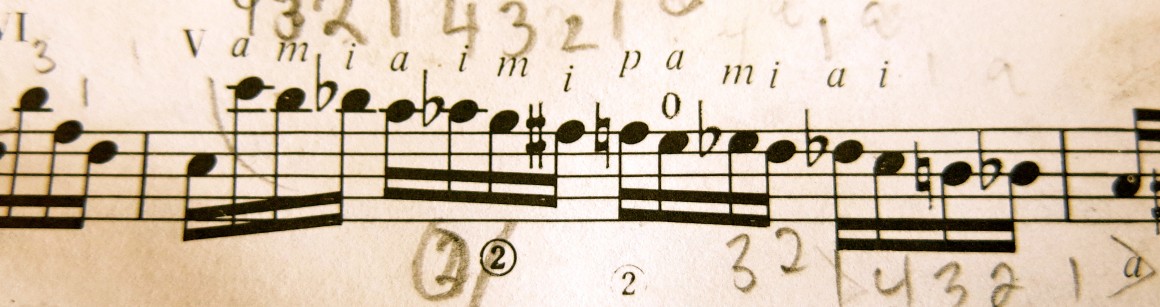
Tremolo, Part 1

Over the years, I have never regretted working on tremolo pieces and technique. From early recordings of John Williams playing Barrios’ Una limosna por el amor de Diós and Un Sueño en la floresta to Pepe Romero playing Francisco Tárrega’s Recuerdos de la Alhambra and Sueño, these pieces are not only special but evocative in ways other instruments cannot replicate. The greatest players manage to give the illusion of an unbroken melodic line while maintaining a well-controlled accompaniment.

There are many skills that must come together to achieve a beautiful sounding tremolo. The most important ones are rhythm precision, consistent intensity from note to note, uniform tone, and speed. One of my favorite guitarists and dear friend, Marco Tamayo, once mentioned that the result of rhythmic regularity and precision created the illusion of speed. I’ll post various ways of working on some of these skills but we’ll look at rhythmic precision first.


The following set of exercises help develop rhythmic control by practicing the tremolo pattern (pami) precisely within the whole of the main beat. When going through the exercises try to remember the inherent hierarchy of the meter and aim to feel p as the main beat. Start slowly with your metronome set to the sixteenth or eighth note. One way to truly feel “in the pocket” with the rhythmic subdivisions is to say the rhythmic breakdown aloud as you play (tee-ka-tee-ka, one-ee-and-ah, etc…). Spend a lot more than one repetition on each pattern. Remember, even Steven!

Exercise 1

Concise Technique Tremolo 1.jpg

Exercise 2

Concise Technique Tremolo 2.jpg

Exercise 3

Concise Technique Tremolo 3.jpg

Exercise 4

Concise Technique Tremolo 4.jpg

After spending a lot of time on the above exercises, you can expand them by varying the string and displacing the thumb onto adjacent or distant strings.

The next set of exercises help develop uniform intensity by changing the initial finger of the tremolo so that every right hand finger within the pattern has a moment to shine in the downbeat spotlight. Think of it like shifting accents in a subtle way.

Exercise 5

Concise Technique Tremolo 1b.jpg

Exercise 6

Concise Technique Tremolo 1c.jpg

Exercise 7

Concise Technique Tremolo 1d.jpg

Again, vary the thumb’s string as you start to gain proficiency and spend lots of time on the weaker patterns. Good luck!
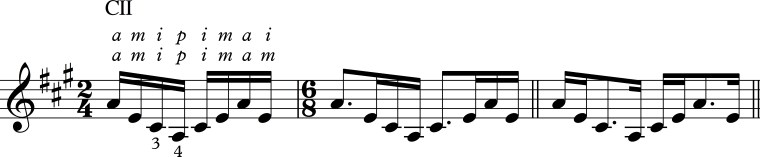

Comfort and Speed in Arpeggios

I thought I would take a moment to stress how important it is to know how to apply the principles from the last post to identify and problem solve mechanical weaknesses in repertoire you are working on. Because I am working on a lot of music by Agustín Barrios Mangoré (1885-1944), I thought I would use two examples of passages you all may be familiar with. I have played the music of the great Paraguayan virtuoso for decades and I still find it fun to work on. I especially enjoy his works with perpetual motion activity. Barrios’ Estudio de concierto, Las abejas, La catedral’s allegro, Danza paraguaya, and passages from his famous waltzes are perfect pieces to spend hours on. So, for this post, we’ll focus on using rhythms to strengthen our understanding and facility of the patterns in these pieces.

Estudio de Concierto

The following example illustrates 5 rhythms in which to work the arpeggio pattern for Barrios’ Estudio de Concierto. Begin by choosing the right hand fingering that most suits your technique. Whether you know the piece or not, practicing each measure in these rhythms will help develop the comfort of playing the arpeggio faster than if you were to only play in a straight rhythm, though it is necessary to do this as well (!).

Arpeggio Fingering                                Rhythm 1                                  Rhythm 2right hand barrios rhythms.jpg

Rhythm 3                                                   Rhythm 4                                  Rhythm 5

right hand barrios rhythms 2.jpg

Vals Op. 8, Nº4

Here is the campanella passage from one of my favorite pieces. This passage deserves more writing but for now I will limit myself to rhythms.

right hand barrios rhythms 3 vals.jpg

Because I know this piece well, I use rhythms to warm up and will often play through the entire section of the piece in as many as 16 rhythms. Here are four that I like to start with:

Rhythm 1                                     Rhythm 2                      Rhythm 3                     Rhythm 4right hand barrios rhythms 4 vals.jpg

Do not feel obligated to go through the entire passage. Instead, spend some time repeating certain groupings in an attempt to make them feel natural and ultimately easy. You may find that you are better at some and that certain patterns remain sticky. Work on the sticky ones.

right hand barrios rhythms 5 vals.jpg

And, if you are not exhausted by this point, here are some additional groupings (notated in shorthand) rotating two eighth notes (represented by a space) through sixteenth notes:

pi  am  pi, pia  mp  i, pi  ampi , p  iamp  i, pi  a  mpi

Or rotating a triplet of sixteenths with 3 eighth notes:

p  i  a  mpi, p  i  ampi  , p  iamp  i  , piam  p  i

Or Using only one dotted eighth note (two spaces):

p   iampi, pia   mpi, piampi   , pi   ampi

I hope this helps. If there are any technical questions you are thinking about in your practice please leave a comment. I’m thinking about a post answering some common questions that I keep getting. And, in the future, I’m going to try to include a video to supplement the posts when I have the time. Until then!







