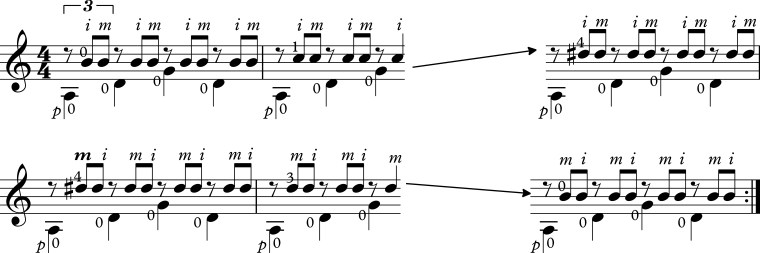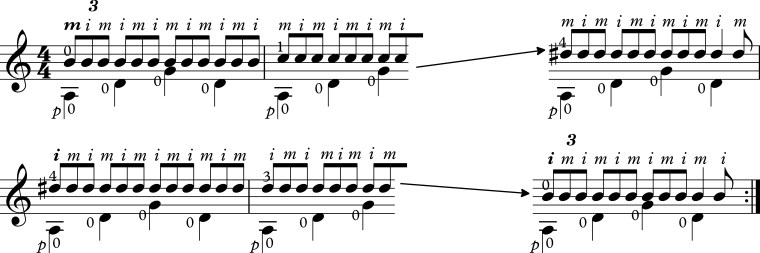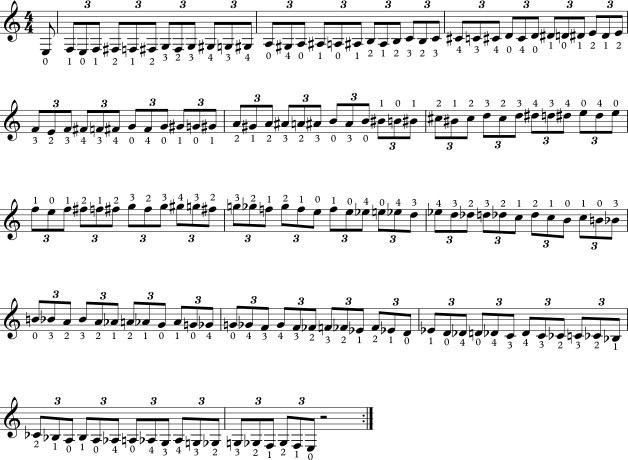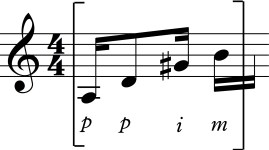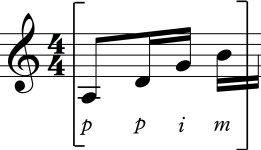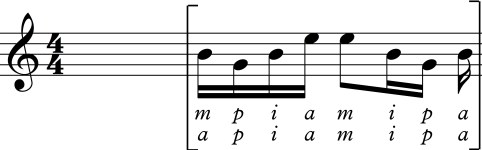
Miracle Right Hand Warm Up Sequence

Here is a warm up sequence that I used to do every morning. It is useful for building right hand endurance, finger alternation, speed, pulse, rhythm, and legato. The idea behind it is simple. Set the metronome to a very slow beat, somewhere (50-70). Throughout the whole sequence, the beat remains constant but with very slight and precise increments we increase the number of notes between the beats.

I would go through all 13 steps (using free stroke) and then go through the whole thing two more times using different right hand fingerings am and ai. So, that’s 39 steps. I actually would go all the way up to fret 12 (3 cycles) and often would use a diminished 7th chord or some left hand variation to keep it interesting. Vary what you need. As you will notice, I’ve been more detailed in the first 3 steps and little by little have resorted to short hand as the basic sequence becomes evident.

Give it a whirl and let me know what you think.

Step 1
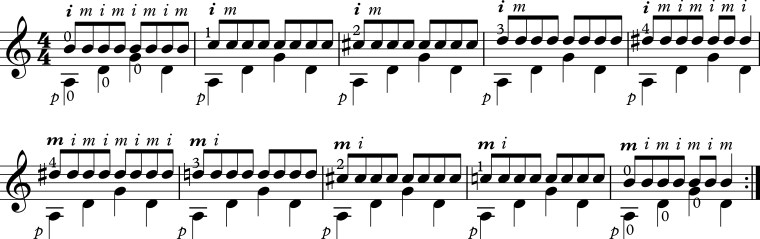
Right Hand Warm Up Sequence 1.jpg

Step 2

Right Hand Warm Up Sequence 2.jpg

Step 3

Right Hand Warm Up Sequence 3.jpg

Step 4

Right Hand Warm Up Sequence 4.jpg

Step 5

Right Hand Warm Up Sequence 5.jpg

Step 6

Right Hand Warm Up Sequence 6.jpg

Step 7

Right Hand Warm Up Sequence 7.jpg

Step 8

Right Hand Warm Up Sequence 8.jpg

Step 9

Right Hand Warm Up Sequence 9.jpg

Step 10

Right Hand Warm Up Sequence 10.jpg

Step 11

Right Hand Warm Up Sequence 11.jpg

Step 12

Right Hand Warm Up Sequence 12.jpg

Step 13

Right Hand Warm Up Sequence 13.jpg

Phew! Go back for more. You know it’s good for you.

A Technical Workout for Guitar

Quick Update!

In addition to the kindle format, my  A Technical Workout for Classical Guitar – Base Building is now available in print via Amazon:

Stay tuned! I’ll be posting some videos to supplement the book soon.

Developing Tone

For my very first video lesson, I thought I would talk about developing tone. I work on tone at the beginning of my first practice session of the day. This aspect of practicing is more of a meditation and serves as a way to psychologically or spiritually enter the practice zone, settle the brain, fine tune the ear, and develop your touch. Hope you all find it helpful.

Yuri Liberzon – Technique


Yuri and I recently got together in my studio to play guitars, talk shop, and brainstorm advice to share with Six String Journal readers. Originally, we were going to post a list of tips and common mistakes guitarists of all levels should watch out for but there is so much valuable insight in what I recorded – from the warm up exercises below, to learning new repertoire, and more – that I’m simply going to post it as an interview next time. Perhaps a formal podcast is up next but in the meantime this will certainly keep everyone’s fingers busy.

Here is Yuri demonstrating one of his favorite warm up exercises (and the music) with videos of him playing it in various ways.

Yuri's Warm Up Scale Pattern.jpg

This next video, he demonstrates what he likes to do before building up to the exercise above. Notice that he plays through the scale with i, m, a, and c, before moving onto im and am. 

Here is true gold, Yuri works on extensors and ami, too.

And, finally, here is Yuri commenting on balance and tone.

Hope that inspires everyone!

Manuel Barrueco on Slow Practice

While listening to Manuel Barrueco’s podcast, he was asked about whether slow practice was a good method. Here was his response:

“[Slow practice] is a very good method, perhaps it’s the best, I’m not sure if it’s the best, but it’s one of. I think slow practice is extremely helpful in a lot of ways. It helps with memory because it breaks down muscle memory. It also allows one to look at the technique very closely. And look at any excess motion, bad movements, and tension in the technique. Also, it gives the hand and the fingers time to learn how to do their job. Also, their is another aspect that is often underrated which is that it is good musically. By practicing slowly, it allows you to slowly hear the harmonies and the lines and everything that is going on in a piece of music. So I wouldn’t be surprised if it is the best technique to practice in.”

With that in mind, try practicing a piece like the Allegro from Agustín Barrios’ La catedral at 60bpm per sixteenth note.

Villa Lobos Etude Nº2, Part 2

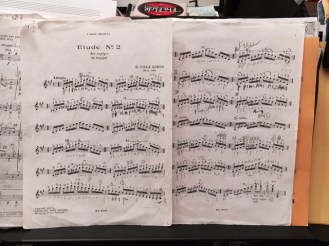
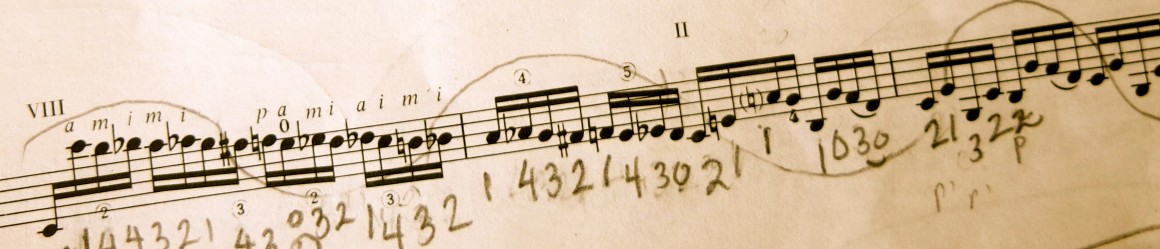
I was going to write about a warm up sequence that builds right hand endurance, speed, pulse, and legato. It was going to be a good one. But, I walked past my music stand and Heitor Villa-Lobos’s Etude Nº2 was taunting me.

FullSizeRender.jpg

So here are a few more thoughts and approaches I’ve found helpful while working on this over the last few weeks.

Right Hand Alone

We all know the value in practicing the right hand alone. It allows us to focus on what might be a potential lack of understanding as to where the trouble in a passage lies. Focusing on the right hand also allows us to feel the rhythm correctly without the hindrance of a faulty left hand or a left hand that cannot keep up. In this particular etude, there are two movements that recur often. Practice these movements or if necessary, build them up to comfortably play them at your target tempo (120+ bpm).                .

Sweeping with p:

villa lobos 2 open string 1b.jpgvilla lobos 2 open string 1a.jpg

Cross-string arpeggio with various fingerings:

villa lobos 2 open string 1c.jpg

Slow and progressive warm up on these two movements helps develop a more ‘in the pocket’ feel and if you can retain the feel when incorporating the left hand, forces the left hand to behave more reliably. Remind yourself that if you cannot play those movements well at your target tempo, you will simply not be able to play the piece at that speed. So, set that metronome and get to work.

Left Hand Without Shifts

Though shifting in this piece does not present too many challenges, there are a few. Practicing a passage without a shift allows us to deconstruct a movement with two potential problems: the change in hand position and the shift. Try playing the first measure with no shift and focus on how it feels. Then, once that feels fluid, incorporate the shift while retaining the fluidity.

Resting the Right Hand Thumb

Do you know when and on what strings your thumb rests when not using it? Instead of randomly placing it for stability, find spots to rest it that coincide with the next note it will play. Not always possible but it certainly helps when you can get away with it.

Hope that helps. Stay tuned for the super warm up exercise and another Artist Spotlight…


Conde Claros, Scales, and String-Crossing

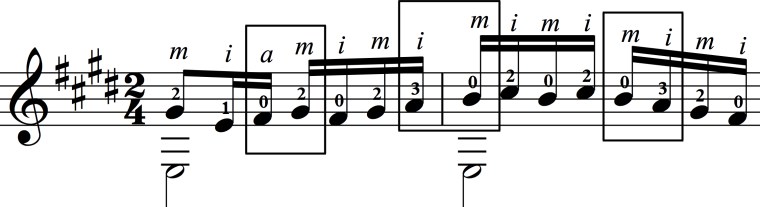
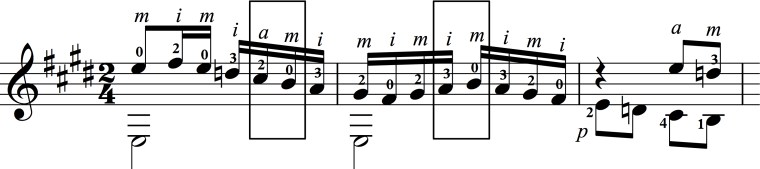
I’ve been reworking the music of the great Spanish composer Luys de Narváez. His Seis Libros del Delphín were published in the early 1500s in Granada. The six volumes contain music that is profoundly beautiful and exquisitely crafted while evoking a time that was ripe with wonder. After all, the music was published a few decades after Christopher Columbus’ great voyage to the New World. Narváez’s Diferencias are some of the earliest know sets of variations and his Canción del Emperador was possibly a favorite of King Charles V. Fortunately for guitarists, conjuring that time period is potentially within our grasp as the music translates well to the modern guitar. Because of the tuning of the vihuela, the slight adjustment of tuning the 3rd string to f-sharp makes the pieces more playable. I prefer placing a capo on the 2nd fret but placing it on the 3rd fret will transpose the piece to the original key.

This post is not a history lesson about the guitar, however. It’s another post about fingering for the right hand as this music is full of scale runs. So I thought I’d list a few rules every aspiring guitarist should use when working out right hand fingerings to perhaps help make conjuring your favorite time period easier. These rules assume you have a functioning technique. If that is not the case, they can still help, but you may want to spend extra hours in the tool shed working on developing a base for your technique (more on this coming!). This way you will get the most out of these rules when applying them.

Rule 1 

When crossing from a lower string to an adjacent higher string (i.e. string 3 to string 2):

  • im is preferable to mi
  • ia is likely preferable to ai
  • pi is preferable to ip
  • ma is preferable to am

conde claros ex. 2.jpgRule 2

When crossing from a lower string to a higher string with a string  or more between them (i.e. string 4 to string 2 or string 5 to string 1)

  • ia is preferable to ai and im
  • pm is likely preferable to pi
  • pa is likely preferable to pm

Rule 3

Try to maintain the rules 1 and 2 throughout scales and right hand cross-stringed fingerings. If you are unable to maintain efficient crossing you can use the following methods to insure rules 1 and 2 are maintained.

Method 1

When playing im scale runs, insert a (ring finger) to change the direction of the fingers. Notice the use of a in the first box to facilitate the string crossing in the next box/boxes.

conde claros ex. 1.jpg

conde claros ex. 3.jpg

Method 2

When playing im scale runs, insert a slur to change the direction of the fingers.

Rule 4

Do not use a slur if it is does not reflect your musical intent.