Right Hand Technical Workout Part 1

Just like in our Left Hand Technical Workout, I’m going to break this post into a few parts. This first part focuses on developing the macro movement of the hand as a unit.

Right Hand Movements

For all of the following movements, begin with the right hand positioned over strings 4, 3, 2, 1 with fingers p, i, m, a, respectively. Later, to expand into tremolo movements, p can remain on a different string and i, m, a can be used on the same string.

This part of the workout for the right hand involvies larger gross-motor skill requiring movements: chords and rasgueados.

Go through all fingerings for each movement.

Step 1

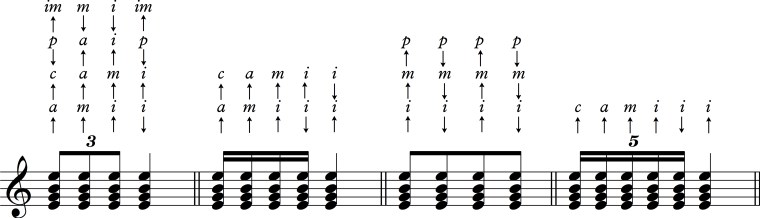
Chordal Movements – pima, pim a, pi ma, pma i, pm ia, pia m, pa im

Groups of fingers that are underlined move together and alternate with the next finger/fingers. Below is an example of pim a. I tend to use a simple scale of thirds or if you are craving dissonance, a diminished 7th chord (think Villa Lobos) as I ascend and descend the fretboard.

right hand chord 1.jpg

Focus on keeping the right hand relaxed but still. All movement must originate from the knuckles as if lightly closing your fist. I really have to get some short videos demos of this stuff…

Step 2

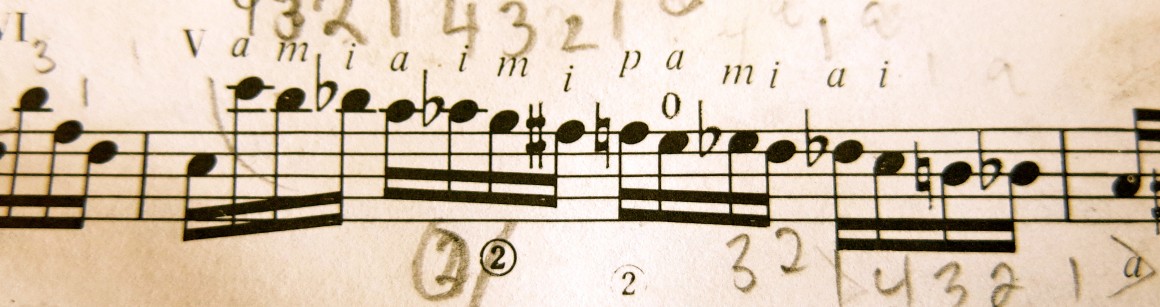
Rasgueado movements – cami, amii, pai, camii, im mi

For the movements below, rest the thumb (p) on string 5 when not using it in the pattern. Movement should originate from the knuckles outwards. Time to develop those flexors. Don’t overdo it though!

right hand rasgueado.jpg

Stay tuned for part 2!

Left Hand Technical Workout – Part 3

To conclude the left hand base building stage, we’ll expand our practice routine to include three finger movements and some four finger movements. While developing four finger movements is beneficial for overall functionality of the left hand fingers, three finger movements occur with a lot more prevalence in repertoire so I would suggest focusing on those first.

As in the previous base building workouts for the left hand, proceed through the steps sequentially.

Three Finger Movements – 124, 421, 134, 431, 123, 321, 234, 432

Four Finger Movements – 1234, 4321 (obviously, there are many more possibilities but I would argue that these two are the most important)

Step 1 – Start movements without slurs (example using 124)

slur124 no slur.jpg

For the right hand, using im either free stroke or light rest stroke is fine. Using thumb (p) throughout is fine as well. Keep in mind the focus should be on the deliberate and precise placement of the left hand fingers. Do not complicate things with nifty right hand fingerings. The right hand technical workouts are coming soon!

Step 2 – Incorporate slurs (examples using 124 and 1234)

slur124.jpgslur 1234.jpg

Step 3 – Build endurance

slur124 endurance.jpg

Explore these movements in several positions and you should be on your way to building a strong technical foundation to back your interpretations.

In the next installment, we’ll work on methods to build on this foundation to develop speed, flexibility, and finger independence. Stay tuned!

Left Hand Technical Workout – Part 2

Assuming the previous workout has had positive effect on your control, accuracy, and finger strength, it’s time to go a bit further. Now we’re going to work on the following two-pair and compound finger movements following the same steps we took in Part 1.

Two Pair – 12 34, 43 21, 13 24, 42 31, 14 23, 32 41

Compound – 121, 212, 232, 323, 343, 434, 131, 313, 242, 424, 141, 414

Step 1 – Start all movements without slurs (example using 12 34 and 121)

slur1234 no slur.jpg

slur121 no slur.jpg

Step 2 – Incorporate slurs

slur1234.jpgslur121.jpg

Step 3 – Build endurance

slur 2121.jpg

Stay tuned for Part 3.

Left Hand Technical Workout – Part 1


I am currently working on a comprehensive technique manual ranging from base building to many advanced practice techniques. The theme for the next few posts will center around developing a strong technique base through a daily routine. We’ll start with some basic movements most students could stand to refine.

Complete steps 1-3 with all of the following left hand finger combinations. It is crucial during base building to focus on clarity, efficiency, and accuracy of both sound and movement.

Single Finger Movements: 01, 10, 02, 20, 03, 30, 04, 40

Single Pair Finger Movements: 12, 21, 23, 32, 34, 43, 13, 31, 24, 42, 14, 41

Step 1 – Perform all movements without slurs (example below using 01 and 10)

slur 10 a no slur.jpg

Step 2 – Perform all movements with slurs (example below using 01 and 10)

slur 10.jpg

Step 3 – Build endurance by extending the time on each string (example below using 12 and 21)

slur 12 p3.jpg

Go very slowly. Listen very carefully. Do several repetitions. Explore various positions.

Try going through this every day for 2-3 weeks. Part 2 coming soon.

Sloppy Left Hand Fingers

Hopefully, as an aspiring guitarist, the principle of precisely pinching frets with your fingertips has been engrained and you now know that it is very difficult to play well without putting this principle into practice. From slurs to counterpoint, training left hand fingers to place carefully insures the likelihood that our notes will emerge clearly from the guitar. But, as any investigative and intellectually-oriented student will discover, there are many cases where sloppy, finger pad pinching would prove the exception to the rule.

One such case would be when reaching for a bass note while playing or holding voices on the higher strings. If there are a few strings between the bass note and the voices being held, flattening the finger slightly while reaching will relax the hand more so than struggling to arch the fingertip into place.

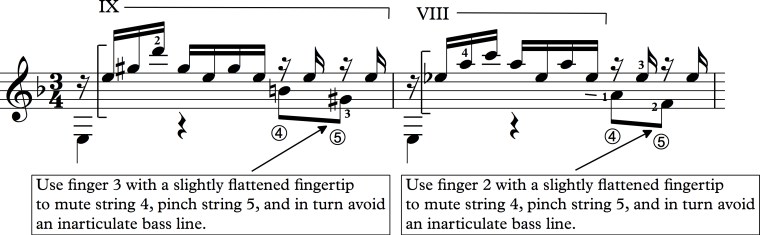
Another case builds on this idea, what if you could use the flattened finger to silence a note on a neighboring string while simultaneously playing a note to achieve the correct musical intent of the composer or to maintain the integrity of a bass line? I’ve mentioned Bach’s Prelude in D Minor BWV999 before as a great piece to study many aspects of left hand technique so I will use a two measures from it as an example.

BWV999 Sloppy Left Hand.jpg

I’m hoping to post my edition of BWV999 soon with more pointers but for now, try to find places in your repertoire where it would be advantageous to not pinch so perfectly!

Left Hand Choreography

Developing a well-crafted, clear, and effortless left hand choreography requires a high level of experience, attention to extreme detail, and a deep understanding of your own hands. Over the years, cultivating these components through the learning process of new repertoire helps us assimilate more music in a more meaningful way and, importantly, retain it when there are limitations to our practice time.

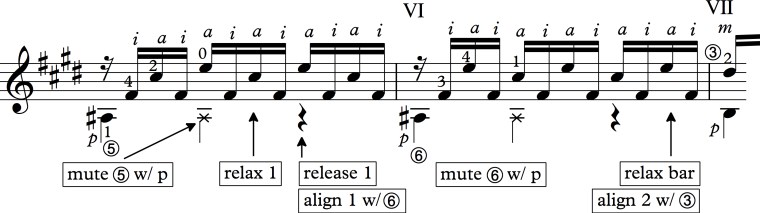
I wrote about attention to detail in an earlier post but thought I would elaborate on one point in particular that many students overlook: when to lift a finger that has been holding down an important voice or serving as an anchor to prepare it for the next activity. I’d venture to say that most students would not know how to answer and those who did would answer, “When you need it.” I’d argue that it would be better to plan it out and take it a step further:  plan it out to align the movement with your inner pulse or at the very least, to align it with a specific beat in the music. Awareness of every detail, after all, is what we are after.

Here is a another passage from Bach’s Prelude in E Major. Notice that at beat 2, thumb silences the 5th string at which point finger 1 can relax. At anytime after that moment, we would want to lift 1 to prepare for the shift. Too early would conflict with the act of silencing the bass note, too late would cause a panic preceding the shift. So, in order to make it feel like the movement is weaved into the choreography, lift at the third beat. Now we have a specific moment that also happens to be in line with a pulse that our bodies should be naturally feeling. This translates into a movement that feels more like a natural occurrence than a movement that augments the challenge of the moment.

Bach Left Hand choreography.jpg

Though this Prelude provides countless moments to exercise this awareness, a more concise piece that I think is great for students in which to practice this concept is Bach’s Prelude BWV999. There are moments in every single measure where timing the left hand finger releases would aid the right hand in maintaining a rhythmic continuity versus introducing some of the manifestations of an erratic left hand choreography: unwanted accents, slightly uneven rhythm, etc…I’m hoping to have an edition of this to post in a few days. Stay tuned and in the meantime, start incorporating the concept of timed left hand finger releases into your repertoire.

Conde Claros, Scales, and String-Crossing

I’ve been reworking the music of the great Spanish composer Luys de Narváez. His Seis Libros del Delphín were published in the early 1500s in Granada. The six volumes contain music that is profoundly beautiful and exquisitely crafted while evoking a time that was ripe with wonder. After all, the music was published a few decades after Christopher Columbus’ great voyage to the New World. Narváez’s Diferencias are some of the earliest know sets of variations and his Canción del Emperador was possibly a favorite of King Charles V. Fortunately for guitarists, conjuring that time period is potentially within our grasp as the music translates well to the modern guitar. Because of the tuning of the vihuela, the slight adjustment of tuning the 3rd string to f-sharp makes the pieces more playable. I prefer placing a capo on the 2nd fret but placing it on the 3rd fret will transpose the piece to the original key.

This post is not a history lesson about the guitar, however. It’s another post about fingering for the right hand as this music is full of scale runs. So I thought I’d list a few rules every aspiring guitarist should use when working out right hand fingerings to perhaps help make conjuring your favorite time period easier. These rules assume you have a functioning technique. If that is not the case, they can still help, but you may want to spend extra hours in the tool shed working on developing a base for your technique (more on this coming!). This way you will get the most out of these rules when applying them.

Rule 1 

When crossing from a lower string to an adjacent higher string (i.e. string 3 to string 2):

  • im is preferable to mi
  • ia is likely preferable to ai
  • pi is preferable to ip
  • ma is preferable to am

conde claros ex. 2.jpgRule 2

When crossing from a lower string to a higher string with a string  or more between them (i.e. string 4 to string 2 or string 5 to string 1)

  • ia is preferable to ai and im
  • pm is likely preferable to pi
  • pa is likely preferable to pm

Rule 3

Try to maintain the rules 1 and 2 throughout scales and right hand cross-stringed fingerings. If you are unable to maintain efficient crossing you can use the following methods to insure rules 1 and 2 are maintained.

Method 1

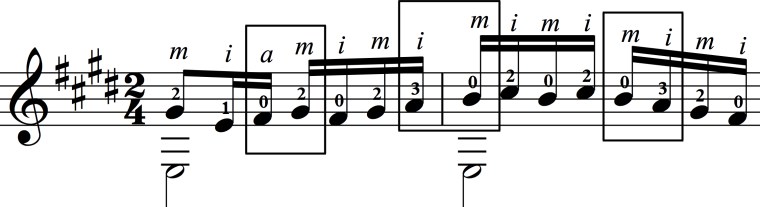
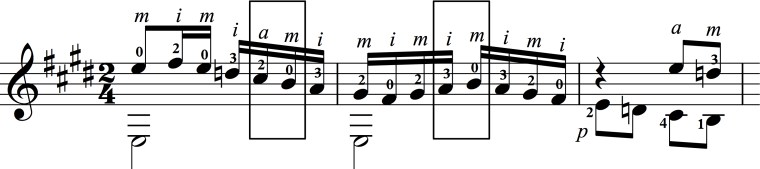
When playing im scale runs, insert a (ring finger) to change the direction of the fingers. Notice the use of a in the first box to facilitate the string crossing in the next box/boxes.

conde claros ex. 1.jpg

conde claros ex. 3.jpg

Method 2

When playing im scale runs, insert a slur to change the direction of the fingers.

Rule 4

Do not use a slur if it is does not reflect your musical intent.

Preludio Criollo

If you have not heard Venezuelan composer Rodrigo Riera’s Preludio Criollo, you have missed out on one of the most beautiful pieces written for the guitar. The play between 6/8 and 3/4, the subtle baroque-like harmonic movement, the clever way in which the tune makes its appearance, all while evoking the spirit of Venezuela, create magic as they come together.

This said, it can be a tricky piece for students because many times, students approach it as a series of chord changes, i.e. preparing the entire harmony or chord before playing. This approach makes it infinitely more difficult to play in time and to maintain the rhythmic integrity of the piece. Further, it creates a sense of panic to quickly place fingers and as a result the right hand inevitably grabs the beginning of each chord change creating unintentional accents throughout the piece.

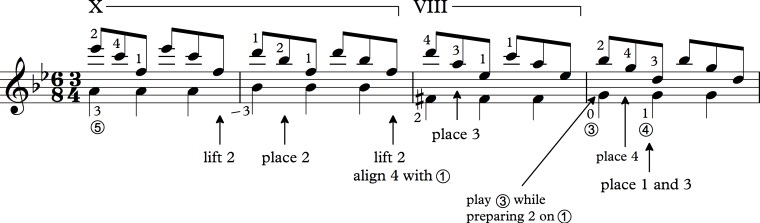
In studying this piece, as well as other pieces with perpetual movement and arpeggios like Heitor Villa-Lobos’ Etude Nº1 or Agustin Barrios’ Estudio de concierto, the main point to get across to students is that they have to prioritize what left hand fingers need to place first in a harmonic change in order to maintain rhythmic continuity as they play. It is important to realize that all fingers of the new harmony do not  need to place before the right hand starts playing the arpeggio. Instead, prepare only what is necessary and then sequentially place the rest of the fingers as the notes are needed. It also works to understand this before arriving to a chord: certain fingers can begin to relax before the change in order to make a relaxed transition. Here are some examples from Preludio Criollo to explore these ideas.

Preludio Criollo Example 1.jpg

When making harmonic changes try the following solutions to help make the transitions musical and smooth.

  1. Practice the transition without the shift first. This gives us a clear feeling of what is required if the shift component is removed from the equation. Most harmonic changes that involve shifts are actually two technical problems lumped into one moment. It helps to know which of the technical problems is creating the challenge. It may be only the shift or it may be the left hand finger placement. It is rarely both.
  2. A slight rallentando before the shift could provide just enough time to make the shift work. This also helps relax the hands so that the placement in the new position is calm.
  3. If there is a bass note to play along with a melodic note, roll them slightly by playing the bass note first. This creates the sense that you are in time even though the rest of the beat has not yet been heard. Don’t overdo this as it can start diffusing the rhythmic momentum of the piece.
  4. Practice the transition in the air above the frets. Sometimes this helps to soften the movement and to bring awareness as to how little is happening physically in the left hand and that the relative distance between the positions is smaller than we perceive.
  5. Beware of accenting the first notes after a shift that is too hasty. Accent ONLY if the music warrants it.

Hope this helps!


Left Hand Contrapuntal Exercise 2

Here is another one of my favorite left hand exercises. Practice it to develop more finger independence and to help stabilize your fixed fingers. The destabilizing element of the slur adds a challenge. Like in the first contrapuntal exercise, go slowly to insure the voices are being held their full duration. You can easily (or maybe with a lot of struggle) create a more challenging exercise by increasing the distance between the strings in use and by maintaining good form. Focus on the vertical movement of the fingers while the left hand remains stable. Use less hand tilting to get to the lower (or higher) strings.

contrapuntal 2

Mini Masterclass – Natalia

Brought to public light by the great maestro Alirio Diaz decades ago, Venezuelan composer Antonio Lauro’s beloved Natalia (aka Valse Criollo and Valse Venezolano Nº3) has become one of the most widely played pieces on our instrument.

There are so many thoughts to share on this piece with students that I thought I’d do a short (which is now looking long) post about a passage in the first part of the piece that most students wrestle with as they begin to enjoy their discovery of Venezuelan guitar music.

To begin, the initial published edition by Broekmans & Van Poppel B.V. and the more recent edition published by Ediciones Caroní differ in several ways. It is important to note that both were revised by Alirio Diaz who over the decades has probably played this piece thousands of times. And, over the course of Alirio’s history with the piece, he has undoubtably made changes simply to keep the piece evolving in a creative way. Is the latest version better? Not necessarily. However, students should become intimately familiar with both and with alternate fingerings that may help them achieve their own musical goals.

It is important to mention that scores are often a very close approximation of the intent of the composer. In guitar scores, because of the fact that composers are cramming everything onto one staff, short hand helps musicians see through the clutter of notating all voices accurately. So with that caveat…

Here is the passage we’re studying from the first two editions for comparison:

Broekmans & Van Poppel B.V.

Natalia 1.jpg

Ediciones Caroní

Natalia 2.jpg

The differences are interesting to say the least. The fingering has evolved which, of course, is a natural thing to occur after years of playing the same piece. But, of note, notice the rhythmic changes with the beaming. Antonio Lauro’s music is always full of the dueling time signatures 3/4 and 6/8 which makes his and other Venezuelan music so alluring on a rhythmic front. There is a very different feel when playing the first measure of this passage.

When I initially learned Natalia decades ago, like most students, I used what was available. For the most part, I followed Alirio’s fingerings closely. However, as my hands have come into their own over the years, my version has evolved quite a bit to suit my strengths, technique, fingers, and musical ideas. Here are two ways I tend to play it these days:

Natalia 2 (Leo).jpg

Natalia 2a (Leo).jpg

The differences have evolved to help me feel more secure as I play the piece. Notice the guide fingers throughout.

As students uncover their own interpretations, I often make sure that they are aurally aware of as much as possible so that if they wanted to draw attention to a particular voice for any reason, they could do so. As much as I like the groovy and energetic way Alirio plays the piece, I often like hearing a more legato version so I try to keep my ear on the following voice:

Natalia 2a (Leo) melody.jpg

Despite the fact that they are written as eighth notes, I often try to connect the line. Did Lauro intend to break the line? Not sure. Can I play it both ways? Yes. Which do I like best? Depends on how I feel.

Another voice I like to draw attention to is this one:

Natalia 2a (Leo) inner voice.jpg

This was intended to be a MINI masterclass so I’m going to wrap this up. The bottom line is that pieces evolve in the musician’s hand. Spend time exploring the history of the pieces you are playing, and specifically with Natalia, the possibilities, fingerings, and seeing which rhythmic version feels right, and you will be on your way to crafting a meaningful interpretation that you can stand behind when sharing it with others.