My Glenn Canin Guitars for Sale

Hello Six String Journal Readers,

I’m in the cue to receive some new guitars soon. And my favored builder, Glenn Canin, is making me a guitar with a slightly smaller neck. So I’m offering these guitars for any of you who are interested. Please contact me directly via email if you are interested in details, more pics, and pricing. leo (at) leonardogarcia (dot) org.


Glenn Canin 2018 (#131)
 – Beautiful cedar/cedar balsa doubletop with elevated fingerboard, custom Rodgers Tuners, and a soundport. All that you would expect from a guitar built by Glenn – powerful concert guitar, wonderful volume, beautiful rich chocolatey sound, well-balanced, strong and resonant trebles, lush basses, super high E string, every note sounds full, quick to react, and fun to play. The woods are absolutely top notch. If I recall, this top was one he acquired from Robert Ruck and the backs and sides are the best Indian rosewood. He built it for me in 2018. 

650mm scale and 52mm nut

Excellent condition. It has a few small marks that are barely noticeable from usual play. Here is a video of it:

Glenn Canin 2011 (#55) – spruce/spruce nomex doubletop with elevated fingerboard, Sloane tuners, soundport. This is the first doubletop Glenn ever built and set him in motion to become one of the sought after doubletop builders in the US. Thick notes, sweet and warm sound but with excellent voice clarity like you would expect from a great spruce guitar, excellent penetrating volume, super easy to play (the back of the neck was oiled instead of polished), and great projection. The top has wonderful bearclaw from the collective where Stadivarius would get his spruce (the video lighting does not show this but I have pics).

650mm scale and 52mm nut

Good condition. Some playing wear on the top with a few small dings, faded polish on the top side and upper back. Here is a video.

Twelve Tips on Rolling, Shifting, and More

by Leonardo Garcia

I originally thought I would do videos to show some of the concepts below in practice but in anticipation of that I thought this might help some of my students so I’ll post it now. These are some recurring themes that I encounter in lessons that have solved a lot of little musical hiccups. Hope they help.

Chord Rolling

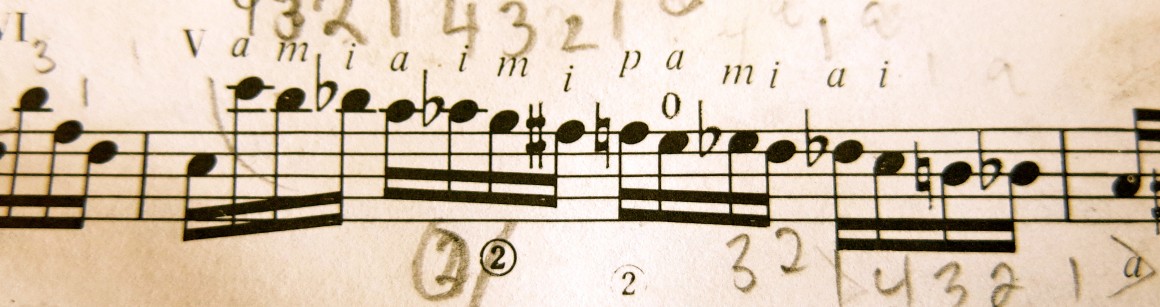
  1. When rolling chords where should the weight of the right hand fingers be distributed? I find that even though we tend to roll towards the a finger in a musical context that not ‘feeling’ the weight behind the i finger leads to a less rhythmic roll.
  2. Accompanying chords can sound really nice when subtly rolled. I recently listened to John Williams’s old Barrios recording and loved his playing of Choro de Saudade. He is very free with the harmonic background even when grooving.
  3. When playing an ornament with a bass note (like all over Capricho Árabe), I find that rolling the bass and first note of the ornament diffuses the rhythm a bit too much unless (maybe) it is a cadential ornament. Maybe not the best place to roll.
  4. Rolling p – Practice this to make it sound less like a guitar affectation and more like an organic roll. Or in the case of playing thirds in a piece like the Gran Solo (Sor), roll with the intention of it sounding like one note. Imagine both strings as one large string the thumb has to traverse in its stroke.

Shifting

  1. Shifting with a relaxed (or less rigid) left hand wrist always feel better and leads to less unintentional accenting when landing in the new position.
  2. Sometimes it helps to keep left hand finger pressure down before glissandos to minimize string squeaks.
  3. Always shift using a guide finger and always relax the left hand thumb away from the back of the neck prior to a shift.

Listening and Accountability

  1. As I play through repertoire, I find that shifting my aural focus to a particular voice can be disorienting sometimes because of the tendency to grow accustomed to ‘hearing’ the music unfold in relation to the melodic content most of the time. So I like to change it up by listening for the bass lines or by shifting my attention to the supporting voices or even to exaggerate (or exaggerate another voice) the melodic content to keep listening in new ways.
  2. Stop whenever something does not sound optimal and study that moment. Then place it back into context by a few notes or measures. Keep asking why and what. Why does it not feel comfortable? What do I want the phrase/pair of notes/background/melody, etc., to sound like? Can I make one note sound the way I want? Two? Why did it work? Can I replicate what is not working so I know how NOT to do that? If you keep playing something that you know doesn’t sound quite right, it is basically how you will play the piece. Don’t rely on luck, if you only nail it 1 out of 4 or 5 tries. Hold yourself accountable.

Speed

  1. Think of gestures especially during faster passages. Find groups of notes and tie them into one physical gesture that feels comfortable to do. Consolidate movements and placements to make many notes fall into one activity for the hands. This is why it is good to practice arpeggio formulas and scales in abstract.

Meter

  1. During scale runs, focus on hearing the main beat subdivisions. If you have 4 quarter notes worth of sixteenths, after working out the correct fingerings in both hands, spend some time listening and then aiming for the quarter beat or the half beat regardless of where the high point of the run is.
  2. Clarity in your playing is enhanced if you know where all the downbeats are in relation to your left hand (and right!). It sounds obvious but play though a piece and just think of downbeats and left hand. Try the same for downbeats and right hand.

Thanks for reading.

One-Time
Monthly
Yearly

Make a one-time donation

Make a monthly donation

Make a yearly donation

Choose an amount

¤5.00
¤15.00
¤100.00
¤5.00
¤15.00
¤100.00
¤5.00
¤15.00
¤100.00

Or enter a custom amount

¤

Your contribution is appreciated.

Your contribution is appreciated.

Your contribution is appreciated.

DonateDonate monthlyDonate yearly