Manuel Barrueco on Slow Practice

While listening to Manuel Barrueco’s podcast, he was asked about whether slow practice was a good method. Here was his response:

“[Slow practice] is a very good method, perhaps it’s the best, I’m not sure if it’s the best, but it’s one of. I think slow practice is extremely helpful in a lot of ways. It helps with memory because it breaks down muscle memory. It also allows one to look at the technique very closely. And look at any excess motion, bad movements, and tension in the technique. Also, it gives the hand and the fingers time to learn how to do their job. Also, their is another aspect that is often underrated which is that it is good musically. By practicing slowly, it allows you to slowly hear the harmonies and the lines and everything that is going on in a piece of music. So I wouldn’t be surprised if it is the best technique to practice in.”

With that in mind, try practicing a piece like the Allegro from Agustín Barrios’ La catedral at 60bpm per sixteenth note.

Villa Lobos Etude Nº2, Part 2

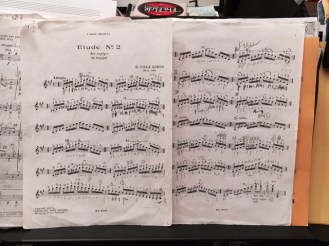
I was going to write about a warm up sequence that builds right hand endurance, speed, pulse, and legato. It was going to be a good one. But, I walked past my music stand and Heitor Villa-Lobos’s Etude Nº2 was taunting me.

FullSizeRender.jpg

So here are a few more thoughts and approaches I’ve found helpful while working on this over the last few weeks.

Right Hand Alone

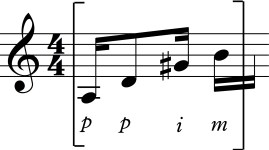
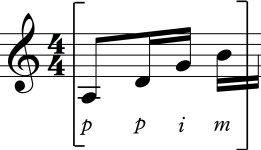
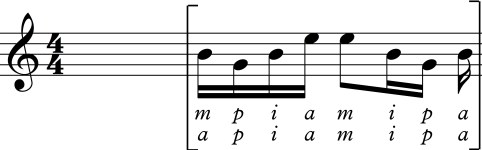
We all know the value in practicing the right hand alone. It allows us to focus on what might be a potential lack of understanding as to where the trouble in a passage lies. Focusing on the right hand also allows us to feel the rhythm correctly without the hindrance of a faulty left hand or a left hand that cannot keep up. In this particular etude, there are two movements that recur often. Practice these movements or if necessary, build them up to comfortably play them at your target tempo (120+ bpm).                .

Sweeping with p:

villa lobos 2 open string 1b.jpgvilla lobos 2 open string 1a.jpg

Cross-string arpeggio with various fingerings:

villa lobos 2 open string 1c.jpg

Slow and progressive warm up on these two movements helps develop a more ‘in the pocket’ feel and if you can retain the feel when incorporating the left hand, forces the left hand to behave more reliably. Remind yourself that if you cannot play those movements well at your target tempo, you will simply not be able to play the piece at that speed. So, set that metronome and get to work.

Left Hand Without Shifts

Though shifting in this piece does not present too many challenges, there are a few. Practicing a passage without a shift allows us to deconstruct a movement with two potential problems: the change in hand position and the shift. Try playing the first measure with no shift and focus on how it feels. Then, once that feels fluid, incorporate the shift while retaining the fluidity.

Resting the Right Hand Thumb

Do you know when and on what strings your thumb rests when not using it? Instead of randomly placing it for stability, find spots to rest it that coincide with the next note it will play. Not always possible but it certainly helps when you can get away with it.

Hope that helps. Stay tuned for the super warm up exercise and another Artist Spotlight…


Leo Brouwer’s Axioms

Years ago, I came across an article on a Spanish site guitarra.artepulsado.com posted by Oscar López who had taken notes during a summer course with the great Cuban composer and guitarist, Leo Brouwer. The title of the post was Axiomas básicos de Leo Brouwer. I found the word file and thought I’d translate it for all non-Spanish speakers. It provides a wealth of advice. I’ve added a few commentaries below to expand the ideas a bit. Hope they are helpful.

Warm Up

Use chromatic octaves for the left hand and arpeggios and rasgueados for the right hand. Play close to the body in higher resonant positions upon starting your practice.

*I think this may mean to start your practice without having the left hand in an extended position. Starting in higher positions is less stressful for the left hand.

Speed and Scales

Use fixed, non-shifting positions in the left hand that are close to the body (i.e. higher positions) to play short bursts of notes. Play bursts in short crescendos (soft to loud or light to intense). Start on one string, then expand to two strings. Add one note at a time and pause between each mini-scale.

Add color and articulations to scales.

Left Hand Shifting

Left-hand notes should be played staccato (*perhaps he means before a shift). Focus on the arrival (not the departure) as you shift from 1st to 2nd, 1st to 3rd, 1st to 4th, etc., position.

Left Hand Independence

With a fixed first finger bar, play slurs and scales across all the strings with the rest of the fingers. Try all combinations possible.

Memory

To avoid embedding errors, do not start memorizing at the very beginning of learning a piece.

Fingerings

There are never definitive fingerings.

*What Brouwer most likely means to covey here is that fingerings evolve throughout the lifetime of learning a piece. Inevitably, we discover better, more efficient, more musical, more interesting ways to play passages and discard or change older fingerings as our familiarity with the piece increases.

Color

Exploit the three primary sonorous zones of the guitar: over the sound hole (resonant zone), over right part of the rosette (resonant and clarity zone), and near the bridge (clarity zone).

Harmonics

Do not pluck harmonics diagonally.

More Advice

  • The position of the guitar to your body should remain consistent.
  • Remember that the 2nd and 3rd strings tend to be the weakest so we must compensate when necessary.
  • Pluck consonant chords with no arpeggiation. Pluck rare (dissonant) chords with arpeggiation for clarity.
  • Velocity contains impulse and direction.
  • Cadential ornaments should be in time.
  • Resonance is at the heart of the guitar.
  • Vibrato is used for intensity not rest.
  • The thumb (left-hand) acts as a pivot during slurs.
  • Forte is found at the limit of a beautiful sound.
  • Breathe between phrases and project energy towards the end.
  • During rasgueados the energy is channeled towards the 1st string.
  • Anything that is repeated should be varied. Change either the color or the volume or the timbre.