This workbook is designed to help late beginners and intermediate guitarists develop a daily routine of movements to strengthen their technical base so that fingers can do their job properly when assimilating new repertoire. Always go slowly with the most control possible. Think of it as writing a program for your brain with no bugs.
This workbook is designed to help late beginners and intermediate guitarists develop a daily routine of movements to strengthen their technical base so that fingers can do their job properly when assimilating new repertoire (that was wordy!). Always go slowly with the most control possible. Think of it as writing a program for your brain with no bugs.
From practice and listening advice to pre-concert rituals, competition-winning guitar powerhouse Piotr Pakhomkin provides a wealth of valuable insight to both beginning and advanced guitarists. Hope you enjoy reading this one!
Hailed by Classical Guitar Magazine as “one of the bright lights of the younger generation of classical musicians, a player of tremendous skill and sensitivity,” Russian-American guitarist, Piotr Pakhomkin has extensively performed and given masterclasses in Europe, Central America, and the U.S. Based in Washington, D.C., he was the only guitarist to be featured at Strathmore, Kennedy Center, and PhillipsCollection series in the span of a single concert season in 2014.
After finishing his studies with Manuel Barrueco at Peabody, Piotr became the First Prize winner of the 2012 Mexican International Guitar Competition in Culiacan and has taken top prizes at the 2012 Boston GuitarFest International Guitar Competition, Great Lakes Guitar Competition, Montreal International Guitar Competition, and the European International Guitar Competition, “Enrico Mercatali,” in Italy. After finishing the prestigious Strathmore Artist-in-Residence program in 2014, he returned to serve as a faculty member and mentor in their Institute for Artistic Development.
As the winner of the 2016 Respighi International Soloist Competition, he will make his concerto and solo debut at Carnegie Hall in the Chamber Orchestra of New York’s “Masterwork Series” in June 2018. Piotr plays exclusively on a 2010 Ross Gutmeier Guitar using Oasis GPX strings.
Here are three links to Piotr’s website (lots of great videos, his recording, and an insightful left-hand workout routine).
When did you start playing and why? Or, what drew you to the guitar initially?
My high school music teacher, Matt Hartman played Bach’s Sleeper’s Awake (performed by Christopher Parkening) in a music appreciation class. The ability to play multiple voices on the guitar had me floored – a full ensemble was hiding inside this little instrument. I was about 16 at the time and I knew I had a ton of work ahead of me. My enjoyment of the challenge and the process was a deciding factor in pursuing the guitar full-time.
What repertoire do you enjoy playing the most?
I have the most fun venturing into new territory with arranging. After hearing Jordi Savall’s playing in the French movie, “All the Mornings of the World”, I fell in love with viola da gamba repertoire. I started with Marin Marais and then graduated to Carl Friedrich Abel. When working with single-line string music, I love the creative freedom involved in filling out the implied counterpoint.
What guitar or guitars do you perform on? Strings?
Which guitarists/musicians have had the most influence on you?
Teachers have had more influence on me than any single recording. I wouldn’t be a guitarist if it wasn’t for my first teacher, Paul Moeller. My current students will find it hard to believe but my first few lessons as a teenage novice were very difficult. Everything was a struggle– sight-reading, right hand patterns, accuracy, memory and rhythm. Despite my lack of training, Moeller was so encouraging. He built up my confidence in my own ability, and taught me the techniques for performing consistently under pressure (slow practice, visualization, left and right-hand separation training). His coaching brought me to a professional technical level in less than two years.
When I started studying with Manuel Barrueco, his ear and meticulous labor over the meaning of every note was a huge source inspiration for me. I was so focused on playing with my hands but he was always teaching us to play with our ears.
Are there any recordings that you consider have the finest recorded sound for guitar?
Manuel Barrueco’s 300 Years of Guitar Masterpieces for the Vox Label. I have those recordings in every format: CD, MP3 and vinyl. The warm sound, attention to detail in voice separation, and precision on those recordings shaped all of my values for learning, recording, and performing music.
What are some up and coming projects you are excited about?
In March 2018 I’ll perform with the New York Chamber Orchestra in Carnegie Hall. Playing in that venue is one of those goals that I set when I began, so it’s an honor to finally see it happen.
Technique and Performance
How much do you practice? And, do you structure your practice in any particular way?
I try to put in 5 hours on average. The quantity really depends on my workload and what stages my pieces are in.
Slow practice takes longer and the hands can withstand more of it. On the other hand, playing at faster tempos is more strenuous and too much repetition without pause can cause injury.
My focus is higher earlier in the day so the earlier portion of the practice session revolves around isolated passages, very slow tempos (roughly one quarter of the concert tempo) and exercises derived from the most difficult aspects of the pieces. I’ll go through the music phrase-by-phrase between 1 and 3 times without errors. I never repeat anything more than that in a single sitting. I think that it’s potentially harmful because it leads to indefinitely long practice sessions, fatigue, more errors, and it wastes time.
Later in the day, I’m working more on the entire performance of each piece at concert tempo. In other words, “work” in the morning and “play” at night. If the pieces aren’t ready to be played at tempo, I’ll spend more time working slowly.
In terms of structure, I keep a list of the goals I have for the practice session with each piece. To maintain interest, I’ll change the order of the passages I’m practicing. If I went through it more chronologically one day, then the next time I’ll start at the end. Without some routine, we can get disorganized but too much routine can numb our focus.
Are there aspects of the guitar that you struggle with or that you find you are still working on?
One challenge is to consolidate your practice regimen to fit the needs of traveling, where you have so much less time. It’s a luxury to practice a lot so when that time isn’t available to you it’s a real test of efficiency, careful planning and time management. I usually plan my daily practice sessions on the airplane, preparing for a worse-case scenario.
Another obstacle for many guitarists is breaking away from the bubble of your own instrument and exploring the much larger world of classical music. Intense focus is a wonderful thing but in this case it can harm you if it keeps you from being well-rounded. It’s important to attend symphonic and choral concerts, for instance. At the very least, you can hear new pieces of music and get new programming ideas from these experiences. I also get a lot of benefit from hearing young players in the Chopin or Van Cliburn competitions instead of just following guitar contests. Hearing an instrument different from the one you play at home with different repertoire allows you to be less judgmental and gives you more freedom in your listening experience.
Do you deliberately memorize music or have a technique that helps assimilate music into memory?
Visualizing every single note of a concert program is essential for a performance free of memory slips. To maintain focus under pressure I sometimes play through my program with loud music playing in the background. If I can push through, even when I can’t hear myself, I know that my focus is strong.
Have you published any editions or do you plan to publish your own editions in the future?
Admittedly, I haven’t had much time to do work in this direction. I’d like to expand our romantic repertoire to include transcriptions of works by Scriabin, Rubinstein, Glinka and Mussorgsky. I hope to publish these in the near future.
Do you have a favorite drill you use to warm up?
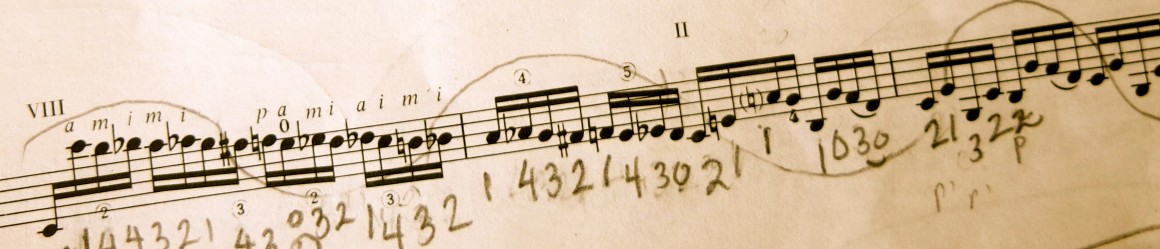
I swap out my exercises on a weekly basis as they get easier. I like this linear chromatic scale exercise because it helps with precise shifting, which is needed in just about every piece. The aim is to make every fingering variation have the same legato quality, rather than broken groupings of four, three, two, and one. [Check out Piotr’s Guitar Gymnastics Publication for more like this. -L]
Left hand fingerings to use:
0 1 2 3 4 1 2 3 4 etc.
0 1 2 3 1 2 3 1 2 etc.
0 2 3 4 2 3 4 2 3 etc.
0 1 2 1 2 etc.
0 2 3 2 3 etc.
0 3 4 3 4 etc.
0 1 1 1 1 etc.
0 2 2 2 2 etc.
0 3 3 3 3 etc.
0 4 4 4 4 etc.
Record them and work on making them all sound like the same fingering, ridding yourself of accents after every shift. This is a great time to work on getting rid of fret noise as well.
Do you have any pre-concert rituals?
Before the concert, I try to meditate for at least 5 minutes to clear my head. I notice a big difference when I don’t get to do this so this is a priority. I use the Neurolinguistic Programming techniques for meditation.
Advice to Younger Players
What single most important piece of advice about practicing would you offer to younger players?
This is a simple piece of advice but it’s easier said than done. I would encourage young players to spend the most time working on their weakest qualities in the early stages of development. With a good teacher’s supervision, get out of your comfort zone and make a game out of the struggle. This is the only way to grow.
What repertoire do you consider essential for young/conservatory students to assimilate? Why?
I think Bach’s Lute Suites (Frank Koonce edition) are a priority. Developing a singing quality with Bach’s long phrases is extremely demanding. Achieving clarity and balance in the counterpoint is an enormous technical feat. Another reason for working through this repertoire is that you can use a wide variety of non-guitar recordings to aid your interpretation. You can learn the the BWV 998 (Prelude, Fugue, and Allegro) along with Sviatoslav Richter or Gustav Leonhardt. You can approach it from opposing standpoints–the romantics as well as the period instrumentalists.
For general technique, it’s important to go through the Villa-Lobos Etudes. They instantly reveal weaknesses and give you a concrete goal to master them when you finally perform each Etude in concert. Etude no. 1 is impossible to play smoothly with a weak m-a-m arpeggio combination. Etude no. 2 will fall apart with excessive left hand tension.
Recordings that every young guitarist should be familiar with and why?
–Vivaldi Four Seasons (Venice Baroque Orchestra) for the energy and new life they pump into this very famous music. Some of the themes have been relegated to the “wedding-music” genre but with this recording, you completely forget that.
Do you try to stay healthy? Exercise? Follow a particular diet? Have a favorite pre-concert food?
Absolutely. I think that performing music is so physical that you have to care for your body like an athlete. I get my protein from fish, vegetables and legumes. I stay away from starches and refined sugars. Healthy fats like avocados and coconut oil are fantastic for fingernail health – both topically and as part of your diet.
Before a concert, I always eat a few bananas. They’re always safe to eat when you’re traveling because of the protective peel. Also bananas are calorie dense and rich in potassium, which I’ve always read is a natural beta-blocker.
Musicians generally fear weigh-training but there are safe ways to approach it. I do do the eccentric portion of every lift very slowly, allowing lighter weights to feel much heavier. This puts less stress on my hands. I also jump rope to keep my heart healthy. With the jump-rope the exercise session will be much shorter and more intense than distance running. This is perfect for a musician’s busy schedule.
What is your favorite way to spend time when not practicing?
I love hiking and the outdoors. In the cold months, you’ll find me catching up on new independent films and documentaries.
Here is a warm up sequence that I used to do every morning. It is useful for building right hand endurance, finger alternation, speed, pulse, rhythm, and legato. The idea behind it is simple. Set the metronome to a very slow beat, somewhere (50-70). Throughout the whole sequence, the beat remains constant but with very slight and precise increments we increase the number of notes between the beats.
I would go through all 13 steps (using free stroke) and then go through the whole thing two more times using different right hand fingerings am and ai . . .
Studio Content This content is restricted to Six String Journal Studio Members only. Join for access.
I’m working on A Technical Workout for Classical Guitar, Speed and Flexibility, and I thought I would share a portion relating to extensor development in the left hand. I will try to post a video to support this but here is something to keep everyone busy.
Excerpt from up and coming book:
Speed in the left hand is determined by several factors but two of the most important ones are the time it takes the finger to achieve precise placement on the fret and the time it takes the finger to release and reload for the next placement. The former movement depends on the flexor muscles of the fingers which are constantly worked in an active fashion (we typically focus our attention on placement) and the latter movement depends on the extensor muscles of the finger (we typically do not focus on this aspect of the movement). In a way, descending slurs work the extensors but we can be a bit more specific and pro-active about developing extensors in our left hand.
In order to develop the extensor muscles, simply place the finger and then actively release the finger back as quickly as possible achieving a slightly sloppy staccato effect with the left hand. This work does not involve the right hand at all. This movement is more strenuous than it sounds. When done correctly it almost sounds like light slurring. Keep the left hand finger placement accurate and keep the left hand contained so that it’s not the hand that is moving away from the fretboard but the fingers.
Complete Exercise 1 below with all the following left hand finger combinations:
Known as Mexico’s “First Lady of the classical guitar”, Zaira Meneses, has been praised by the New York Times as “an arresting performer full of colorful touches” and has built a stellar reputation for her dark sound, powerful technique, and superb musicality. As a performer, she has graced the greatest stages of the world including New York City’s Carnegie Hall, Alice Tully Hall, Boston’s Jordan Hall, Salzburg’s Wiener Saal, and the Great Hall of the Shanghai Conservatory. As a recording artist, she has released the CD Latina and is releasing three new CDs on the Centaur label. Zaira is also active in the contemporary music scene and has had works dedicated to her by the great American composer, Robert Beaser, and by award-winning composer Stephanie Ann Boyd. Besides her collaborations with prominent musicians, like her husband Eliot Fisk, the flamenco virtuoso Grisha Goryachev, flutist Viviana Guzman, among others, Zaira is active as educator at the New England Conservatory’s Preparatory Division and as an outreach coordinator for the Boston Guitar Festival.
Here she is performing a beautiful voice and guitar piece followed by a stunning 3rd movement from Leo Brouwer’s Sonata.
When I mentioned featuring Zaira on Six String Journal, we thought it might be nice to add some personal details in a short magazine style interview so here it is:
What’s the most recent news in your guitar activities?I’ve become a baroque guitar soloist. I’ve also created a new guitar performance art approach with Latin American Collages where I combine guitar, poetry, acting, and singing. Another thing I’ve been enjoying lately is improvising with my requinto and jarana “jarocha” instruments from native Veracruz Son Jarocho music. I’ve also performed in some great venues this year: Carnegie Hall, Jordan Hall in Boston, and at the Mozarteum.
When did you start playing? At age of 7 years old.
What repertoire do you enjoy playing the most? Music that is rich in counterpoint, and that has interesting harmony, rhythms, and phrasing, such as Bach , Santiago de Murcia, Gaspar Sanz, and latin american music especially from Mexico and Cuba.
How much do you practice? It depends, if I have a performance coming up I don’t notice the time. On regular days I practice two to three hours.
Do you structure your practice? Yes. For concerts I prioritize memory reinforcement, sound projection, and how to connect with my audience.
Do you have a system or favorite drills you use to warm up? I start by playing the song I can’t wait to play because it will bring the best out of me. Then I practice the passages that I need to be improve.
Do you have any pre-concert rituals? I always meditate but before a concert I meditate to specific passages of the concert. I also do mind/rehearse [visualize] the music in the sauna and steam room a week before concert. Sometimes I run with the music I will be performing. I fall asleep reading the music. It really depends what performance I’m presenting but more or less I breath music as much as I can.
What is the last book that you read? Or the greatest book you’ve read this last year… Oh my gosh! I love the Austrian novelist Stefan Zweig. He’s a great writer and his books are full of imagination and detail. My favorite book is his short stories of “Forgotten Dreams”.
Any advice about practicing to younger players? Practice only if you want to practice. Practicing should come from your gut. Practicing is not a labor, it’s a need. It has to become your need otherwise its not worth doing it.
What guitar or guitars do you perform on? I use a guitar built by Stephan Connor and a Spanish baroque guitar.
Which guitarists have had the most influence on you? Oscar Ghiglia, Eliot Fisk, Joaquin Clerch.
Are there any recordings of guitar music that you think every young guitarist should be familiar with? Alirio Diaz’s Venezuelan Waltzes, Andres Segovia playing Spanish composers, any of Oscar Ghiglia’s Manuel Ponce recordings, Eliot Fisk’s playing Bach, Latin American guitar music, and his recordings of music by Robert Beaser.
Do you exercise? Do you think it helps your playing? YES absolutely! I run outdoors when it’s super cold and when it’s super hot. This helps me adjust my body to any hall circumstances.
What do you eat before a concert? If I can, my daughter Raquel’s best shake for performances: banana, almond milk, oatmeal, and chia seeds. If I’m in a hotel, I eat turkey or white meat and avocados. If I’m in hotels I also like to order Chinese steam ed vegetarian dumplings.