Left Hand Technical Workout – Part 2

Assuming the previous workout has had positive effect on your control, accuracy, and finger strength, it’s time to go a bit further. Now we’re going to work on the following two-pair and compound finger movements following the same steps we took in Part 1.

Two Pair – 12 34, 43 21, 13 24, 42 31, 14 23, 32 41

Compound – 121, 212, 232, 323, 343, 434, 131, 313, 242, 424, 141, 414

Step 1 – Start all movements without slurs (example using 12 34 and 121)

slur1234 no slur.jpg

slur121 no slur.jpg

Step 2 – Incorporate slurs

slur1234.jpgslur121.jpg

Step 3 – Build endurance

slur 2121.jpg

Stay tuned for Part 3.

Left Hand Technical Workout – Part 1


I am currently working on a comprehensive technique manual ranging from base building to many advanced practice techniques. The theme for the next few posts will center around developing a strong technique base through a daily routine. We’ll start with some basic movements most students could stand to refine.

Complete steps 1-3 with all of the following left hand finger combinations. It is crucial during base building to focus on clarity, efficiency, and accuracy of both sound and movement.

Single Finger Movements: 01, 10, 02, 20, 03, 30, 04, 40

Single Pair Finger Movements: 12, 21, 23, 32, 34, 43, 13, 31, 24, 42, 14, 41

Step 1 – Perform all movements without slurs (example below using 01 and 10)

slur 10 a no slur.jpg

Step 2 – Perform all movements with slurs (example below using 01 and 10)

slur 10.jpg

Step 3 – Build endurance by extending the time on each string (example below using 12 and 21)

slur 12 p3.jpg

Go very slowly. Listen very carefully. Do several repetitions. Explore various positions.

Try going through this every day for 2-3 weeks. Part 2 coming soon.

Sloppy Left Hand Fingers

Hopefully, as an aspiring guitarist, the principle of precisely pinching frets with your fingertips has been engrained and you now know that it is very difficult to play well without putting this principle into practice. From slurs to counterpoint, training left hand fingers to place carefully insures the likelihood that our notes will emerge clearly from the guitar. But, as any investigative and intellectually-oriented student will discover, there are many cases where sloppy, finger pad pinching would prove the exception to the rule.

One such case would be when reaching for a bass note while playing or holding voices on the higher strings. If there are a few strings between the bass note and the voices being held, flattening the finger slightly while reaching will relax the hand more so than struggling to arch the fingertip into place.

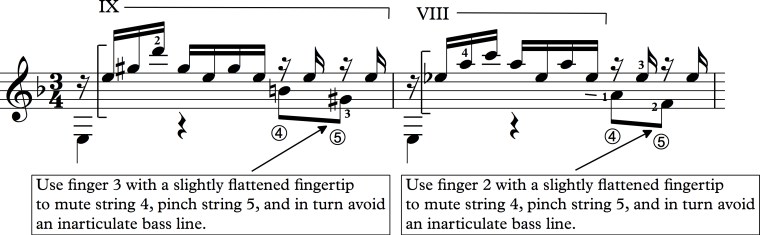
Another case builds on this idea, what if you could use the flattened finger to silence a note on a neighboring string while simultaneously playing a note to achieve the correct musical intent of the composer or to maintain the integrity of a bass line? I’ve mentioned Bach’s Prelude in D Minor BWV999 before as a great piece to study many aspects of left hand technique so I will use a two measures from it as an example.

BWV999 Sloppy Left Hand.jpg

I’m hoping to post my edition of BWV999 soon with more pointers but for now, try to find places in your repertoire where it would be advantageous to not pinch so perfectly!

Left Hand Contrapuntal Exercise 2

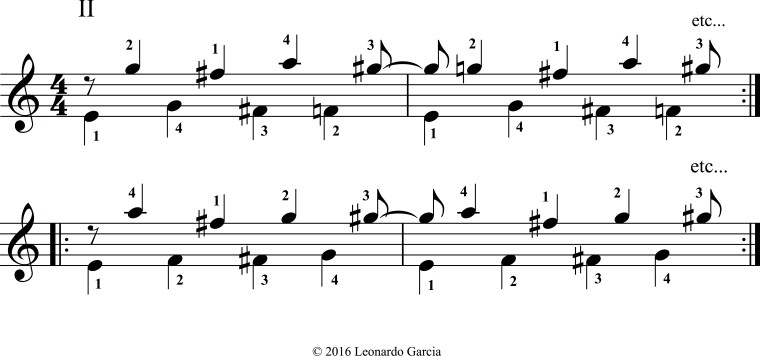
Here is another one of my favorite left hand exercises. Practice it to develop more finger independence and to help stabilize your fixed fingers. The destabilizing element of the slur adds a challenge. Like in the first contrapuntal exercise, go slowly to insure the voices are being held their full duration. You can easily (or maybe with a lot of struggle) create a more challenging exercise by increasing the distance between the strings in use and by maintaining good form. Focus on the vertical movement of the fingers while the left hand remains stable. Use less hand tilting to get to the lower (or higher) strings.

contrapuntal 2

A Look at Guide Fingers

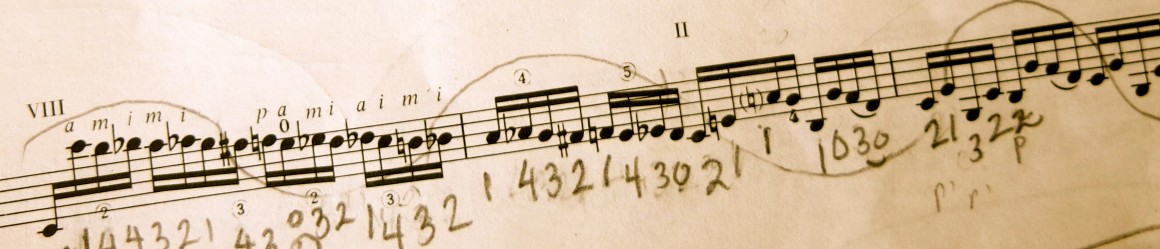
The great Cuban guitarist Marco Tamayo reminded me that all shifts should occur with guide fingers lightly gliding on the strings, preferably the treble strings to avoid unnecessary noise. If you observe any great guitarist’s left hand, like Marco’s, you will witness a great left hand choreography – smooth, soft, efficient, relaxed. One of the key elements in building an effective left hand choreography is a thorough understanding of how to use guide fingers to bridge and connect movements that may seem unrelated. Think of guide fingers as fingers that remain in passive contact with the string while shifting.

See if you can find guides in the next passage.

Excerpt from J. S. Bach’s Double from BWV997

Bach BWV997 Guides 1

Did you find them all?

Bach BWV997 Guides 2

Try to locate all and label all the guides in your repertoire. You’ll find that it not only improves left hand fluidity but it also deepens your physical understanding of the piece you are working on and in turn can help your memory.

Stay tuned for ghost guide fingers and changing guide fingers…