
by Leonardo Garcia
If you’re practicing diligently and still feel stuck, more hours probably aren’t the answer.
Skill does not respond to effort alone. It responds to specific kinds of effort. Decades of research in motor learning show that certain practice structures reliably produce improvement, while others only create the illusion of work. That distinction matters.
Psychologist K. Anders Ericsson, who is known for his work on expertise, found that improvement comes from deliberate practice, which is highly focused work on specific weaknesses with clear goals and immediate feedback. In other words, playing through a piece from beginning to end is not necessarily practice. It may feel productive, but it often reinforces what is already comfortable. Growth happens at the edge of difficulty.
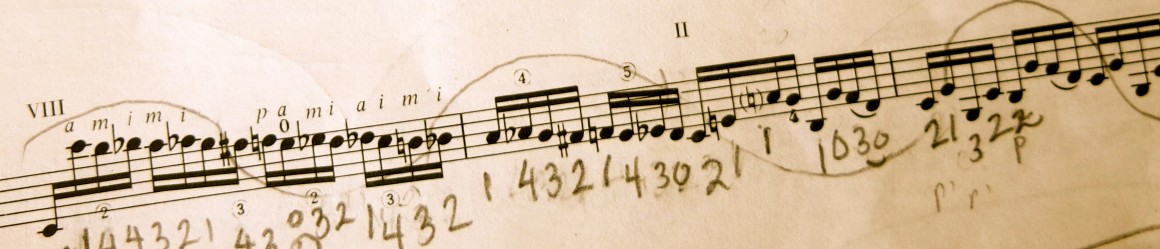
For classical guitarists, this means identifying the technical bottleneck with precision. Is it the balance between voices in a fugue by Bach? Is it right-hand clarity in a quick arpeggio passage? Is there a left-hand shift that appears unreliable when under pressure? Instead of restarting the piece, isolate the measure. Reduce it to its smallest workable unit. Solve that problem. Record yourself to see if the problem is solved.
Slow practice, often dismissed as old-fashioned advice, is strongly supported by motor learning research. When we repeat a movement, we strengthen the neural circuits responsible for that movement. If we practice sloppily at tempo, we are encoding sloppiness. Precision at a slower tempo allows the brain to build efficient motor “chunks.” Once the movement is encoded cleanly, speed can be added without adding tension. If the body tightens, the tempo is too fast.
Spacing is another principle consistently supported in the literature. Distributed practice—shorter sessions spread out over time—produces stronger retention than massed practice. Two focused 20-minute sessions will often outperform a single 40-minute block. Sleep then consolidates those motor pathways further. For difficult repertoire, it is more effective to revisit problem passages several times a day than to grind them into fatigue.
Interleaving also plays a role. Instead of practicing one piece exclusively for an hour, rotating between sections of repertoire and technique introduces what researchers call “desirable difficulty.” It feels less smooth in the moment, but it improves long-term retention and adaptability—essential qualities in performance.
Finally, rest is not weakness. Attention and motor precision degrade before we consciously notice it. Brief breaks every 25–30 minutes restore clarity and reduce injury risk. Elite athletes train in cycles; musicians should as well.
All of this matters most when the stakes are high. Performance anxiety often exposes whatever is least stable in our preparation. Under pressure, we do not rise to the level of our aspirations; we fall to the level of our training. Clean neural encoding, spaced reinforcement, and deliberate correction create margins of safety. When a shift feels problematic in the practice room, it is far more likely to be a problem on stage. Science does not remove nerves, but it reduces uncertainty—and uncertainty is what amplifies fear.
As I write this, I remember a quote from the Brazilian guitarist Edson Lopes, who said in an interview that, in translation, it was something like, “Humans can be conditioned.” Practicing is behavioral conditioning. Good playing is built through biological adaptation. Practice is about shaping the nervous system with intention. When we approach the instrument like scientists—observing, adjusting, and refining—artistry becomes more reliable, and performances feel less accidental. Maybe instead of “Practice makes perfect,” it should be, “Practicing deliberately using science leads to improvement.”
Want to Go Deeper?
If the science behind effective practice interests you, these two books offer a strong foundation:
Peak: Secrets from the New Science of Expertise—K. Anders Ericsson & Robert Pool
Make It Stick: The Science of Successful Learning—Peter C. Brown, Henry L. Roediger III, Mark A. McDaniel