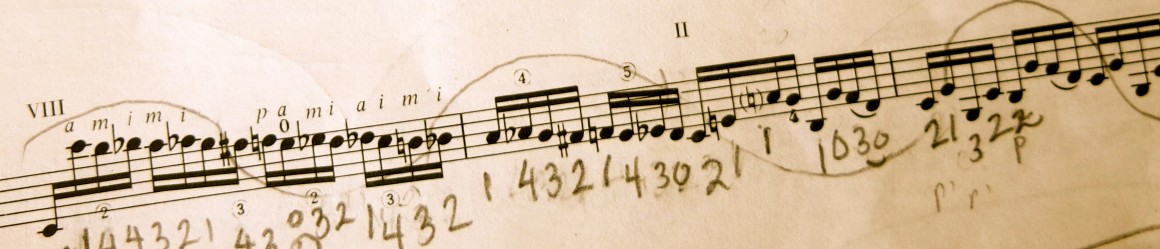

Building Right Hand Confidence
Here is a list to help you build confidence in your right hand while you work on your repertoire. I hope it helps.
- Use sequential and block planting as much as possible.
- Practice sections of your songs with your right hand alone. This helps even in the most simple passages to clarify right-hand position and rhythm. It also forces you to make right-hand fingering decisions.
- Look at your right hand when practicing a passage. Aiming for the string helps. Unless you are particularly physically gifted, our brains don’t always map our reality perfectly, so aiming is one way to ensure the fingers are going to land in the right place. While watching your fingers, study what they are doing.
- Practice exercises that are extracted from your repertoire in addition to your other skill-building technique exercises. You will often discover new and intriguing tasks for your right hand that you had not previously noticed.
- Observe the orientation of your right-hand fingers: are they aligned over strings 4321? 5321? 5432? When does the orientation change? Or are i and m aligned on the same string?
- Proximity to the strings is also surprisingly effective when it comes to right-hand control. Try practicing in pianissimo and, again, watch those fingers to see if they are straying beyond their allocated territory.
- Use rest strokes strategically. The nature of the rest stroke is that it helps stabilize the right hand because you are apoyado, or supported, after the stroke with string contact.
- Dragging or sweeping with the same right-hand finger is fine. If you play a rest stroke with m on string 1, your m ends up resting on string 2. If you need to play string 2, it’s ok to use m as a free stroke. This approach is effective when used in the context of a chord.
- Make sure that your nail shape is not creating displacement in the hand that requires a recovery movement to realign the fingers. Nail shape is personal, but if you have to move your wrist in addition to the finger joints, rethink your nail shape.
- Break rules if they help you feel stable. I sometimes like to use i repeatedly if I’m playing something slowly on the same string. It’s easy to get a consistent tone while the other fingers plant to support a great stroke.
- Keep p in contact with the next lowest string when playing free stroke. If i and m are playing a melodic phrase on string 2, p should rest on string 3, for example. This helps keep the hand’s weight centered behind the strings you are playing, allowing less effort from the stroke.
- Relax. Make sure your wrist and arm are as relaxed as possible. If you are holding tension in your hand or farther up your wrist and arm, moving efficiently is more stressful and slower.
- Plant the thumb (p) where it does not interfere with the music and resonances to help i, m, and a have a stable finger to move against. Plant the fingers as a group or individually (ima, im, ma, i, m, a) so that p has a stability point to move against. Avoid floating above the strings.


