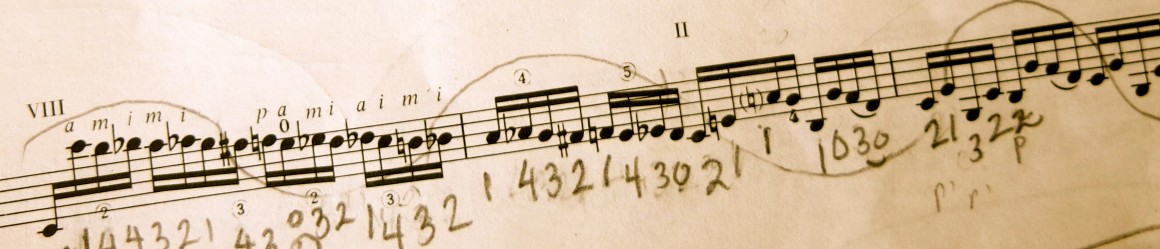


Very early on in my guitar adventure, my teacher at the time said that he would never perform anything unless he could see it physically happen in his head. He had me read a few articles on visualizing, and, because I tried to be a good student and wanted to be a good guitarist, I tried his advice. It was hard work. I SO much preferred to “do.” I close my eyes and mentally sweat to “see” my fingers on the fretboard. No, thank you.
But I persisted. And, having read enough about it, I am convinced it has helped me in many ways. For one, I feel more secure if I can imagine everything. Two, it inevitably builds your ability to focus. Three, I’m not sure to what degree it helps, but I like to think of it as a memory safety net, one of many safety nets (mental and physical) that come with mastering pieces and eventually performing them.
At this point in my playing, I enjoy doing it. It’s pleasant to play and listen to a piece develop in my mind when I close my eyes. Visualizing frees my musical imagination in ways that are not confined by the physical struggles of the early stages of learning new music and cold fingers.
Here are some useful visualizing techniques; some are easier than others and can be used as training wheels until you get the hang of it. Or, you’ll find the ones that work well for you and that you enjoy doing. Like exercise, the best visualization is what you’ll actually do. From easier to more difficult:
- Read through the score of your piece without the guitar in hand. As you read the music, try to hear it in your head and picture your hands playing.
- Watch a video of your favorite player and play along in your head. This is light visualization.
- Listen to your favorite player or a good recording of yourself and play along in your head, trying to stay with it. No backtracking. If you encounter any unclear areas, focus on those carefully during your next physical practice session.
- Close your eyes, imagine a stage, and imagine where you would sit. Perform the piece in as much detail as possible, paying extra attention to your left-hand choreography as it unfolds. Try the same but with the right hand.
- Try doing the previous step with a metronome set to an ultra-slow tempo and see the piece unfold, matrix-like. Try with an ultra-fast tempo. How much can you keep up? What goes blurry?
Don’t forget to smile, breathe calmly, and remain optimistic. Happy visualizing.