Seven Ways to Use a Metronome for Better Practice

What do you call a dwarf who rides the subways of Paris?
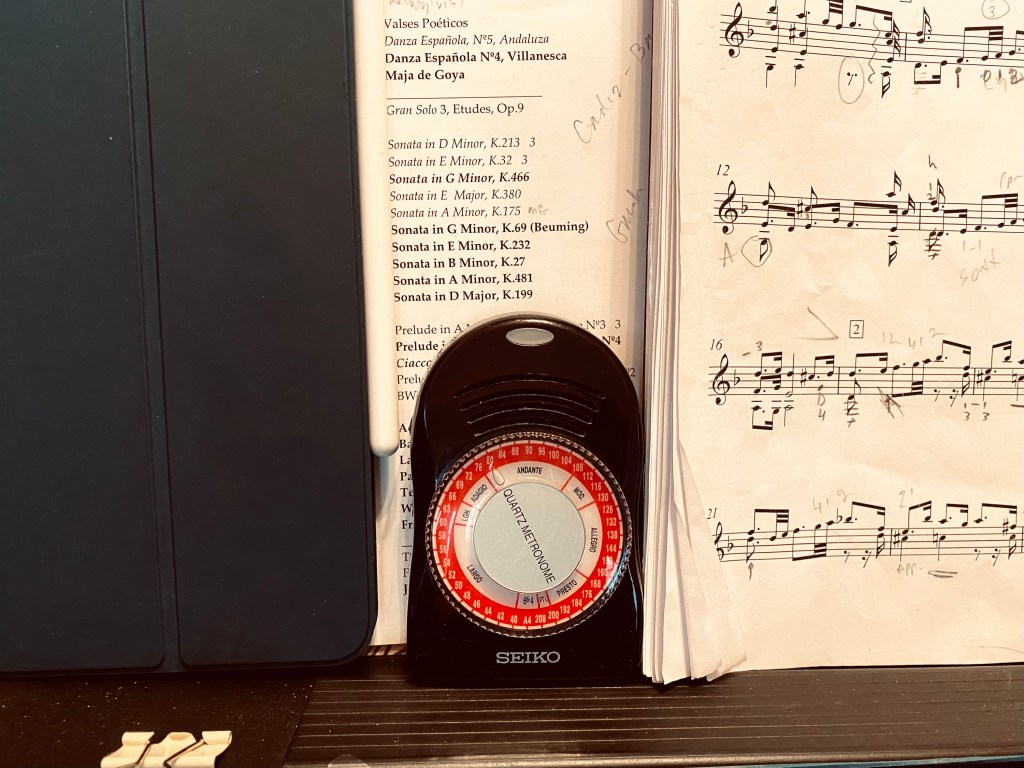
A metronome should be your ally in the practice room. While it may seem like a cold, unforgiving taskmaster, it’s one of the most powerful tools you have for becoming a better guitarist and musician. Beyond simply keeping you in time, the metronome develops your internal pulse and reveals where your playing might be rushing or dragging. There is a lot of fun you can have with the metronome. Here are my favorite ways to use it when I’m practicing:


1. Gradual Tempo Building (“Clicking Up”)

Start at a comfortable tempo where you can play the passage cleanly. Slowly increase the tempo in small increments (2-10 bpm at a time) until you reach or even slightly surpass your target tempo. This method builds accuracy first, then speed.


2. Fewer Clicks, Longer Phrases

Keep the metronome at the same speed but reduce the number of clicks per bar—for example, setting it to click only on beats 1 and 3, or just on beat 1. This approach forces you to internalize the pulse and feel longer phrases instead of relying on every beat.


Metronome-Off Challenge

Set the metronome, play along to establish the tempo, then turn it off and continue playing. After a few bars or phrases, turn it back on to see if you stayed in time. This practice is excellent for developing your internal pulse.


4. Offbeat & Subdivision Clicks

Instead of clicking on the downbeats, have the metronome click on the upbeats (the “and” of each beat) or on subdivisions (e.g., sixteenth notes in a fast passage). For perpetual motion pieces, such as a Bach Allegro, this approach keeps you honest and aids in maintaining rhythmic stability and precision.


Half-Time or Double-Time Feel

Set the metronome to half the tempo so it clicks only once every two beats (or every bar). Alternatively, set it to double the tempo so it clicks on every subdivision. Both methods challenge you to maintain a steady groove and avoid rushing.


Random Dropout Practice (Advanced)

Some modern metronome apps allow the click to drop out randomly. This feature forces you to maintain steady timing when the click disappears, which helps train your internal rhythm consistency.


Polyrhythmic Practice

Set the metronome to a different pulse than the meter you’re playing—for example, a 3:2 feel (triplets against duplets). This develops rhythmic independence and makes you far more rhythmically flexible.


Recommended Metronomes

My favorite old-school quartz metronome is the Seiko Quartz SQ50-V but here are a few more that I’ve used in the past.

  • Tonal Energy Tuner (App)—combines metronome, tuner, and advanced rhythmic tools.
  • Dr. Beat DB-90 (Boss)—classic, reliable, and feature-rich with multiple patterns.
  • Metronome+ (App) is a helpful tool I have on my iPad because you can set tempo increases automatically. It is excellent for technique practice.

This post includes affiliate links. If you decide to use it, thank you—it helps keep this blog up and running.

Building Right Hand Confidence

Building Right Hand Confidence

Here is a list to help you build confidence in your right hand while you work on your repertoire. Hope it helps.

  1. Use sequential and block planting as much as possible.
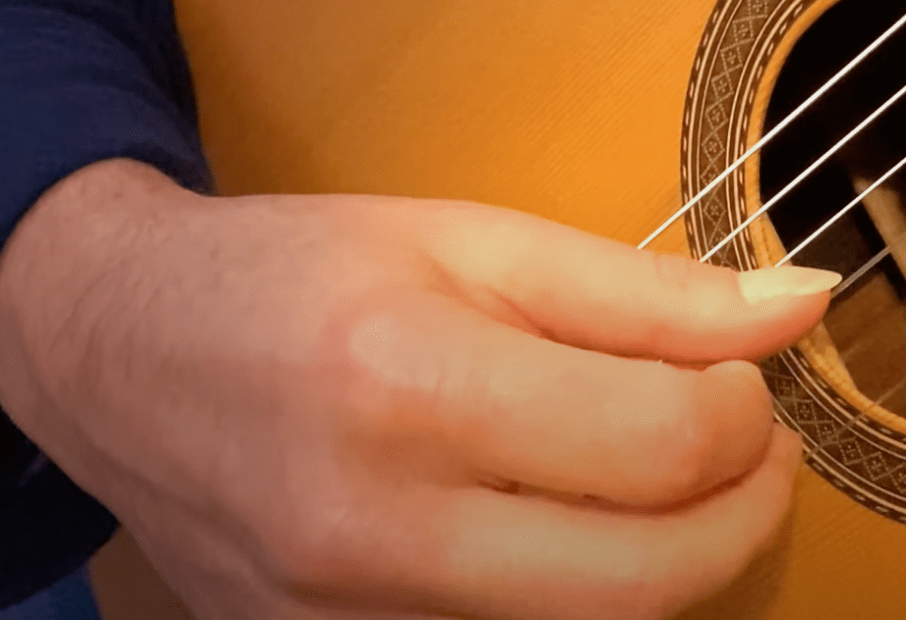
  2. Plant the thumb (p) where it does not interfere with the music and resonances to help i, m, and a have a stable finger to move against. Plant the fingers as a group or individually (ima, im, ma, i, m, a) so that p has a stability point to move against. Avoid floating above the strings.
  3. Practice sections of your songs with your right hand alone. This helps even in the most simple passages to clarify right-hand position and rhythm. It also forces you to make right-hand fingering decisions.
  4. Look at your right hand when practicing a passage. Aiming for the string helps. Unless you are particularly physically gifted, our brains don’t always map our reality perfectly, so aiming is one way to ensure the fingers are going to land in the right place. While watching your fingers, study what they are doing.
  5. Practice exercises that are extracted from your repertoire in addition to your other skill-building technique exercises. You will usually find interesting things to do that are being demanded of your right hand that you hadn’t noticed before.
  6. Observe the orientation of your right-hand fingers: are they aligned over strings 4321? 5321? 5432? When does the orientation change? Or are i and m aligned on the same string?
  7. Proximity to the strings is also surprisingly effective when it comes to right-hand control. Try practicing in pianissimo and, again, watch those fingers to see if they are straying beyond their allocated territory.
  8. Use rest strokes strategically. The nature of the rest stroke is that it helps stabilize the right hand because you are apoyado, or supported, after the stroke with string contact.
  9. Dragging or sweeping with the same right-hand finger is fine. If you play a rest stroke with m on string 1, your m ends up resting on string 2. If you need to play string 2, it’s ok to use m as a free stroke. In the context of a chord, this works well.
  10. Make sure that your nail shape is not creating displacement in the hand that requires a recovery movement to realign the fingers. Nail shape is personal, but if you have to move your wrist in addition to the finger joints, rethink your nail shape.
  11. Break rules if they help you feel stable. I sometimes like using i repeatedly if I’m playing something slowly on the same string. It’s easy to get a consistent tone while the other fingers plant to support a great stroke.
  12. Keep p in contact with the next lowest string when playing free stroke. If i and m are playing a melodic phrase on string 2, p should rest on string 3, for example. This helps keep the weight of the hand centered behind the strings you are playing, allowing less effort from the stroke.
  13. Relax. Make sure your wrist and arm are as relaxed as possible. If you are holding tension in your hand or farther up your wrist and arm, moving efficiently is more stressful and slower.

The Best Guided Warm-Up for Your Left Hand, Part 4

Here is Part 4 of a new series of guided warm-ups for my students and Six String Journal readers. In these guided warm-ups, I’ll go through some of the most important drills to help you establish a good routine for warming up before practicing your repertoire.

So go grab your guitar and get comfortable. In this second video, I’ve set the metronome for quarter = 60. We’ll go through the third part of my go-to slur routine, which involves three and four-note slurs (124, 134, 123, 234, 1234). For the right hand, I simply use p for strings 6, 5, and 4, and then use i, m, and a for strings 3, 2, and 1. Follow along, stay aware of good form, stay relaxed, and stick with it until you can start to increase tempo with a good foundation.

If you’re a beginner, take it slowly and don’t wear your hand out. Pause occasionally for rest and let your hand catch up. It might help to just watch the first few minutes to get a sense of how it unfolds for the fingers.

The Best Guided Warm-Up for Your Left Hand, Part 3

I’m in the process of creating a new series of guided warm-ups for my students. Here is Part 3 for Six String Journal readers. In these guided warm-ups, I’ll go through some of the most important drills to help you establish a good routine for warming up before practicing your repertoire.

So go grab your guitar and get comfortable. In this second video, I’ve set the metronome for quarter = 60. We’ll go through the second part of my go-to slur routine, which involves compound slurs (121, 232, 343, 131, 242, 141). For the right hand, I simply use p for strings 6, 5, and 4, and then use i, m, and a for strings 3, 2, and 1. Follow along, stay aware of good form, stay relaxed, and stick with it until you can start to increase tempo with a good foundation.

If you’re a beginner, take it slowly and don’t wear your hand out. Pause occasionally for rest and let your hand catch up. It might help to just watch the first few minutes to get a sense of how it unfolds for the fingers.

The Best Guided Warm-Up for Your Left Hand, Part 2

I’m in the process of creating a new series of guided warm-ups for my students. Here is Part 2 for Six String Journal readers. In these guided warm-ups, I’ll go through some of the most important drills to help you establish a good routine for warming up before practicing your repertoire.

So go grab your guitar and get comfortable. In this second video, I’ve set the metronome for quarter = 60. We’ll go through the first part of my go-to slur routine. For the right hand, I simply use p for strings 6, 5, and 4, and then use i, m, and a for strings 3, 2, and 1. Follow along, stay aware of good form, stay relaxed, and stick with it until you can start to increase tempo with a good foundation.

If you’re a beginner, take it slowly and don’t wear your hand out. Pause occasionally for rest and let your hand catch up. It might help to just watch the first few minutes to get a sense of how it unfolds for the fingers.

Warm Up With Me!

I’m in the process of creating a new series of guided warm ups for my students. Here is part 1 for Six String Journal readers. In these guided warm ups, I’ll go through some of the most important drills to help you establish a good routine for warming up before practicing your repertoire.

So go grab your guitar and get comfortable. In this first video I’ve set the metronome for quarter = 60. We’ll string cross with single and pairs of fingers and go through a great slur routine with all the pairs of left hand fingers. For the right hand, I simply use p for strings 6, 5, and 4, and then use i, m, and a for strings 3, 2, and 1. Follow along, stay aware of good form, stay relaxed, and stick with it until you can start to increase tempo with a good foundation.

Two Pieces by Agustín Barrios Mangoré

I recently recorded several of my favorite pieces by Paraguayan composer, Agustín Barrios Mangoré. Here are two of them, well-loved and well-known to most of you. Julia Florida was the first Barrios piece I learned decades ago and I still love playing it. And, of all of Barrios’s waltzes, his Vals Op.8, Nº3 is probably my favorite. Thank you to Stefan Nitschke for such a beautiful sounding guitar.

Thanks for listening!

Six String Journal’s Complete Technique Course on Sale

Have some time to work on your technique over the holidays? Through December, my course Complete Technique for Classical Guitar will be on sale through Six String Journal’s Podia page. Use this COUPONCODE for a 20% discount.

Six String Journal’s Complete Technique for Classical Guitar Course was developed for the advancing beginner with some experience, the advancing intermediate guitarist, and will even benefit those with lots of playing experience. Though music theory isn’t necessary, a rudimentary understanding of rhythm is helpful.

The course consists of primary movement videos where I will teach the foundational movements that you’ll need in order to master classical guitar. These videos cover topics such as free-stroke, rest-stroke, arpeggios, alternation, scales, hand coordination, slurs, and shifts. These are followed by several series of secondary videos where I’ll apply the techniques and movements in various ways to help you engrain them into your own practice. Stringing the secondary videos into a sequence will teach you how to form an effective practice routine that will maximize your results and get you closer to your musical goals.

Course Includes

  • Hours of focused technique lessons with an award-winning classical guitarist, the founder of Six String Journal, and sought-after educator. 
  • Over 50 extensively detailed but digestible videos demonstrating essential foundational movements, technique tips, exercises, routines, and how to implement them into your practice, carefully edited in small bite size videos for easy assimilation and viewing.
  • Printable PDF summarizing the entire course with a condensed visual of the material presented. 
  • Loads of bonus content from Six String Journal’s Mastering Diatonic Scales.

The Keys to Right Hand Control

In the videos below, I go through a progression of movements in the right hand that lead to better control of both rest stroke and free stroke. Grab your guitar and follow along. Hope this helps!

One-Time
Monthly
Yearly

Make a one-time donation

Make a monthly donation

Make a yearly donation

Support Content Creation! : )

$5.00
$15.00
$100.00
$5.00
$15.00
$100.00
$5.00
$15.00
$100.00

Or enter a custom amount

$

Your contribution is appreciated.

Your contribution is appreciated.

Your contribution is appreciated.

DonateDonate monthlyDonate yearly

Four Essential Ways to Work on Tremolo

In the video below, I demonstrate four great ways to help your tremolo improve. Two of them I’ve outlined in my book Mastering Tremolo, which if you haven’t picked up, you should : ). But the last two I came across in Abel Carlevaro’s hand-written notes to himself in one of his editions of Agustín Barrios Mangoré’s Una limosna por el amor de Diós. Below you’ll find links to Mastering Tremolo and a NEW study score of Barrios’s Una limosna. Hope it helps.

Mastering Tremolo on Amazon

Mastering Tremolo on Podia

Una limosna por el amor de Diós (Agustín Barrios Mangoré) study score