Seven Ways to Use a Metronome for Better Practice

What do you call a dwarf who rides the subways of Paris?
A metronome should be your ally in the practice room. While it may seem like a cold, unforgiving taskmaster, it’s one of the most powerful tools you have for becoming a better guitarist and musician. Beyond simply keeping you in time, the metronome develops your internal pulse and reveals where your playing might be rushing or dragging. There is a lot of fun you can have with the metronome. Here are my favorite ways to use it when I’m practicing:


1. Gradual Tempo Building (“Clicking Up”)

Start at a comfortable tempo where you can play the passage cleanly. Slowly increase the tempo in small increments (2-10 bpm at a time) until you reach or even slightly surpass your target tempo. This method builds accuracy first, then speed.


2. Fewer Clicks, Longer Phrases

Keep the metronome at the same speed but reduce the number of clicks per bar—for example, setting it to click only on beats 1 and 3, or just on beat 1. This approach forces you to internalize the pulse and feel longer phrases instead of relying on every beat.


Metronome-Off Challenge

Set the metronome, play along to establish the tempo, then turn it off and continue playing. After a few bars or phrases, turn it back on to see if you stayed in time. This practice is excellent for developing your internal pulse.


4. Offbeat & Subdivision Clicks

Instead of clicking on the downbeats, have the metronome click on the upbeats (the “and” of each beat) or on subdivisions (e.g., sixteenth notes in a fast passage). For perpetual motion pieces, such as a Bach Allegro, this approach keeps you honest and aids in maintaining rhythmic stability and precision.


Half-Time or Double-Time Feel

Set the metronome to half the tempo so it clicks only once every two beats (or every bar). Alternatively, set it to double the tempo so it clicks on every subdivision. Both methods challenge you to maintain a steady groove and avoid rushing.


Random Dropout Practice (Advanced)

Some modern metronome apps allow the click to drop out randomly. This feature forces you to maintain steady timing when the click disappears, which helps train your internal rhythm consistency.


Polyrhythmic Practice

Set the metronome to a different pulse than the meter you’re playing—for example, a 3:2 feel (triplets against duplets). This develops rhythmic independence and makes you far more rhythmically flexible.


Recommended Metronomes

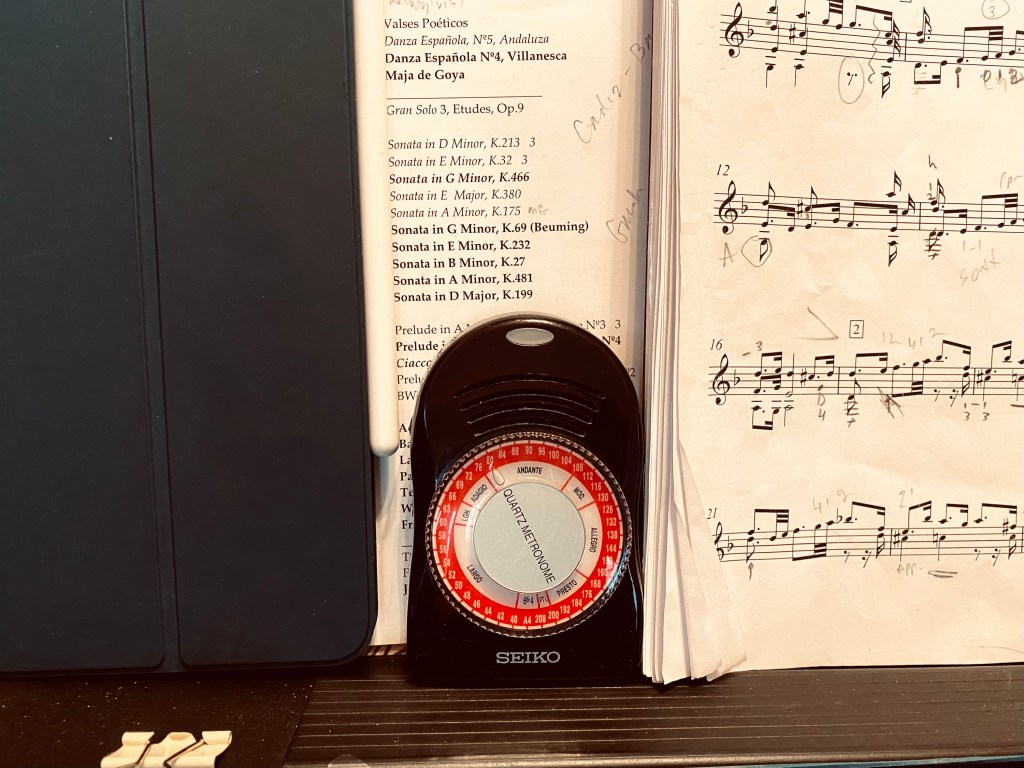
My favorite old-school quartz metronome is the Seiko Quartz SQ50-V but here are a few more that I’ve used in the past.

  • Tonal Energy Tuner (App)—combines metronome, tuner, and advanced rhythmic tools.
  • Dr. Beat DB-90 (Boss)—classic, reliable, and feature-rich with multiple patterns.
  • Metronome+ (App) is a helpful tool I have on my iPad because you can set tempo increases automatically. It is excellent for technique practice.

This post includes affiliate links. If you decide to use it, thank you—it helps keep this blog up and running.
Are You Practicing Productively?

Psychologist Dr. Noa Kageyama is now my favorite resource for all things related to performance issues and practice strategies. His blog, Bulletproof Musician, is loaded with interesting articles that are applicable to both musicians and athletes. Here are some important points gleaned from one of his productive practice talks.

1) Set Goals

Practice with a specific goal. Take time to plan what you would like to accomplish (i.e. figure out right hand fingerings to a movement, master a particularly hard passage from a repertoire piece, memorize 16 bars of a new piece, etc…) during your practice session.

2) Impose Time Limits

download

Limit the amount of time for achieving the goal/s. This is not a problem for most of us with limited hours to practice but the key is to set a time limit or to perceive that there is one. This not only boosts productivity, it will, in the long run, save you time.

3) Record Yourself

I have to admit that I’ve been told this from every single great musician I know and yet my fingers resist pressing the record button like my life depended on it. However, Dr. Kageyama suggests shifting your post-listening assessment not to how many things went wrong to turn this potentially demoralizing activity into an assessment of how long you positively remained in performance mode. So… turn off the self-assessment mode, the inner critic, the frustrated musician, the nit-picky super charged inner ear, and just play. Whether it is what you worked on in your session or whether it’s a repertoire piece that is part of your current program, flipping the switch from practice mode to performance mode is essential if you indeed want to feel like you are training to perform. Otherwise, it is a skill that remains in its infancy until too close to the performance.

699d5906f2219e0903a0bc6ea6f441da.jpg

4) Keep a Practice Journal

Take consistent notes during your practice sessions. Tedious? Perhaps. But, without doubt, it will lead to better practice hygiene. Goals that are trackable are attainable. Invest in a sweet journal if you aren’t inspired to write in a cheap notebook.

Hope this to helps Six String Journal readers extract more juice from their practice sessions!


On Practicing as a Journey

“I  just go to the piano simply because I’m naturally attracted to it, not because I ever feel I have a task to accomplish. Well, I do in a way, but only in the sense that it’s just continuing a journey with a certain piece, or with a number of pieces at the same time.”

— Piano virtuoso Marc-André Hamelin talk about practicing this morning.

Hear him talk about practice on Classical KDFC.

MAHDec201620.jpg

The Science of Practicing Effectively

Annie Bosler and Don Greene’s TED-Ed talk “How to Practice Effectively” provides a great summary of how to get the most from your practice sessions.

Here are the tips given for more effective practice:

  1. Focus on the task on hand. Minimize distractions (turn off screens and phones!).
  2. Start slowly or in slow motion. Coordination is built with repetitions. If you gradually increase the speed of the quality repetitions you have a better chance of doing them correctly.
  3. Frequent repetitions with allotted breaks are common practice habits of elite performers. Many divide their time for effective practice into multiple daily practice sessions.
  4. Practice in your brain in vivid detail. Visualize everything. Once a physical motion has been established it can be reinforced just by imagining it.