Rafael Elizondo’s Technique Videos

Rafael Elizondo is a fabulous Mexican concert guitarist who has been making wonderful videos for his youtube channel. If you don’t speak Spanish, you may not be at too much of a disadvantage because he demonstrates everything very clearly. This instructional video below is a fine example of Rafael explaining how to use fixed fingers to establish stability and confidence in the right hand.

Here is another great one where he demonstrates 4 finger coordination patterns for the left hand:

Check out and subscribe to his channel. There are tons of great posts.

More soon…


Technical Workout for Classical Guitar, Level 1 – Base Building, Part 3 (video)

Here is the third of Six String Journal’s series of technique videos to accompany my recent workbook, A Technical Workout for Classical Guitar, Level 1 – Base Building. This video corresponds to Left Hand Movements, Part 3.

This workbook is designed to help late beginners and intermediate guitarists develop a daily routine of movements to strengthen their technical base so that fingers can do their job properly when assimilating new repertoire. Always go slowly with the most control possible. Think of it as writing a program for your brain with no bugs.

Technical Workout for Classical Guitar, Level 1 – Base Building, Part 2 (video)

Here is the second of Six String Journal’s series of technique videos to accompany my recent workbook, A Technical Workout for Classical Guitar, Level 1 – Base Building. This video corresponds to Left Hand Movements, Part 2.

This workbook is designed to help late beginners and intermediate guitarists develop a daily routine of movements to strengthen their technical base so that fingers can do their job properly when assimilating new repertoire. Always go slowly with the most control possible. Think of it as writing a program for your brain with no bugs.

Legato and Dissonance

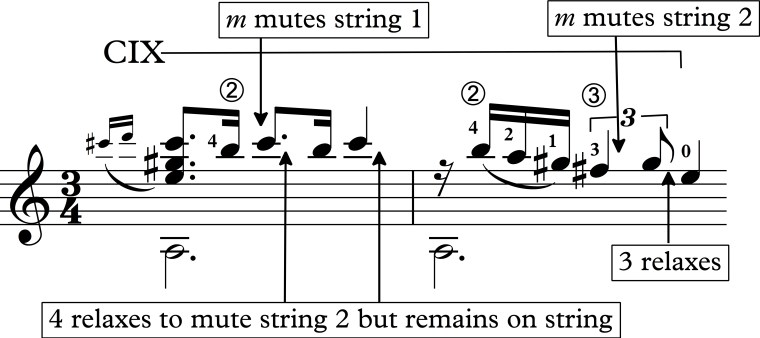
Creating a beautiful melody on the guitar is challenging due to the fact that every note you pluck decays from that moment on. If you play two consecutive melodic notes on one string, the touch requires extreme precision to give the impression of legato. At certain times, it is easier to achieve a sense of legato by using cross string fingerings. But there is a fine timing line between achieving beautiful legato and dissonance with cross strings and it requires the use of controlled damping – sometimes with the left hand and sometimes with the right.

Here is a great example from Leo Brouwer’s beautiful piece Un dia de noviembre. For a benign light passage there is a lot to think about musically.

Dia de Noviembre Ex.1.jpg

Notice that in the example above muting occurs the moment after the new melodic note turns on. This is a great way to exploit the resonance of the guitar. Of course, there are many variations on this, including one where you would turn off the notes simultaneously with the entrance of the new note but this would achieve a less legato line.

Coming soon, I’m going to post a workout based on Leo Brouwer’s Axioms!


Leo Brouwer’s Axioms

Years ago, I came across an article on a Spanish site guitarra.artepulsado.com posted by Oscar López who had taken notes during a summer course with the great Cuban composer and guitarist, Leo Brouwer. The title of the post was Axiomas básicos de Leo Brouwer. I found the word file and thought I’d translate it for all non-Spanish speakers. It provides a wealth of advice. I’ve added a few commentaries below to expand the ideas a bit. Hope they are helpful.

Warm Up

Use chromatic octaves for the left hand and arpeggios and rasgueados for the right hand. Play close to the body in higher resonant positions upon starting your practice.

*I think this may mean to start your practice without having the left hand in an extended position. Starting in higher positions is less stressful for the left hand.

Speed and Scales

Use fixed, non-shifting positions in the left hand that are close to the body (i.e. higher positions) to play short bursts of notes. Play bursts in short crescendos (soft to loud or light to intense). Start on one string, then expand to two strings. Add one note at a time and pause between each mini-scale.

Add color and articulations to scales.

Left Hand Shifting

Left-hand notes should be played staccato (*perhaps he means before a shift). Focus on the arrival (not the departure) as you shift from 1st to 2nd, 1st to 3rd, 1st to 4th, etc., position.

Left Hand Independence

With a fixed first finger bar, play slurs and scales across all the strings with the rest of the fingers. Try all combinations possible.

Memory

To avoid embedding errors, do not start memorizing at the very beginning of learning a piece.

Fingerings

There are never definitive fingerings.

*What Brouwer most likely means to covey here is that fingerings evolve throughout the lifetime of learning a piece. Inevitably, we discover better, more efficient, more musical, more interesting ways to play passages and discard or change older fingerings as our familiarity with the piece increases.

Color

Exploit the three primary sonorous zones of the guitar: over the sound hole (resonant zone), over right part of the rosette (resonant and clarity zone), and near the bridge (clarity zone).

Harmonics

Do not pluck harmonics diagonally.

More Advice

  • The position of the guitar to your body should remain consistent.
  • Remember that the 2nd and 3rd strings tend to be the weakest so we must compensate when necessary.
  • Pluck consonant chords with no arpeggiation. Pluck rare (dissonant) chords with arpeggiation for clarity.
  • Velocity contains impulse and direction.
  • Cadential ornaments should be in time.
  • Resonance is at the heart of the guitar.
  • Vibrato is used for intensity not rest.
  • The thumb (left-hand) acts as a pivot during slurs.
  • Forte is found at the limit of a beautiful sound.
  • Breathe between phrases and project energy towards the end.
  • During rasgueados the energy is channeled towards the 1st string.
  • Anything that is repeated should be varied. Change either the color or the volume or the timbre.
Grisha Goryachev

If given three wishes, I think one would be to play flamenco like Grisha.

I remember searching out Grisha’s posts when Eliot Fisk’s wife, and phenomenal guitarist in her own right, Zaira Meneses showed me a video of Grisha playing Enteban Sanlucar’s Panaderos. I was floored.

Lucky for us, here he is demonstrating some useful scale tips.

And, here is that video of him playing Sanlucar’s Panaderos:

Part 2 of Modes coming soon….

Finger Contraction Equals Tension

Yesterday I was working on Julio Sagreras’ super fun El Colibri (The Hummingbird) with my son which made it twice the super fun. He’s at the point where he can play through the entire piece, correct fingerings in both hands, smoothly. His lofty goal is 180bpm. Yikes! I explained to him that lofty goals are the best because he may get closer than if setting a lesser goal. And, who knows, maybe he will be the first : ).

In an effort to support this enthusiasm, we went through the piece again in an effort to discover ways to help him make both hands more efficient and relaxed. The one principle which really translated into faster and better looking hands almost immediately was shifting without finger contraction (or extension) and maintaining a relaxed left hand position.

If you are trying to squeeze every last drop of tension out of your hands in order to speed things up, do not contract the left hand fingers into each other (and, of course, do not extend the fingers away from each other).

The temptation to contract to prepare finger 4 is overwhelming but it is not the finger to focus on. Instead focus on using finger 1 to shift and as a result yank finger 4 into place. This reduces our mind’s focus to one movement: the shift. Otherwise, we focus our attention on placing finger 4 and then shifting. I don’t know about you all, but I’d rather have less to think of when playing quickly. It makes the piece feel slower.

And, now, for my first instructional video:

And, if you want to see the absolute finest and scariest rendition of this, check out the great Cuban guitarist Marco Tamayo:


By the way, he has a hyper-detailed edition of El colibri available from his website. Wait, is that 180bpm?

The Best of YouTube

YouTube is both a blessing and a curse. Among thousands of videos not worth watching, there are a few gems waiting for discovery. I’m hoping to add video tutorials on the elementary pieces that my students enjoy playing after they’ve finished the KinderGuitar curriculum. In the meantime, I’ll share some great videos I’ve discovered after being trapped in the YouTube world a few weeks ago. If you are still developing your technique, watch them over and over. If you are far along, there are still wonderful moments of insight to extract. I watched most of them in one sitting at 1.5x speed, taking notes, and sipping coffee. These videos come from Russian guitarist Andrey Parfinovich. He’s done the guitar world a great service when he decided to film his lessons with the masters!

Pepe Romero on left hand technique:

Pepe Romero on rest stroke technique:

Pepe Romero on tremolo:

Pepe Romero on rasgueado:


More soon….


Three Basic Scale Forms to Master

I just returned from a vacation that went by way too fast. As always, I was over ambitious when it came to planning out which pieces to learn but I did manage to re-work most of the Chaconne and will have many posts exploring what I’ve come across this time around.

In the meantime, the next post to help you develop a scale practice is here. Here are three moveable scale forms (major, harmonic minor, and melodic minor) covering three octaves starting on three different strings.

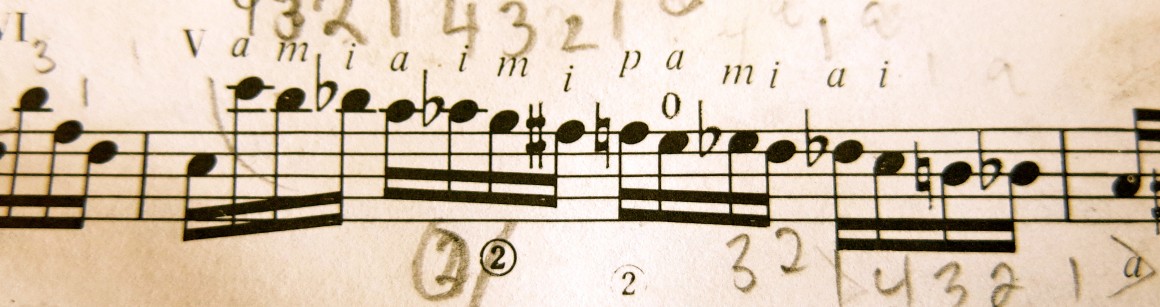
In general, focus on developing the skills you have worked on from the previous preparatory post in the more musical and sophisticated setting of scales: rest stroke, free stroke, string crossing, and very accurate transitioning from finger to finger. Use a metronome to track your progress and don’t be afraid to live in slow tempo world if it means you are becoming better and more consistent with your sound from note to note.

Rest-stroke fingerings: im, mi, ma, am, ia, ai, p, ami, ima, imam, amim, aimi

Free-stroke fingerings: im, mi, ma, am, ia, ai, pi, pm, pa, ami, ima, imam, amim, aimi, pmi, pami.

C Major Scale 3rd string major dia.jpgScale 4th string major dia.jpgScale 5th string major dia.jpg


C Harmonic MinorScale 3rd string har minor dia.jpgScale 4th string har minor dia.jpgScale 5th string har minor dia.jpg


C Melodic MinorScale 3rd string mel minor dia.jpgScale 4th string mel minor dia.jpgScale 5th string mel minor dia.jpg


Stay tuned (!) for the 3rd installment related to developing your scale practice where I’ll go through other scale forms.


Left Hand Technical Workout – Part 3

To conclude the left hand base building stage, we’ll expand our practice routine to include three finger movements and some four finger movements. While developing four finger movements is beneficial for overall functionality of the left hand fingers, three finger movements occur with a lot more prevalence in repertoire so I would suggest focusing on those first.

As in the previous base building workouts for the left hand, proceed through the steps sequentially.

Three Finger Movements – 124, 421, 134, 431, 123, 321, 234, 432

Four Finger Movements – 1234, 4321 (obviously, there are many more possibilities but I would argue that these two are the most important)

Step 1 – Start movements without slurs (example using 124)

slur124 no slur.jpg

For the right hand, using im either free stroke or light rest stroke is fine. Using thumb (p) throughout is fine as well. Keep in mind the focus should be on the deliberate and precise placement of the left hand fingers. Do not complicate things with nifty right hand fingerings. The right hand technical workouts are coming soon!

Step 2 – Incorporate slurs (examples using 124 and 1234)

slur124.jpgslur 1234.jpg

Step 3 – Build endurance

slur124 endurance.jpg

Explore these movements in several positions and you should be on your way to building a strong technical foundation to back your interpretations.

In the next installment, we’ll work on methods to build on this foundation to develop speed, flexibility, and finger independence. Stay tuned!