Studio Content
This content is restricted to Six String Journal Studio Members only. Join for access.
Tag: Practice
Technical Workout – Speed and Flexibility
I’ve just published another workbook entitled A Technical Workout for Classical Guitar: Level 2 – Speed and Flexibility.


Like A Technical Workout for Classical Guitar: Level 1 -Base Building, it expands some basic building block movements to help the guitarist develop a strong technique through the use of rhythms, extensor movements, and fixed fingers.
Miracle Right Hand Warm Up Sequence
Here is a warm up sequence that I used to do every morning. It is useful for building right hand endurance, finger alternation, speed, pulse, rhythm, and legato. The idea behind it is simple. Set the metronome to a very slow beat, somewhere (50-70). Throughout the whole sequence, the beat remains constant but with very slight and precise increments we increase the number of notes between the beats.
I would go through all 13 steps (using free stroke) and then go through the whole thing two more times using different right hand fingerings am and ai . . .
Studio Content
This content is restricted to Six String Journal Studio Members only. Join for access.
Left Hand Speed Development, Part 1
I’m working on A Technical Workout for Classical Guitar, Speed and Flexibility, and I thought I would share a portion relating to extensor development in the left hand. I will try to post a video to support this but here is something to keep everyone busy.
Excerpt from up and coming book:
Speed in the left hand is determined by several factors but two of the most important ones are the time it takes the finger to achieve precise placement on the fret and the time it takes the finger to release and reload for the next placement. The former movement depends on the flexor muscles of the fingers which are constantly worked in an active fashion (we typically focus our attention on placement) and the latter movement depends on the extensor muscles of the finger (we typically do not focus on this aspect of the movement). In a way, descending slurs work the extensors but we can be a bit more specific and pro-active about developing extensors in our left hand.
In order to develop the extensor muscles, simply place the finger and then actively release the finger back as quickly as possible achieving a slightly sloppy staccato effect with the left hand. This work does not involve the right hand at all. This movement is more strenuous than it sounds. When done correctly it almost sounds like light slurring. Keep the left hand finger placement accurate and keep the left hand contained so that it’s not the hand that is moving away from the fretboard but the fingers.
Complete Exercise 1 below with all the following left hand finger combinations:
Single Pair Finger Movements: 12, 21, 23, 32, 34, 43, 13, 31, 24, 42, 14, 41
Exercise 1 – Focus on the instantaneous release and post relaxation after the placement of each finger (example below using 12 and 21)

Good luck!
Ricardo Gallén on Technique
I just came across some newly posted videos of Spanish guitarist extraordinaire, Ricardo Gallén, performing Leo Brouwer’s Sonata Nº4 Sonata del Pensador. The piece is dedicated to Ricardo and whether or not this is the premier or not, it is a fabulous performance.
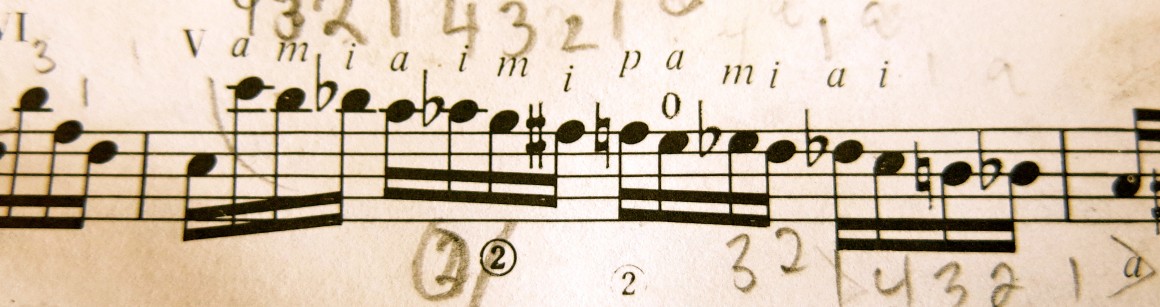
Then, as often happens, I find myself watching more videos than I really have time for. There is too much to learn. In the next video, Ricardo gives a masterclass with demonstrations and a tremendous amount of insight. Some of the topics he discusses relate to using percussive practice in the left hand when playing fast, drawing on the metaphor of the difference between walking and running. When we walk, our feet plant fully as we balance to lift and take the next step. When we run, we are pounding lightly a bit more percussively. Translated back to guitar, if the left hand holds down and luxuriates on the fret, energy is lost and tempo slows. Ricardo plays an excerpt of Villa-Lobos Etude Nº2 to demonstrate (around minute 17). The key point is that because the left hand is acting more percussively when playing fast, part of the sound comes from the left hand, so that the right hand can relax, aiding in speed.
Another point he makes (around minute 19) is the unbalanced nature of playing guitar. Instinctually our hands want to act together (thought on this in a recent post about neural coupling), squeeze together, let go together. When playing softly or piano in the left hand but the right hand plays loudly or forte we must practice compensating for the discrepancy in energy between both hands. These are brilliant points to ponder. Undoubtably, there are more insights but I’m dying to go practice…
A Technical Workout for Guitar
Studio Content
This content is restricted to Six String Journal Studio Members only. Join for access.
No Numbers Challenge
Studio Content
This content is restricted to Six String Journal Studio Members only. Join for access.