Artist Spotlight and Interview: Patrik Kleemola

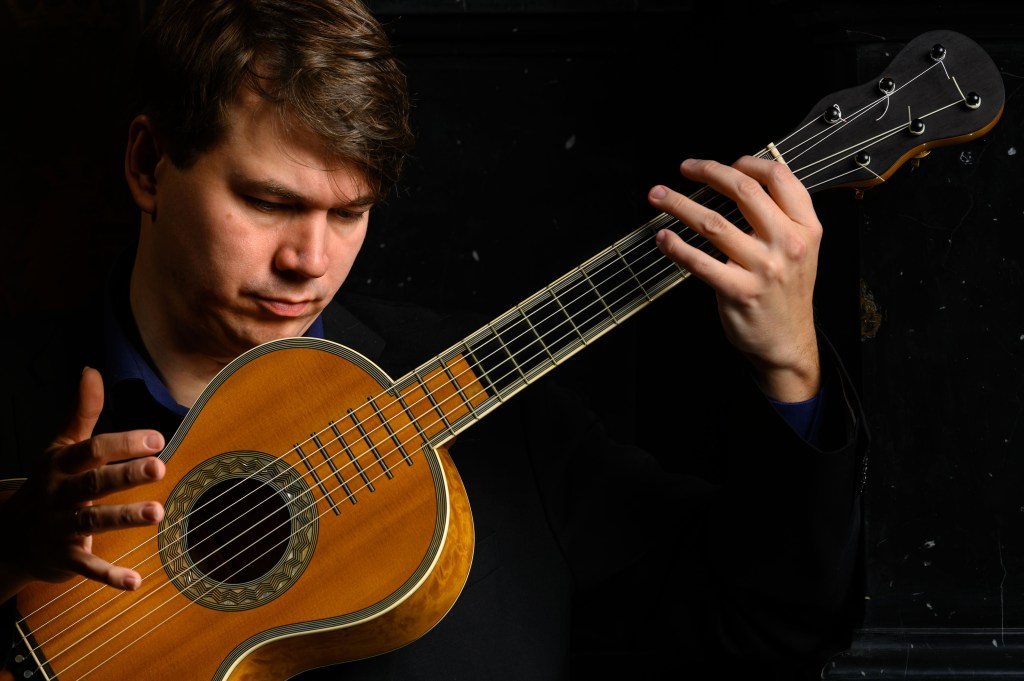
Photo credit:Tuomas Kourula

Hailing from Finland, guitarist virtuoso Patrik Kleemola recently sat down with Six String Journal to share some insight about his artistry and his journey with music. An active performer, educator, and chamber musician, Patrik is immersed in many projects, from recording whole cycles of etudes to concerts dedicated to one composer. His wonderful YouTube channel highlights his affinity for 19th century music; all performed on exquisite period instruments. His recordings of guitar repertoire across the centuries are wide-ranging though and are just as magically musical and engaging. Hope you enjoy this interview as much as I did.

PERSONAL
When did you start playing and why? Or, what drew you to the guitar initially?
There was my father’s semi-acoustic guitar in our house while I was growing up and before I entered for the guitar lessons in the city of Valkeakoski’s Music institute I knew some basic chords and how to play the main riff of Roy Orbison’s Pretty Woman. My grandfather from my mother’s side was in his youth an accordion player playing gigs professionally around the time of the 2nd World War and the war between Finland and Russia. Otherwise I’m the first professional musician in the family.

What repertoire do you enjoy playing the most?
To me probably the best thing in being “a classical musician” is the great variety of styles throughout the centuries and having a chance to dig in deep to the different styles, musical langueages and the culture. Whether it’s the French baroque style of Lully and De Visée, playing early romantic guitar repertoire by Sor and his contemporaries with an original Lacote guitar, playing Tárrega transcriptions of the great romantic piano literature or commissioning myself new pieces from contemporary composers, the great variety is the most rewarding thing.


What guitar or guitars do you perform on? Strings?
This past summer was a special one as I performed many concerts on an original René Lacote (1839) and Jose Luis Romanillos (1979). With Lacote I have done already some video recordings on my YouTube channel (more coming soon!) and I’m looking forward to do new recordings with Romanillos in 2025 and share those with followers of my channel. I also have played for ten years with a Rinaldo Vacca guitar made for me in 2014 and with this I have done many recordings and concerts. I have played a long time with Savarez strings and also have had a good experiences with Thomastik trebles which I use regularly. When playing with Lacote one has to be well aware of the maximum tensions of different strings in order to use them safely on the guitar. I usually use Ambra 800 by Aquila strings on my Lacote. I also try to experiment with gut strings but it’s challenging when playing with nails. However in the early 19th century many played with nails including Aguado, so it should be possible so I keep searching for the best gut strings that work with nail-playing.

Which guitarists/musicians have had the most influence on you?
In my early teens the Julian Bream’s Guitarra video series was a fascinating documentary on the history of the Spanish guitar with passionate and colourful performances by Bream through-out the series. Later on the many great pianists such as Arrau, Cherkassky and Lupu interpretating the incredible repertoire written for piano have been an inspiration. Although now as I have been more involved in the research of the early 19th century guitar repertoire, its technique and general approach, I have realized that the improvisational approach and ornamenting the repeats, for example, have been a vital part of the performance practice of the musicians at the time. In general these great pianists, as prime examples of the great musicians of the last century, didn’t dare to touch the “sacred texts” of the great composers. However this wasn’t the way Liszt, Hummel or Sor approached their performances in the early 19th century. I try get closer to this early 19th century tradition although I feel I’m still in the beginning of the journey.


What recording(s) are you most proud of?
There are two CD solo recital recordings that I did on the works that I commissioned from the Finnish and Italian composers Perchitarrasola (2012) and Through Green Glass (2015) by Pilfink Records and I’ve also been on other commercial recordings as well. The change in record business industry during the last decade have made me, and many other musicians, to think the reason to put out new commercial recordings. In the meanwhile I’ve released many video recordings on my

YouTube channel including series of pedagogic guitar literature including the complete set of Estudios sencillos by Leo Brouwer, 25 Studies by Carcassi, Sor studies op. 6 and op.35 and selection of 12 Studies by Aguado. During the COVID-19 period I did 18 works by Tárrega, a Baroque selection and rarely performed Sor masterpieces played on Louis Panormo (1838) guitar. I’ve done recordings of Sor duos with my former teacher Timo Korhonen. As an artist I think it’s important to document one’s activity (commercially or not) and the YouTube channel has now over 7000 subscribers so it has gained some following.


What are some up-and-coming projects (recordings, concerts) you are excited about?
I’m going to do more Sor recordings on my René Lacote (1839) and later on I will include also other composers from the period. Looking forward to record some of the great 20th century repertoire on the Romanillos in 2025. All these I will be released on the YouTube channel, free for everyone.

The past Autumn has been very hectic with concerts of different programs including solo recitals, chamber music with strings, Concerto by the great Finnish composer Mikko Heiniö for guitar and choir and premieres of contemporary music. Besides playing a lot in Finland I’ll be playing in Italy in December and returning there in March to play in Rome which follows concerts in Germany and Japan. There will be other concerts abroad as well to be confirmed so 2025 will be internationally quite active year for me.

I’m also going to start performing “Soirée Sor” concerts with my Lacote in 2025. Focusing a whole concert to just one composer will be an interesting challenge for me. I’ll be playing works by Fernando Sor from the early Spanish period to the last ones written in Paris. I’ll also talk about the incredible life of this fascinating composer which indeed had it’s dramatic turns, more than once.

TECHNIQUE AND PERFORMANCE
How much do you practice? And do you structure your practice in any particular way?
Some hours everyday, more or less. At the moment I’ve one year scholarship from the Finnish State so I have one year off from the Turku Conservatory where I work as a lecturer. This means I don’t have to teach so much, so I’ve even more time to expand my repertoire, be active on chamber music and playing concerts. I also try to give some time in my practice sessions to focus on refining the technique. There’s almost always some work I’ve commissioned from a composer so I’m active working with them which is very inspiring, trying to find out technical and musical solutions to textures that are not written by a guitarist.
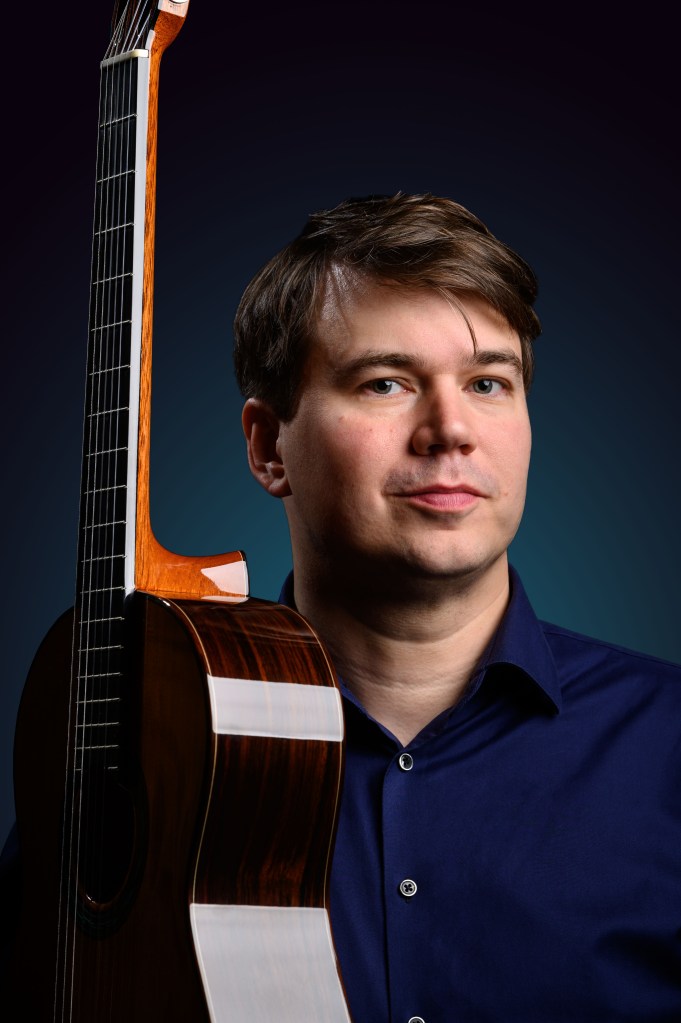
Photo credit:Tuomas Kourula

Do you deliberately memorize music or have a technique that helps assimilate music into
memory?

I still strive to play pieces by heart when playing solo recitals although expecially with contemporary works the score is sometimes needed. I don’t trust just to the muscle memory when memorizings works. If I can play the whole piece in my head without the instrument (concentrating mostly to the left hand movements), I’m confident playing the work in public.


Have you published any editions or do you plan to publish your own editions in the future?
I’ve been very involved in the prepration of the published works that I’ve commissioned from the composers from the pedagogic literature to solo works, chamber music and concertos. If it’s pedagogic literature (like Etudes by Markku Klami, see the YouTube playlist) then it’s good to have more fingerings in the score. If it’s very demanding contemporary work, then it’s probably approached only by professionals and these cases the less is more when it comes to fingerings.

I have done arrangements of works by Tsaikovski, Sibelius, Satie, Bach and others. I’m thinking to publish these, hopefully soon, with video performances on my YouTube channel.

Do you have a favorite drill or set of exercises you use to warm up?
I have certain patterns for both hands taking from here and there that I do if I have just 20 minutes for warming up. If I have more time I might take some of the many technique books I have and do something from there just for the fun of it.


Do you have any pre-concert rituals?
The rest is very important so I try have good amount of sleep the night before. I like to have a proper warm-up session on the concert day. I might go through the program during the day, but very lightly and not necessarely all of it. Usually I try to work quite hard the day(s) before and then just let it happen on the concert day.

ADVICE TO YOUNGER PLAYERS
What single most important piece of advice about practicing would you offer to younger
aspiring players?

Playing guitar is work of a long-distance runner. The talent is not enough and it’s also a talent to be able to work consistently and regularly.


What repertoire do you consider essential for young/conservatory students to assimilate?
I think in the early 19th century repertoire there are the main technical things that one needs in playing the guitar. However from my experience as a teacher it’s not always the most inspiring material for the young students. Also reading music on the guitar is not the easiest task for young students and often this is also slowing things down. So good mixture of interesting repertoire from the classical tradition and new pedagogic literature that perhaps reflects more closely the music kids hear in their everyday life.


Are you accessible as a teacher?
I teach as a lecturer in the Turku Conservatory and I’m available also for lessons online, although the latter I have to do according to my schedules which varies quite a bit.
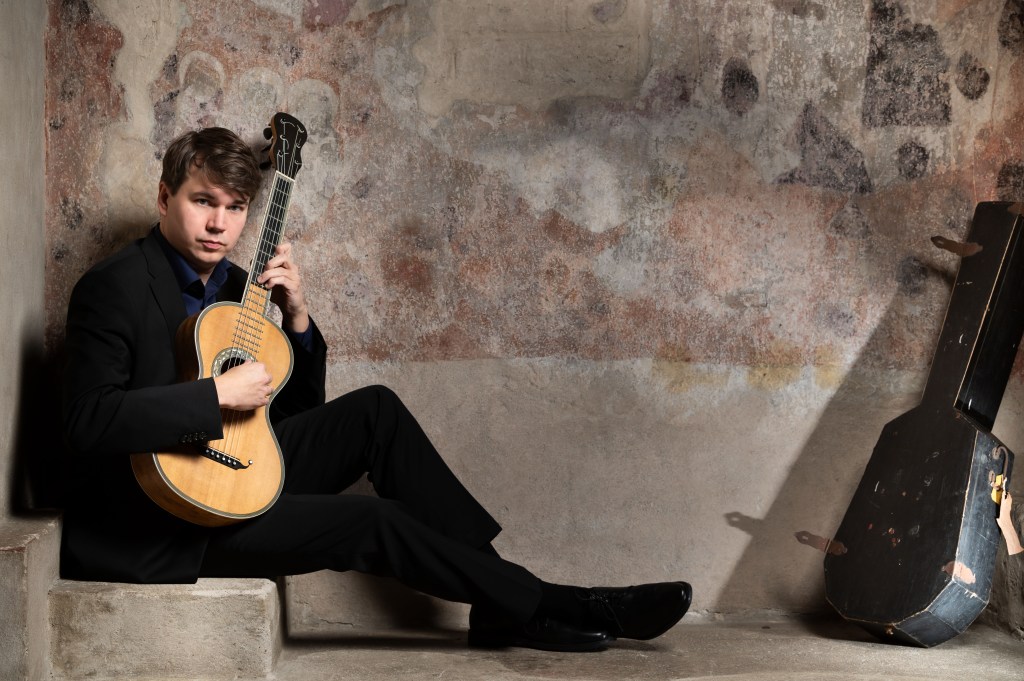
Photo credit:Tuomas Kourula

TANGENT
What is the last book that you read? Favorite author/s?
I just ended Madame Bovary by Gustave Flaubert. As I’ve been recently doing a research on Sor and the early 19th century guitar, it has inspired me to read a few books by the early 19th century French authors such as Balzac and Flaubert. Often music that I’m working open doors to choose the literature. Finnish composer Harri Suilamo wrote for me recently two guitar works inspired by the Austrian author Thomas Bernhard and I ended up reading a few books of this fascinating contemporary author.


What is your favorite way to spend time when not practicing?

Spending time with my family including our six-year-old son who is such an light of the day.

The Best Guided Warm-Up for Your Left Hand, Part 4

Here is Part 4 of a new series of guided warm-ups for my students and Six String Journal readers. In these guided warm-ups, I’ll go through some of the most important drills to help you establish a good routine for warming up before practicing your repertoire.

So go grab your guitar and get comfortable. In this second video, I’ve set the metronome for quarter = 60. We’ll go through the third part of my go-to slur routine, which involves three and four-note slurs (124, 134, 123, 234, 1234). For the right hand, I simply use p for strings 6, 5, and 4, and then use i, m, and a for strings 3, 2, and 1. Follow along, stay aware of good form, stay relaxed, and stick with it until you can start to increase tempo with a good foundation.

If you’re a beginner, take it slowly and don’t wear your hand out. Pause occasionally for rest and let your hand catch up. It might help to just watch the first few minutes to get a sense of how it unfolds for the fingers.

The Best Guided Warm-Up for Your Left Hand, Part 3

I’m in the process of creating a new series of guided warm-ups for my students. Here is Part 3 for Six String Journal readers. In these guided warm-ups, I’ll go through some of the most important drills to help you establish a good routine for warming up before practicing your repertoire.

So go grab your guitar and get comfortable. In this second video, I’ve set the metronome for quarter = 60. We’ll go through the second part of my go-to slur routine, which involves compound slurs (121, 232, 343, 131, 242, 141). For the right hand, I simply use p for strings 6, 5, and 4, and then use i, m, and a for strings 3, 2, and 1. Follow along, stay aware of good form, stay relaxed, and stick with it until you can start to increase tempo with a good foundation.

If you’re a beginner, take it slowly and don’t wear your hand out. Pause occasionally for rest and let your hand catch up. It might help to just watch the first few minutes to get a sense of how it unfolds for the fingers.

Great Exercise for Building Your Right Hand Skills

by Leo Garcia, © 2022

If you’ve been working on right hand arpeggios or etudes and find that alternation between m and a is not as comfortable as i and m (or i and a) then you’ve come to the right place. The exercises below will help remedy this problem. Simply because of our hand anatomy, independence between m and a is more difficult to develop, so I often suggest adding a bit of extra mama to the basic patterns most students use to develop their right hand position and their arpeggios. Adding a little bit extra mama consistently will pay off over the course of weeks, so keep at it.

Here are the six patterns I encourage students to practice regularly:

Here is pima with extra mama (I like to add some activity in the left hand but it is not necessary):

pima + mama

Continue through the other patterns in a similar way. As always, use a metronome, strive for a consistent sound, and relax your right hand.

piam + amam

pmia + mama

piam + amam

pami + mama or amam

paim + amam

Good luck!

One-Time
Monthly
Yearly

Make a one-time donation

Make a monthly donation

Make a yearly donation

Choose an amount

¤5.00
¤15.00
¤100.00
¤5.00
¤15.00
¤100.00
¤5.00
¤15.00
¤100.00

Or enter a custom amount

¤

Your contribution is appreciated.

Your contribution is appreciated.

Your contribution is appreciated.

DonateDonate monthlyDonate yearly

From the Archives: Miracle Right Hand Warm Up Sequence

Here is a warm up sequence that I used to do every morning. It is useful for building right hand endurance, finger alternation, speed, pulse, rhythm, and legato. The idea behind it is simple. Set the metronome to a very slow beat, somewhere (50-70). Throughout the whole sequence, the beat remains constant but with very slight and precise increments we increase the number of notes between the beats.

I would go through all 13 steps (using free stroke) and then go through the whole thing two more times using different right hand fingerings am and ai. So, that’s 39 steps. I actually would go all the way up to fret 12 (3 cycles) and often would use a diminished 7th chord or some left hand variation to keep it interesting. Vary what you need. As you will notice, I’ve been more detailed in the first 3 steps and little by little have resorted to short hand as the basic sequence becomes evident.

Give it a whirl and let me know what you think.

Step 1

Right Hand Warm Up Sequence 1.jpg

Step 2

Right Hand Warm Up Sequence 2.jpg

Step 3

Right Hand Warm Up Sequence 3.jpg

Step 4

Right Hand Warm Up Sequence 4.jpg

Step 5

Right Hand Warm Up Sequence 5.jpg

Step 6

Right Hand Warm Up Sequence 6.jpg

Step 7

Right Hand Warm Up Sequence 7.jpg

Step 8

Right Hand Warm Up Sequence 8.jpg

Step 9

Right Hand Warm Up Sequence 9.jpg

Step 10

Right Hand Warm Up Sequence 10.jpg

Step 11

Right Hand Warm Up Sequence 11.jpg

Step 12

Right Hand Warm Up Sequence 12.jpg

Step 13

Right Hand Warm Up Sequence 13.jpg

Phew! Go back for more. You know it’s good for you.

One-Time
Monthly
Yearly

Make a one-time donation

Make a monthly donation To support content creation

Make a yearly donation

Choose an amount

¤5.00
¤15.00
¤100.00
¤5.00
¤15.00
¤25.00
¤5.00
¤15.00
¤100.00

Or enter a custom amount

¤

Your contribution is appreciated.

Your contribution is appreciated.

Your contribution is appreciated.

DonateDonate monthlyDonate yearly

Jacob Cordover Interview

With reviews praising his superb interpretations, his flawless technique, and his virtuosic mastery of the instrument, Spanish-based Australian guitarist Jacob Cordover‘s performances speak for themselves. He recently sat down for an interview with Six String Journal where he enthusiastically and generously shares details about his journey with guitar, the way he prepares for concerts, how he warms up, advice for younger guitarists, and even why he gave up on pre-concert rituals.


Personal

SSJ: When did you start playing and why? Or, what drew you to the guitar initially?

JC: My mother has told me that I first started asking to play the guitar when I was only three or four years old. As there was no guitar in the household, but there was a piano, it was suggested I start by playing piano. When I was about 10 years old however, my parents bought me a guitar and signed me up for Suzuki guitar lessons.

It was around this time that my father took me on a trip to the Philippines. One calm, balmy evening in Manila we went to a classical guitar concert. There, sitting in the open-air-theatre – or rather an old Spanish-style interior courtyard, two classical guitarists took the stage. It was whilst listening to this concert that I first had the realisation that I would be a musician, that the classical guitar would become my “voice”. I don’t know what it was specifically, but the sound of the classical guitar entered my ears and truly captivated me. As a child I also learned clarinet, saxophone, piano and sang in choirs, but for reasons beyond my knowledge, the guitar never felt like work, I always found great satisfaction playing the guitar.

What repertoire do you enjoy playing the most? 

JC: I don’t think there is any one – in fact, what excites me most about the classical guitar repertoire is the variety offered. I go through a lot of repertoire and change programs several times a year. Besides my solo work, I also play a lot of chamber music; with string quartet, as duo with guitar, oboe, violin, cello, voice and even once with cornett. I am equally happy playing music from the Spanish Renaissance as I am working with composers on new works, I love the music of Spain and South America, Bach and Giuliani equally. Life is full of differences and the music I play reflects that. There is so much variety in life and I like that there is always a piece of music to reflect, or emote, or console any possible mood or feeling. There is a time and a place for beauty, for pain, for virtuosity, for ugliness, for chords, for counterpoint, for the avant-garde and everything in between.

What guitar or guitars do you perform on? Strings?

JC: I have been playing Smallman guitars since 2002. All 5 of my CDs (three solo and two duo) have been recorded on either a 2002 or my 2006 Smallman guitars. However, in recent years I’ve been lucky enough to have multiple beautiful instruments at my disposal. I have been performing more and more on a fabulous guitar by the young Spanish luthier Elias Bonet. I bought one of his spruce topped instruments in 2015 and fell in love with the sound. It has much more of a traditional sound than the Smallman and is full of colours, fabulous clarity and a bell like projection in the trebles. I also play on a romantic guitar built by the Famiglia Vinaccia in 1915. The family continued building their guitars in the 19th Century style right through the middle of the 20th century, so this guitar has all the wonderful characterises of an original period instrument, but is only 102 years old.

I enjoy playing on a variety of guitars as the instruments are so unique. I like to try each piece on the different instruments to see what qualities the different guitars bring out in the music. My Smallman has a resonance and richness that makes melodies sing whereas the clarity and colours of the Bonet brings out the intricate textures and rhythms. The Vinaccia obviously suits the 19th century music with its rich vibrato and velvety sound, but also lends an intimacy to many more contemporary works.

I play exclusively on Knobloch Strings and use them on all my guitars. Depending on the concert, the stage, and the repertoire, I change between Knobloch Actives Q.Z. (nylon) Double Silver and the Q.Z. Sterling Silver strings, and always Hard Tension.

Which guitarists/musicians have had the most influence on you?

JC: There have been so many over the years, but my biggest musical influence was my undergraduate teacher in Australia, Timothy Kain. I also had a couple of lessons with the bassist Edgar Meyer and the violinist Lorand Fenyves which left a lasting impact on my playing. They both said things that I still think about to this day, even if it was only a simple impactful sentence. In addition, listening to some of the great players of today – like oboist Nicholas Daniel, cellist Tsuyoshi Tsutsumi, or the Assad Brothers – has influenced me by pushing me to always express the music beyond the limits of one’s chosen instrument, in my case, the guitar. For me, the Assad Brothers do this extraordinarily well; their articulation, sense of line and rhythm and their fluidity have always captivated me. I love the way they always make music, that happens to come from a guitar, that is to say, I never get the impression that the musical decisions were made because of the guitar, but often in spite of the guitar. As a duo, the Assad Brothers have found a way to go beyond the difficulties and technical limitations of the guitar and always play with singing lyrical melodies, a strong rhythmic pulse and a seamless rubato.

What recording/s are you most proud of? 

JC: That’s a tough question as I’m equally proud of all my CDs. Each of them for me represents a time in my life and playing, and each CD is the culmination of the long process of getting to know the pieces intimately, internalizing them and then recording a version of each work in my voice. Now, when I listen back to these discs they carry with them the memory of the process and artistic decisions from the point in my career when they were recorded and I am proud of having created an honest and true interpretation of each piece across my 5 CDs.

I’ll give you my highlights from each CD. From my first CD, Stélé, the title track carries with it the many conversations with the composer of the work, Philip Houghton who just passed away. I am still proud of this recording of his beautiful work.

My duo CD Songs from the Forest by the Australian Guitar Duo (with Rupert Boyd) includes many more Australian works, in which I think we capture the essence and colours of the Australian musical language.

An example from my second solo CD, Blackwattle Caprices is J.S. Bach’s Suite BWV 997, which was the culmination of years of studying this piece, listening to many interpretations, delving into performance practice and being especially influenced by the interpretation of Robert Hill.

In my Zoco Duo CD Historias (with Laura Karney, oboe/cor anglais), I am proud of the arrangements we made. Although the oboe / cor anglais and guitar is an unusual combination, we were able to highlight the colours, timbres and variety of the instruments and give a wonderful representation of the sultry power of this combination.

In many ways, my most recent CD, Expresivo, was the most difficult to record. Expresivo is an album full of the classical guitar favourites and the music that first captivated me when I started to learn the guitar – works by Tárrega, Albéniz, Granados, Barrios, Villa-Lobos, Piazzolla and others. I tried very much to play this music honestly, and the way I hear it, rather than trying to capture or imitate older recordings of this repertoire from the ‘greats’.

The result is something I’m immensely proud. I think my own arrangements and interpretations are different enough to be captivating, but familiar enough to do justice to the legacy of the greats. In fact, Ken Keaton wrote in the American Record Guide “Even if you already have these pieces in other performances, Cordover’s have such a distinct and attractive personality that it will be worth finding.” (ARG Nov/Dec 2016)

Are there any recordings that you consider have the finest recorded sound for guitar?

JC: Whilst I always have chosen to record with John Taylor because I love the sound he captures in his recordings, I would be hard pressed to mention any one as ‘the finest’. Again, I like the variety. For me it’s interesting to hear how different engineers and different performers want to capture the sound of different guitars and I believe these differences in the recorded sound are just an extension of the great variety of interpretation that makes each performer unique. I have always felt I can learn so much listening to a recording and trying to answer why someone played a phrase the way they did, or why they use that guitar, or those strings, or that recording engineer with that sound. What were they striving for and why?

What are some up and coming projects (recordings, concerts) you are excited about?

JC: My next project will be returning to Mario Castelnuovo-Tedesco’s breathtaking setting of Platero and I for guitar and narrator. Back in 2015 I toured Platero with my brother Gideon. Early next year we will record a CD of Platero and I am excited to be developing this project further; not just as a CD, but a live staged production and other multi-media collaborations as well. These stories are just spectacular and Castelnuovo-Tedesco’s musical setting, in my mind, borders on the divine. Here’s a link to a video I recently made of one movement (without the narrator) and here’s a link to a movement, Ronsard, with narrator.

I am also excited to be heading into the studio to record some of the contemporary works for guitar and oboe / cor anglais that my ensemble Zoco Duo have premiered over the last decade. We will be recording works by composers from Australia, Norway, Spain, the U.K., and the U.S.A.

As for live performances, I’m very much looking forward to performing an arrangement of Enrique Granados’ Valses Poéticos for guitar and orchestra in the closing concert of the Art Llobet Festival here in Barcelona on November 5th.  The waltzes are little gems and the orchestration gives adds so many new colours to this wonderful work.


Technique and Performance

How much do you practice? And, do you structure your practice in any particular way?

JC: I practice each and every day and aim for between 4 – 5 hours. I have the luxury of being exclusively a concert artist so can focus all my energy on honing my performance. I start each day with at least 40 minutes of warm-ups which include scales, slurs, RH cross-string exercises and tremolo study. On concert days, I like to be well warmed up and will usually aim for at least two hours of practice before a concert. Travel days are more difficult but I generally manage to get my warm-ups done as well as playing through some pieces or working on tricky passages, even if this has to be done at the airport, bus station, or at my hotel – before breakfast, after dinner, or whenever I can squeeze it in.

In recent years, I have tried to give myself a couple of “rest days” a year where I don’t worry about practicing, but I still enjoy playing guitar so much that even on my days off I often end up playing guitar for its own sake – either reading through new music or playing some old favourites. Always after doing my warm-ups of course!

Are there aspects of guitar that you struggle with or that you find you are still working on?

JC: I still pretty much work on everything because, well, as Pablo Casals once famously said “because I think I’m making progress”.

Do you deliberately memorize music or have a technique that helps assimilate music into memory?

JC: Often memorization just happens organically, but if I’m pressed to memorize a piece quickly, or especially when memorizing Bach (or other complex contrapuntal music) I try to use every possible technique. I will try to make sure I have the muscle memory (which I prove by trying to hold a conversation whilst letting my fingers play on their own), I try to visualize the score in my head, I try to visualize the left and right-hand fingerings, and if I really want to make sure I know a piece, I’ll get a piece of manuscript and write it out from memory – not just notes, but left and right hand fingerings as well. If there is one thing I’ve learned about live performance is that you never know what might distract you at any moment, and it’s nice to have the security that I really, really know a piece inside and out.

Have you published any editions or do you plan to publish your own editions in the future?

JC: I have made lots of arrangements, not just for solo guitar but also for guitar and oboe for my ensemble Zoco Duo. Publishing is certainly on my list of things to do as I’d love to have these arrangements publicly available, but for now, you can just hear them on my CDs.

Do you have a favorite drill you use to warm up?

JC: I have a fairly consistent set of warm-up exercises which I change up (for my own sanity) a couple of times a year. The first thing I always start with is a couple of cross-string RH exercises that were once shown to me, one by Pavel Steidl and the other by the Argentinean guitarist Lautaro Tissera. I then play through that month’s selection of Aaron Shearer LH slurs exercises, a rotating selection of Giuliani RH exercises, scales – starting with three repetitions of each note accenting the first of each grouping (mim imi or ama mam) then duplets (mi, im, am, ma) and if I feel I have time with the little finger as well (ca, cm, ci, ai etc). I also do repetitions of 4 then 2 on each note with ami (amia miam iami etc) – this way you’re always changing which finger you start the grouping on. I’ll then change it up to starting each new note with the same fingering. I do these right-hand variations whilst playing two octave scales from C to Eb, then three octaves from E to C (My Bonet guitar has a 20th fret!).

I then practice tremolo – starting slowly and most often whilst playing Recuerdos or Barrios’ Una limosna por el amor del diós . I always start p and a finger together (i.e. p&a mia, p&m iam, p&i ami, etc), then a 5 tremolo  tremolo  (piami) then the regular tremolo  but either changing up the order, or putting accents of different RH fingers (i.e. pami, pami, pami, pami, etc.).

Do you have any pre-concert rituals?

JC: I learned over 10 years ago to abandon any pre-concert ritual. My teacher had once told me to try and think of a concert day as any other day so that you can get on stage and play as calmly as you would in a practice room, or on any given Tuesday. That really hit home at a series of concerts I did in the mid-Pyrenees back in 2006 or 2007; performing each night in a different ancient church. Often, there were no bathrooms, no places to wash your hands, no regular eating schedule, no guarantee of a chair at the ‘right’ height and so on. I learned that having a ritual could be dangerous, so learned to perform regardless of the situation.

This has been great when having to get off a long flight and go straight to a live TV or radio interview or if there is traffic and you arrive later to a concert than is ideal. The only thing that stays consistent is I always play at least a 10 minute expurgated version of my warms-ups backstage, and I try to carry a bag of cashew nuts in case I need an energy boost. Oh, and a nap. I always squeeze in a nap if it’s possible, even if it’s a short 10 minutes on the couch in the Green Room.


Advice to Younger Players

What single most important piece of advice about practicing would you offer to younger players?

JC: To practice actively and not passively. It’s amazing how much more productive a practice session is when you’re actually listening to what you are playing and thinking about what you’re doing. If you’re not paying attention, you’re not practicing you’re just playing. There is a time and a place for this “playing” too, but it’s not practice.

I also think it’s essential to practice performance. If I have a recital coming up, and especially if I’m perfomring a work for the first time, I will try to replicate the performance experience as much as possible. I give myself some time for a warm up, I walk to my chair, bow, and start to perform. Sometimes I do this in my living room to a tape recorder, sometimes to an audience of friends. I will often (more often than not) do this in performance clothes too. In my mind nothing prepares you for a concert more than playing concerts, so even if I don’t have an audience I will practice the performance aspect. I will practice my spoken introductions to the pieces, practice playing the pieces in the program order with no breaks, practice the tuning peculiarities between pieces. This can be as essential as practicing the notes.

What repertoire do you consider essential for young/conservatory students to assimilate? Why?

JC: I would say that variety is actually very important. Young students need to learn that there are differences, both stylistically and technically, between playing Bach and Barrios, or Walton and Weiss. Studies are also essential. It can be nothing but beneficial to slowly and carefully work your way through all the Sor, Villa-Lobos, Brouwer or Dodgson studies, to name just a small handful. Studies are a great way to train oneself to play music, and to play musically, in spite of technical difficulties.

Recordings that every young guitarist should be familiar with and why?

JC: Again, I’d say variety. The differences between Segovia, Bream, Williams, Russell, Diaz, Presti/Lagoya etc. are so vast. I think guitarists should actively listen to the same piece played by as many guitarists as possible, then decide not just which one they prefer, but why!?! There is no right or wrong way to approach a piece, it’s just a matter of taste. Listening to the infinite possibilities can only strengthen one’s own conviction and reasons for playing the way one does.


Tangent

What is the last book that you read? Favorite author/s?

JC: I just re-read Albert Camus’ short story The Artist at Work. A wonderfully satirical yet poignant story of an Artist who battles with the will to work and the distraction of ‘fame’ – a concept that is both curious to the artist and at the same time irrelevant to his work, but nevertheless something that dominates all. I also recently re-read Music of Chance, a fabulous book by one of my all-time favourite authors, Paul Auster.

Do you try to stay healthy? Exercise? Follow a particular diet? Have a favorite pre-concert food?

JC: I swim a lot; when I’m not on tour I try to swim 3 – 4 times a week. I also have a series of Yin Yoga postures and stretches that I do regularly, if not daily. With all the traveling and guitar playing I do, I’m finding it more and more important each year to keep the body moving and healthy, and in positions that are as antithetical to guitar playing as possible!

Do you meditate in any way?

JC: I don’t mediate in a traditional sense; however, I do find swimming laps concentrates my mind and allows me to focus only on my breath alone which clears out anything else.

What is your favorite way to spend time when not practicing?

JC: I like cooking and all things food related. Nothing makes me happier than having a group of friends around, lighting up the grill and spending the day chatting, cooking, eating and drinking. To be honest though, a guitar usually makes its way out of the case at some point!

Any things else you’d like to add?

JC: Thank you for your interest in my music and for listening to my answers! I hope your readers enjoy listening to my music as much as I enjoy making it.

SUPPORT JACOB’S MUSICAL JOURNEY:

Coordination and Right Hand Arpeggios

One of the easiest ways to improve right-hand arpeggio studies like Heitor Villa-Lobos’s Etude Nº1, Leo Brouwer’s Etude Nº6, or Francisco Tárrega’s Estudio Brillante, or the parts of pieces where arpeggios occur for an extended time is understanding when exactly the left-hand fingers must place or release to prepare for the next note or chord formation. Often, fingers are placed too early or too late, and both situations either overexert the fingers, the nerves, or worst of all, the musical intent. Arpeggios are, after all, broken chords. It is very rare that all fingers should place at once if they come in ‘broken’.

Sequential planting of the left-hand fingers is a skill that choreographs left hand movement to a deeper and more subtle level than simply grabbing at the next chord frantically at the start of a measure.

Here is a simple but effective exercise to help develop the principle of timely left-hand finger placement. The key is to time the placement of the new finger in relation to the meter and when it is due to enter and to avoid arbitrarily placing it at the beginning of the measure.

Go through each exercise a few times plucking every single note of the arpeggio. Once this feels comfortable and the timing is starting to feel synced with both hands, slur the entering note in time to develop a sense of pulse in the left hand, too.

Exercise 1

right hand ar[eggio coordination.jpg

Exercise 2

right hand ar[eggio coordination 2.jpg

Exercise 3

right hand ar[eggio coordination 3.jpg

Exercise 4

right hand ar[eggio coordination 4.jpg

There are infinite ways to expand this concept but one of my favorites is to move into cross-rhythms with accents. My idea of fun!

Exercise 5

right hand ar[eggio coordination 5.jpg

Explore your arpeggio pieces to see if you can apply this concept and let me know if it helps!

Francisco Tárrega’s Technical Studies

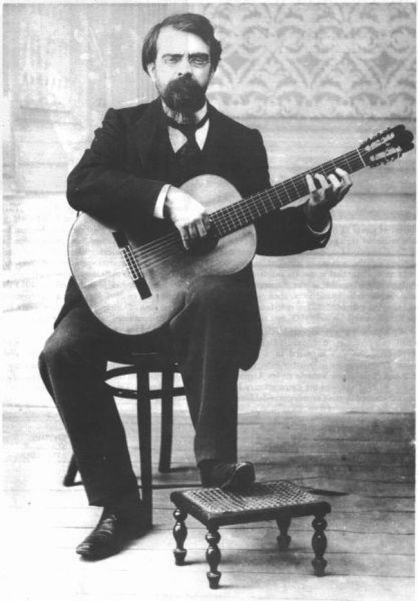
francisco-t-rrega-recording-artists-and-groups-photo-1My usual morning consists of a good warm-up (a combination of left hand movements and slurs, right hand alternation movements and arpeggios, and scales), before moving on to practicing spots in pieces, and finally playing through pieces and working on new pieces. However, there are periods of the year where I have more time to extend my technique practice and to learn new pieces. I’m approaching that period now (yeah!) so I’m experimenting with new finger gymnastics to address weaknesses in my technique and building a hearty list of new repertoire to absorb over the summer.
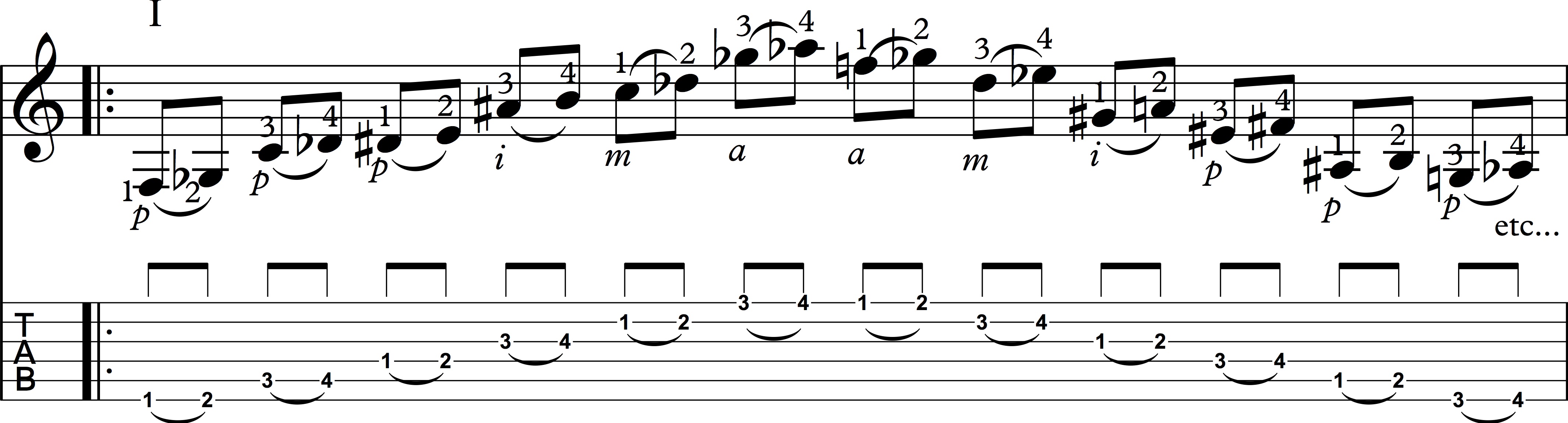
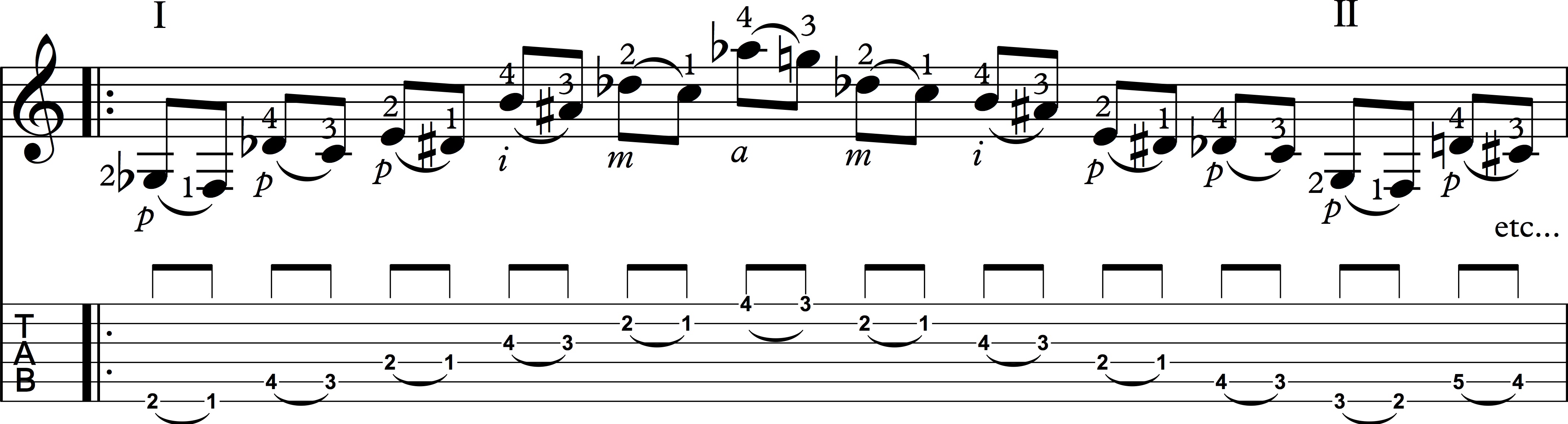
To this end, I was rummaging through my boxes and shelves of music and found a well-worn copy of Francisco Tárrega’s Complete Technical Studies. I pulled it out and went through it again for fun. If you’re looking to shake up your routine, I highly recommend some of his studies.

Below are two of Tárrega’s left-hand exercises that will surely make your left hand sweat. Tárrega notates using im alternation for the right hand but I prefer to simply assign i, m, and a, to strings 3, 2, and 1, and have p play all the bass strings to preserve my nails.

Exercise 1

Tarrega Exercise 33.jpg

Exercise 2

Tarrega exercise 34.jpg

Try going from 1st position all the way to 9th and back. Also, try the same concept with other sets of left hand pairs: 14 and 23 or 13 and 24.

Hope that gets your left hand going!


Want Speedy Scales?

Want to feel more accurate when playing through your pieces? Want speedy scales? Want fluid arpeggios? Want to be a guitar superhero? Work on basic movements. Hard work on the very basic movements of technique allows an inner exploration of our limits and abilities while giving us a bit of a roadmap for quantifiable and steady improvement.

Below are some very basic right hand drills that find their way back into my warm-up and finger routines often. It’s not that I need to practice them much anymore but rather they allow me to continually refine the most important movements necessary for pleasurable music making. They also allow me to set both short and long term tempo and endurance goals.

Try going through each of these three drills with the suggested fingerings. If you are more of a beginner, spend time on the bold faced fingerings, if you are more advanced, go through all fingerings in search for what does not work well, then focus your energy there. Don’t neglect the basics, though!

Follow these guidelines:

  1. Use a metronome and start slowly (quarter = 50-60).
  2. Go through each drill at least 3 times (I do 5 if I have time) with each fingering. Increase tempo slightly for each one.
  3. Do not sacrifice clarity and movement efficiency.
  4. Focus on the quality of the movements and the sound.

Fingerings

Rest-stroke fingerings: immi, amma, ai, ia, ami, ima, imam

Free-stroke fingerings: immi, ammapipm, ai, ia, ami, ima, imam, pa, pami, pmi

For patterns involving three fingers play three repeats to hit all permutations.

Exercise 1

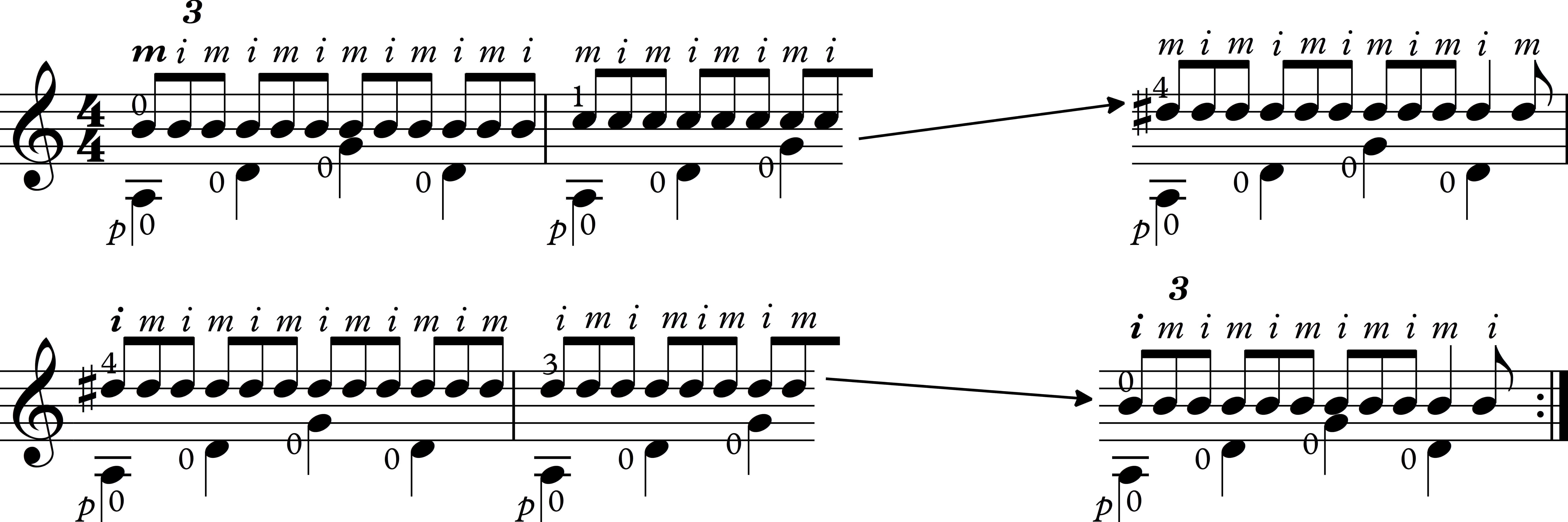
Technique Cheat Sheet 1.jpg

Exercise 2

Technique Cheat Sheet 2.jpg

Fingerings

Play the following drills using free-stroke and by relegating each right hand finger group across the three strings (for example, with ima, place i on string 3, m on string 2, and a on string 1).

Play each of the seven movements for at least 4+ repetitions or set a timer for 30-45 seconds.

All free-stroke: ima, pim, pma, pia

Exercise 3

Technique Cheat Sheet 3.jpg

Try dedicating 60 days in a row (or with as much consistency as possible) to these movements and you will see results. Also, if you want a simple goal. Try to get each movement up to quarter = 126 over the course of the 60 days. Or, shoot higher! Why not?

David Russell Technique Talk

David Russell is a guitar hero for many reasons but one of them is for his ability to make everything he plays look effortless. Here is another masterclass snippet where he provides insightful guidance on the importance of a proper warm-up routine. He makes the analogy to sports, where warming up the muscles for practice helps to refine the motion and muscles necessary to perform efficiently. If muscles are not warmed up, larger muscles take over causing imbalance and tension.


Even if you do not speak Spanish, you can follow David’s crystal clear and carefully conceived approach to warming up. Nevertheless, I’ll summarize a few key points:

  1. Start with very simple movements in the left hand like ascending slurs with all the pairs of fingers (12, 23, 34, 13, 24, 14).
  2. Move on to the right hand and work on perfecting a single finger free-stroke with each finger (i, m, a, p)
  3. Go back to the left hand and work on descending slurs (21, 32, 43, 31, 42, 41).
  4. Back to the right hand to work on alternation between pairs of fingers (im, mi, ma, am, etc.). During this time, focus on the effort and resistance it takes each finger to pull through the string. Adjust nails as necessary to create equal resistance. Otherwise, there is imbalance and this will compromise your fluidity. Also, moving from i to m may be easier than moving from m to i. Your job is to make both directions feel as equal as possible.
  5. Move on to imimim, ama, mam, etc., then incorporate slight accents imi, imiama, ama, etc…
  6. Back to the left hand to try compound movements (121, 212, 232, 323, 343, 434, etc…)
  7. Back to right hand to work on imim, mimi, amam, mama, etc… then try doing these movements cross-string.
  8. Then bring the warm-up to a close by spending 10+ minutes coordinating both hands with scale fragments: im with 12, 23, 34, 13, 24, 14, mi with 12, 23, 34, 13, 24, 14, etc…

If you’d like a bit more detail and a program that follows this approach please check out my recent publication, A Technical Workout for Classical Guitar.