
Six Tips to Master Tremolo

Over the years, I’ve posted several times about tremolo technique and even wrote the book Mastering Tremolo. Check it out if you haven’t yet! Nevertheless, there are times when I decide to spend a lot of time working on certain techniques to brush up, improve, try new approaches, revisit, and revise. I did this with tremolo this week and though I may have mentioned them in my book, some stood out to me. Here are a few entries I wrote in my practice notes:

  1. The movement from p to a is key – This is a feel thing. Think of snapping with p and a. As p articulates the bass note, a lands with some energy. It is almost like they are landing at the same time but not quite, allowing the melodic note on the higher string to vibrate justy a bit more.
  2. Nails – Each nail has to offer identical resistance to the string so that the quality of evenness is built in. If you are negotiating different stroke strength from finger to finger, it is too much effort.
  3. Proximity – Watch fingers closely and observe their distance from the string before the contact point and subsequent stroke. If there is too much discrepancy between the lineup, it can lead to galloping.
  4. Evenness – When practicing slowly, evenness is very important for both the attack and the silence or momentarily planting between notes.
  5. Left Hand Softness – Make sure the choreography of the left hand is worked out well. Abrupt motions in the left hand to make shifts can manifest in the right hand as accents. Keep the left hand as relaxed as possible.
  6. Right Hand Fingers – Sometimes increasing the perception of space between the right hand fingers seems to help me even out the notes. Try it.

Four Essential Ways to Work on Tremolo

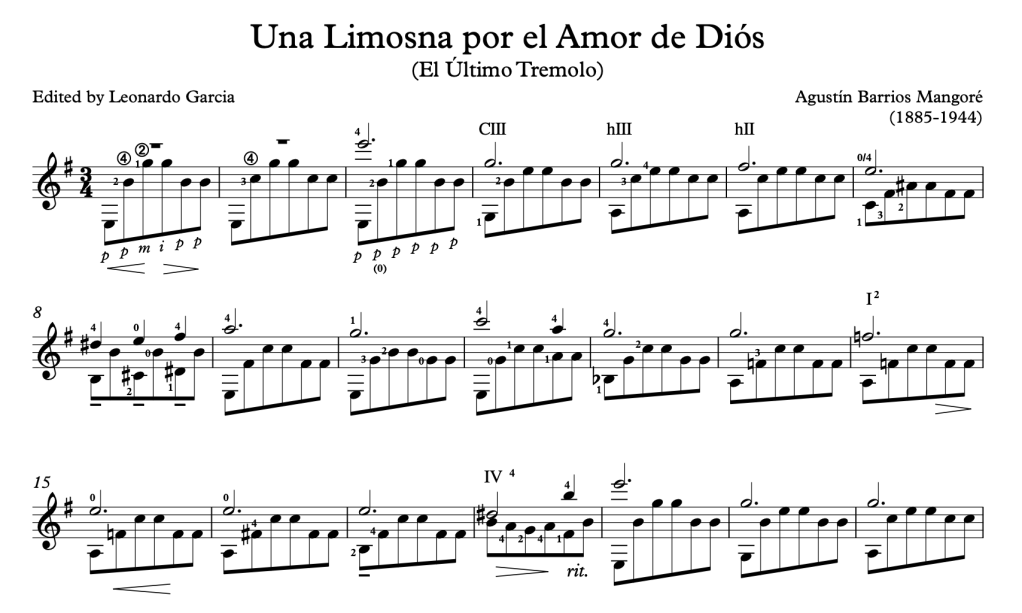
In the video below, I demonstrate four great ways to help your tremolo improve. Two of them I’ve outlined in my book Mastering Tremolo, which if you haven’t picked up, you should : ). But the last two I came across in Abel Carlevaro’s hand-written notes to himself in one of his editions of Agustín Barrios Mangoré’s Una limosna por el amor de Diós. Below you’ll find links to Mastering Tremolo and a NEW study score of Barrios’s Una limosna. Hope it helps.

Mastering Tremolo on Amazon

Mastering Tremolo on Podia

Una limosna por el amor de Diós (Agustín Barrios Mangoré) study score

Maya Kazarina playing Barrios and Koshkin

I stumbled upon this video of Maya Kazarina, a tremendously gifted young guitarist, filmed during the final of a competition she obviously won! Here she plays Agustín Barrios Mangoré’s well known tremolo piece Una Limosna por el Amor de Dios with sublime tremolo and Nikita Koshkin’s Usher Waltz with the brilliance and ease of someone well beyond her years. Enjoy!

Motivation from David Russell

Though the following video is in Spanish, David Russell offers a bit of an intimate motivational talk after a festival in Ecuador.

What I love hearing from him and what I hope students take away from this is the key and central point of hard work. As David says, “There are no shortcuts.”

Other bits of wisdom from the talk:

“Demand the most from yourself without losing sight of why you started in the first place.”

“Like compound interest, the hard work you do now will pay you back many times over in the future.”

And, this is where dedicated hard work gets you:

Tremolo and Sympathetic Motion Awareness

“You have to learn to do nothing.” —Pepe Romero

Watching legendary guitarist Pepe Romero teach tremolo was a revelation to me. One of his key points about finger movement in tremolo is timing the reload or return of a after m plucks (as if a and m were alternating) and not after i. As he explains the motion, the movement from a to the string is deliberate or active and from the instant after a plucks our attention moves to m while a unconsciously or passively relaxes. Essentially, the act of doing nothing releases a back to its place to ready for its next stroke. This is counterintuitive, as it would seem more natural to let a remain flexed after m due to the basic sympathetic motion of the fingers. But it is precisely in the case of tremolo that developing independence between a and m, and timing their return, can lead to a better sense of both rhythm and overall movement.

sympathetic Tremolo 1.jpg

Of all the techniques in Mastering Tremolo, focusing on timing the return of a, even for a little bit, has been most helpful to me in evening out my tremolo and reining in the gallop that often occurs into the next beat when playing at high tempos.

New Publication: Mastering Tremolo

After lots of hard work, I’m excited to announce to all of you the publication of my new book, Mastering Tremolo.

Here is a description: Leonardo Garcia’s Mastering Tremolo is an extensive guide for all aspiring guitarists wishing to develop solid tremolo technique. From a multitude of preliminary technical exercises and drills to develop a foundation for your tremolo and invigorate your technique, to more than a dozen active practice techniques detailed with musical examples to develop rhythmic precision, note consistency, tone, and speed, to the mental game of playing tremolo, this book will help improve your tremolo and playing regardless of your level.

It’s available in print and on Kindle.

Over the next few weeks I will post some content for Six String Journal readers!

Tremolo, Part 2

Happy 2017!

Any guitar related New Year’s resolutions? If one of them was to improve your tremolo technique, then this post is for you.

As we all know, tremolo is tricky. As I mentioned a while ago in the Tremolo, Part 1 post, the elements in place necessary for tremolo to achieve musical expressivity, and come across as fluid and natural, are rhythm precision, consistent intensity from note to note, uniform tone, and speed. Here are several tried and true ways of working on tremolo that always make my fingers feel more confident with tremolo.

Training for Finger Return and Speed

We can work on speed indirectly by changing the right hand pattern. This demands the return of each finger to prepare for its next stroke. Choose a large section of a tremolo piece you are working on and play it with the following fingerings:

  1. To develop the return of i practice pimi and piai.
  2. To develop the return of practice pmim and pmam.
  3. To develop the return of practice pama and paia. I would argue that pama is the most beneficial as a usually has a developmental deficiency.

After a masterclass at Antonio Lauro Festival in Venezuela 20+ years ago, phenomenal guitarist David Russell was fielding questions about technique. I think someone asked him how he did tremolo if he broke a nail. With his usual enthusiastic demeanor, he sat down and demonstrated, “If I break a, I play tremolo like this [pimi]. If I break m, I play tremolo like this [piai]. And, if I break i, I’m screwed!”

Training for Improved Rhythm

Another technique to improve pulse, rhythmic consistency, and control from note to note is a bit more difficult to master but well worth exploring. Set your metronome to a slow tempo at first and then practice a section of a piece or the tremolo pattern (pami) on open strings by setting the click to coincide with a. 

Limosna Example metro on a.jpg

Then apply the same technique by setting the click to coincide with m.

Limosna Example metro on m.jpg

And, finally, apply the same technique by setting the click to coincide with i.

Limosna Example metro on i.jpg

Here is a masterclass where David Russell demonstrates the technique with his foot instead of the metronome (15:41), and, incidentally, talks about a whole variety of relevant guitar issues – practicing technique, memorizing effectively, etc… You’re in luck if you speak Spanish.

Training for Improved Finger Placement

And, once you’ve practiced the techniques above, try playing expanded bits repeatedly focusing on planting the finger next in line after playing what’s in the brackets.

Play what is in the brackets. Plant a. Rest. Repeat 3x or more.

Limosna Example burst 1.jpg

Proceed to the next group.

Limosna Example burst 1 part 2.jpg

Continue with emphasis on the next finger for planting.

Play what is in the brackets. Plant m. Rest. Repeat 3x or more.

Limosna Example burst 1 part 3.jpg

Proceed to apply the same to i

Hope this helps!

Tremolo, Part 1

Over the years, I have never regretted working on tremolo pieces and technique. From early recordings of John Williams playing Barrios’ Una limosna por el amor de Diós and Un Sueño en la floresta to Pepe Romero playing Francisco Tárrega’s Recuerdos de la Alhambra and Sueño, these pieces are not only special but evocative in ways other instruments cannot replicate. The greatest players manage to give the illusion of an unbroken melodic line while maintaining a well-controlled accompaniment.

There are many skills that must come together to achieve a beautiful sounding tremolo. The most important ones are rhythm precision, consistent intensity from note to note, uniform tone, and speed. One of my favorite guitarists and dear friend, Marco Tamayo, once mentioned that the result of rhythmic regularity and precision created the illusion of speed. I’ll post various ways of working on some of these skills but we’ll look at rhythmic precision first.


The following set of exercises help develop rhythmic control by practicing the tremolo pattern (pami) precisely within the whole of the main beat. When going through the exercises try to remember the inherent hierarchy of the meter and aim to feel p as the main beat. Start slowly with your metronome set to the sixteenth or eighth note. One way to truly feel “in the pocket” with the rhythmic subdivisions is to say the rhythmic breakdown aloud as you play (tee-ka-tee-ka, one-ee-and-ah, etc…). Spend a lot more than one repetition on each pattern. Remember, even Steven!

Exercise 1

Concise Technique Tremolo 1.jpg

Exercise 2

Concise Technique Tremolo 2.jpg

Exercise 3

Concise Technique Tremolo 3.jpg

Exercise 4

Concise Technique Tremolo 4.jpg

After spending a lot of time on the above exercises, you can expand them by varying the string and displacing the thumb onto adjacent or distant strings.

The next set of exercises help develop uniform intensity by changing the initial finger of the tremolo so that every right hand finger within the pattern has a moment to shine in the downbeat spotlight. Think of it like shifting accents in a subtle way.

Exercise 5

Concise Technique Tremolo 1b.jpg

Exercise 6

Concise Technique Tremolo 1c.jpg

Exercise 7

Concise Technique Tremolo 1d.jpg

Again, vary the thumb’s string as you start to gain proficiency and spend lots of time on the weaker patterns. Good luck!











