The Pakhomkin System: A Structured Approach to Efficient Practice
By Piotr Pakhomkin
Many guitarists practice for hours and make very little noticeable progress. The problem is rarely a lack of proper motivation—it’s a lack of discipline and structure. Over years of preparing for stages from Carnegie Hall to the Kennedy Center, I’ve developed a fixed system that replaces vague “practice more” advice with a specific sequence, applied the same way every session. I call it, simply, the Pakhomkin System. Follow these seven steps, always in order.
I. Prepare the score once, properly.
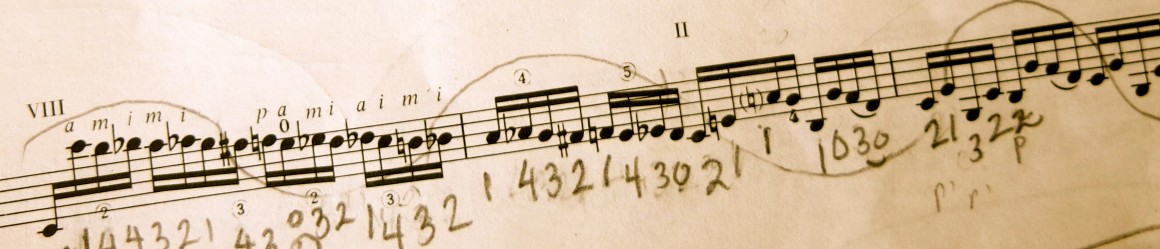
Every left- and right-hand fingering, every expressive marking, gets written into the score in full before serious work begins. If the fingers forget a passage of music during its break-in period, that’s absolutely human. Coming back to a piece of music after a break from practice and having no memory of how it was fingered is a preparation failure and an avoidable one.
II. Eliminate mindless repetition.
Every repetition, from the very first note of the session, is held to the same standard as a performance. This isn’t a prohibition on warming up—it’s a refusal to let “practice” mean idle repetition without a target. If a passage isn’t ready to be played correctly, the answer is to isolate and slow it down, not to run through it hoping it improves on its own.
III. Build a hierarchy of difficulty.
Mark the hardest passages in red and the moderate ones in blue, and leave the easy ones untouched. Red passages earn more frequent attention. Treating every measure in a piece as equally demanding is one of the most common ways serious practice time gets spent on passages that were never the actual problem.
IV. Set limits on repetition.
This approach runs against instinct. If a passage takes more than one to three slow, correct attempts to get right, the answer isn’t to repeat it harder. The answer is to make it smaller or slower. Repetition without accuracy doesn’t reinforce the music. It reinforces the mistake.
V. Apply the Varied Repetition Method
This technique is the system’s core, and its power comes from asking the brain something different each time:
First, play both hands together at roughly a quarter of concert tempo, entirely unmeasured—tempo ad libitum—taking as long as necessary between notes to achieve total precision. Second, the right hand alone, on open strings, isolating rhythmic stability without the left hand’s interference. Third, the left hand alone, in silence—no sound at all, building tactile memory of the shapes themselves. Fourth, a full visualization of every note in the passage, away from the instrument entirely. If the passage remains difficult after this cycle, one or two more unmeasured repetitions with both hands are added before moving on. Only once the passage becomes manageable does the metronome enter, at seventy-five percent of the final concert tempo, for one or two final repetitions.
Most guitarists reach for the metronome far too early in this process. If the fingers are still clumsy, a metronome doesn’t fix that. It simply rushes the clumsiness.
VI. Space the repetitions across the session.
Cramming every repetition of a difficult passage into a single block feels efficient and isn’t. Returning to that passage several times throughout the session, with other work in between, is what moves it from short-term recall to long-term memory.
VII. Respect the first repetition.
The first time a passage is played in any session must be clean — only the first attempt, before the fingers have warmed up. That first repetition is the only honest simulation available of what happens on stage: one attempt, with nothing to fall back on.
None of these seven steps are complicated on their own. What they share is a refusal to mistake motion for progress. This is the same discipline that differentiates practicing until you achieve something right and practicing until you no longer make it wrong.
The Pakhomkin System summarized
1. Score Preparation—Write every fingering and marking into the score.
2. Zero Mindless Repetition—every repetition is held to performance quality, with no idle playing.
3. Difficulty Hierarchy — red/blue/unmarked by difficulty.
4. Limit the Repetition — 1-3 correct slow reps or splice/slow down further.
5. Varied Repetition Method — use the six-part sequence (hands together ad libitum → right hand alone → left hand silent → visualization → optional extra ad libitum reps → metronome at 75%).
6. Spaced Repetition—across the whole session: Don’t cram all reps of a challenging passage into one block; return to it several times with other work in between.
7. First Repetition Rule — Within any single return to that passage, the very first attempt has to be clean, since it’s the only true simulation of a one-shot stage performance.
ABOUT THE AUTHOR

Piotr Pakhomkin is a classical guitarist trained under Manuel Barrueco at the Peabody Conservatory. He made his Carnegie Hall debut in 2018 with the Chamber Orchestra of New York’s Masterwork Series and has since performed at the Phillips Collection, the Kennedy Center Terrace Theater, and the Baltimore Basilica, with additional concerts and masterclasses across Europe, Canada, and Latin America. He performs chamber music regularly with members of the National Philharmonic and the National Symphony Orchestra. His 2024 Naxos recording with Yuri Liberzon has drawn international attention, and his playing has been praised by the Financial Times, NPR, and Classical Guitar Magazine.
As founder of the Georgetown Guitar Academy’s Pre-College Preparatory Program for Guitar, Pakhomkin has placed students at the Peabody Conservatory, Trinity Laban Conservatory in London, and the Hanns Eisler Hochschule in Berlin. His student Grace Elmer recently accepted a full-time professorship at the University of South Carolina. While teaching in Germany, one of his students placed nationally in the Jugend Musiziert competition and gained acceptance into the Mainz Hochschule Pre-College program.
Piotr teaches the full system to students at the Georgetown Guitar Academy in Washington D.C., McLean, Virginia, and Potomac, Maryland.
Thanks Leo…very helpful…if only my teachers and I had this approach 60 years ago!
Still helpful at 80!