Twelve Tips on Rolling, Shifting, and More

by Leonardo Garcia

I originally thought I would do videos to show some of the concepts below in practice but in anticipation of that I thought this might help some of my students so I’ll post it now. These are some recurring themes that I encounter in lessons that have solved a lot of little musical hiccups. Hope they help.

Chord Rolling

  1. When rolling chords where should the weight of the right hand fingers be distributed? I find that even though we tend to roll towards the a finger in a musical context that not ‘feeling’ the weight behind the i finger leads to a less rhythmic roll.
  2. Accompanying chords can sound really nice when subtly rolled. I recently listened to John Williams’s old Barrios recording and loved his playing of Choro de Saudade. He is very free with the harmonic background even when grooving.
  3. When playing an ornament with a bass note (like all over Capricho Árabe), I find that rolling the bass and first note of the ornament diffuses the rhythm a bit too much unless (maybe) it is a cadential ornament. Maybe not the best place to roll.
  4. Rolling p – Practice this to make it sound less like a guitar affectation and more like an organic roll. Or in the case of playing thirds in a piece like the Gran Solo (Sor), roll with the intention of it sounding like one note. Imagine both strings as one large string the thumb has to traverse in its stroke.

Shifting

  1. Shifting with a relaxed (or less rigid) left hand wrist always feel better and leads to less unintentional accenting when landing in the new position.
  2. Sometimes it helps to keep left hand finger pressure down before glissandos to minimize string squeaks.
  3. Always shift using a guide finger and always relax the left hand thumb away from the back of the neck prior to a shift.

Listening and Accountability

  1. As I play through repertoire, I find that shifting my aural focus to a particular voice can be disorienting sometimes because of the tendency to grow accustomed to ‘hearing’ the music unfold in relation to the melodic content most of the time. So I like to change it up by listening for the bass lines or by shifting my attention to the supporting voices or even to exaggerate (or exaggerate another voice) the melodic content to keep listening in new ways.
  2. Stop whenever something does not sound optimal and study that moment. Then place it back into context by a few notes or measures. Keep asking why and what. Why does it not feel comfortable? What do I want the phrase/pair of notes/background/melody, etc., to sound like? Can I make one note sound the way I want? Two? Why did it work? Can I replicate what is not working so I know how NOT to do that? If you keep playing something that you know doesn’t sound quite right, it is basically how you will play the piece. Don’t rely on luck, if you only nail it 1 out of 4 or 5 tries. Hold yourself accountable.

Speed

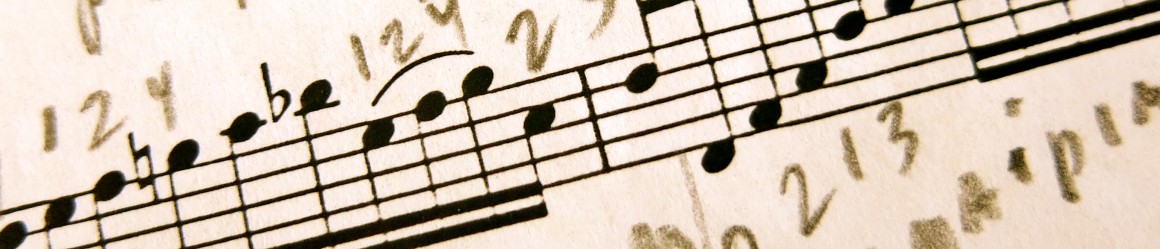
  1. Think of gestures especially during faster passages. Find groups of notes and tie them into one physical gesture that feels comfortable to do. Consolidate movements and placements to make many notes fall into one activity for the hands. This is why it is good to practice arpeggio formulas and scales in abstract.

Meter

  1. During scale runs, focus on hearing the main beat subdivisions. If you have 4 quarter notes worth of sixteenths, after working out the correct fingerings in both hands, spend some time listening and then aiming for the quarter beat or the half beat regardless of where the high point of the run is.
  2. Clarity in your playing is enhanced if you know where all the downbeats are in relation to your left hand (and right!). It sounds obvious but play though a piece and just think of downbeats and left hand. Try the same for downbeats and right hand.

Thanks for reading.

One-Time
Monthly
Yearly

Make a one-time donation

Make a monthly donation

Make a yearly donation

Choose an amount

¤5.00
¤15.00
¤100.00
¤5.00
¤15.00
¤100.00
¤5.00
¤15.00
¤100.00

Or enter a custom amount

¤

Your contribution is appreciated.

Your contribution is appreciated.

Your contribution is appreciated.

DonateDonate monthlyDonate yearly

Daniel Schatz plays Bach and Albéniz

I stumbled upon these two videos recently and I have listened and watched them multiple times. I keep returning to them. Serene, calm, magical, profound… I’m not sure what the right words are but Daniel’s interpretations are wonderful. If you want to read a great interview with Daniel here it is: Daniel Schatz SSJ Interview.

Technique Focus – Boost Left Hand Efficiency

Leo Garcia's avatarSix String Journal

When working out the choreography to a new interpretation there are a few aspects of left hand technique that can dramatically improve efficiency. One of those aspects involves a similar idea often referred to as ‘planting’ for the right hand. For example, when playing a rapid and repeated pim arpeggio (like in Asturias), it is common practice to place all three fingers down in a group to stabilize the right hand and to create one efficient gesture instead of three separate actions. The basic rule is that as we move away from p and towards a across string we plant fingers down so the right hand fingers are prepared. Essentially, we stabilize the right hand as we move away from the grounding of p and i.

Applying this concept to the left hand is equally important but the ‘planting’ occurs as we move from finger 4 (pinky) towards finger…

View original post 384 more words

Magical Performances from OMNI Foundation

One of the positive things to emerge from the pandemic has been the OMNI Foundation’s pairing of world class filming with world class guitarists from all over the world. I wanted to highlight a few of these OMNI on Location Series performances which I’ve listened to multiple times for their displays of stunning musicality, virtuosity, and beauty.

Alberto Mesirca plays Regondi

Carlotta Dalia playing Rodrigo, Scarlatti, and Piazzolla

Kristina Varlid plays Theodoroudis, Vasks, and Rodrigo

Great Marco Tamayo Interview on Tonebase YouTube

I just stumbled upon Tonebase‘s Marco Tamayo interview as it was live the other day (lucky me!) and thought I would share it here since there is so much valuable insight from one of the guitar world’s most gifted artists. As many of you already know, Marco’s command of the guitar is legendary. He is also a gifted educator who teaches at the Mozarteum in Salzburg. I’d also recommend checking out his technique videos on Tonebase (and if you use the code SSJ-30 you’ll receive 30% a subscription to all of their guitar videos after the free trial period).

Mateusz Kowalski plays Bach, Tárrega, and Ravel

Brilliant rising star of the guitar world, Mateusz Kowalski, just released a magical rendition of Johann Sebastian Bach’s Sheep May Safely Graze from Cantata, BWV208 and is about to release two wonderfully produced videos to bring in the New Year. Six String Journal is offering a preview here as a short recital to inspire those New Year resolutions.

In case you missed it, here is Six String Journal’s Interview and Artist Profile with Mateusz.

Enjoy!

Johann Sebastian Bach Sheep May Safely Graze from Cantata, BWV208

Francisco Tárrega Recuerdos de la Alhambra

Maurice Ravel Pavane pour une infante défunte

33 Ways to Improve Ears, Fingers, and Fingerboard Familiarity

Moveable Scale Forms for Development

by Leo Garcia

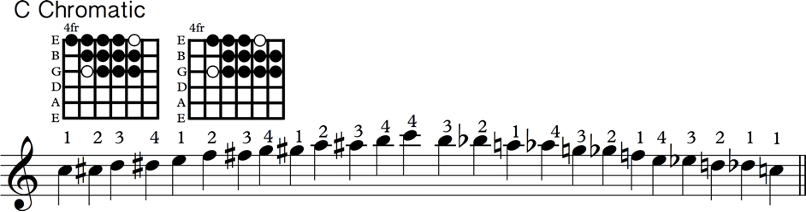
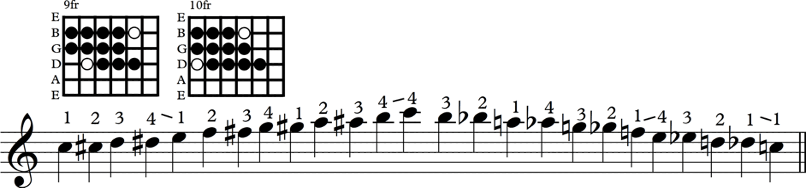
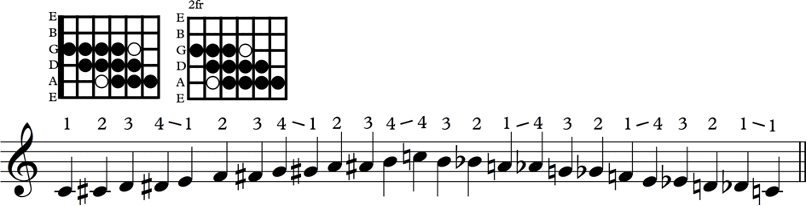
After watching Eliot Fisk demonstrate all of these, I thought I would write them out and share them with students. I have to confess that although I practiced scales religiously (and still do) I rarely ever went through modes. There are many reasons to work on these though: ear training, technique development, and for fingerboard familiarity.

The first form has the root starting on string 3, the second form has the root starting on string 4 and the third form works for both strings 5 or 6. Two-octave forms can easily be assembled by combining two forms. Scale diagrams have been included as I find them extremely helpful for visualizing the pattern as it falls on the fretboard.

There are 33 forms ahead, better get started. : )

For a pdf click here: Moveable Scale Forms


Here are some more resources for scale practice:


Leo’s Scale Book: https://sixstringjournal.podia.com/si…

More Guitar Publications: https://sixstringjournal.podia.com/

More Publications: https://sixstringjournal.com/music/

Leo’s YouTube Page: https://www.youtube.com/c/LeonardoGarciaguitar

One-Time
Monthly
Yearly

Make a one-time donation

Make a monthly donation

Make a yearly donation

Choose an amount

¤5.00
¤15.00
¤100.00
¤5.00
¤15.00
¤100.00
¤5.00
¤15.00
¤100.00

Or enter a custom amount

¤

Your contribution is appreciated.

Your contribution is appreciated.

Your contribution is appreciated.

DonateDonate monthlyDonate yearly

Leo Garcia plays Sonata in A Minor, K.175 by Scarlatti


Ever since hearing Eliot Fisk’s recording of this sonata, I’ve wanted to learn it. I tried Eliot’s brilliant transcription years ago but my smaller hands couldn’t even play it poorly. Then a good friend showed me French harpsichordist Jean Rondeau’s version and it rekindled the desire to learn it. This edition was transcribed by the Spanish guitarist Marcos Díaz, which is a bit more tame of a transcription but nonetheless it retains a good amount of substance on the guitar. I’ve changed some minor things that work better for my hands and for my ear. The manic quality of this sonata is another glimpse into Domenico Scarlatti’s fertile musical mind. It conjures images of chaos, bliss, seriousness, dementia, and lots of emotions that I cannot pinpoint. A bit trippy. : )

Leo Garcia plays Villa-Lobos Prelude Nº1

This is the first of five wonderful preludes by the Brazilian composer Heitor Villa-Lobos. With his gift for sorrowful lyrical melodies to the rhythmic and joyful interlude with its changing meters and Spanish flair, Villa Lobos creates a true guitar masterpiece which fully exploits the richness, emotional depth, and colors of the guitar. Hope you enjoy it.