Technical Workout for Classical Guitar – Level 1 – Base Building, Part 1 (video)

Here is the first of Six String Journal’s series of technique videos to accompany my recent workbook, A Technical Workout for Classical Guitar, Level 1 – Base Building. This video corresponds to Left Hand Movements, Part 1.

This workbook is designed to help late beginners and intermediate guitarists develop a daily routine of movements to strengthen their technical base so that fingers can do their job properly when assimilating new repertoire (that was wordy!). Always go slowly with the most control possible. Think of it as writing a program for your brain with no bugs.


Developing Coordination and Stroke Control

Whatever your musical intentions, developing evenness from finger stroke to finger stroke across various pulse patterns is an essential component to good right hand technique. One tool to develop this through scales is to pair three-finger right hand patterns (ami, pmi, ima) to duple rhythms, such as eighth and sixteenth notes, or two-finger patterns (im, am, ai, pi, pm, pa) to triplet patterns. Sort of like patting your head and rubbing your belly at the same time.

I’ll use the following Major scale form to illustrate.

Scale Warmup 1.jpg

Three Against Two

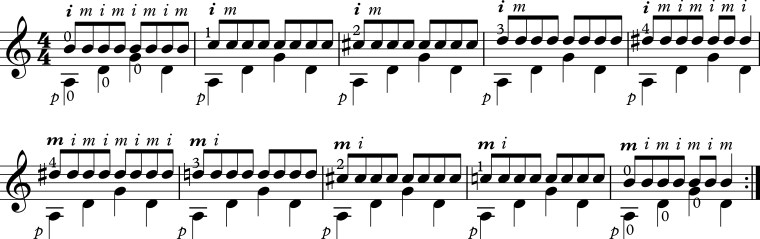
Step 1 – Play the following eighth notes using the following three-finger right hand fingerings: ami, pmi, ima. Focus on maintaining a clear duple pulse and a consistent tone quality from note to note.

Scale Warmup 2.jpg

Step 2 – Play the following sixteenth notes using the following right hand fingerings: ami, pmi, ima. Focus on maintaining a clear duple pulse and a consistent tone from note to note.

Scale Warmup 8.jpg

Step 3 – Once that is comfortable, you can further develop coordination between your hands by playing patterns that emphasize a duple feel continuing to use the right hand fingerings: ami, pmi, ima. Here are some of my favorites.

Pattern 1

Scale Warm Up 2a.jpg

Pattern 2Scale Warmup 2c.jpg

Pattern 3

Scale Warmup 2b.jpg

Pattern 4

Scale Warmup 8a.jpg

Pattern 5

Scale Warmup 8b.jpg

Two Against Three

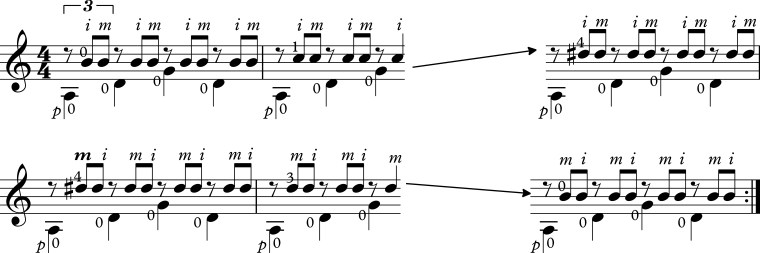
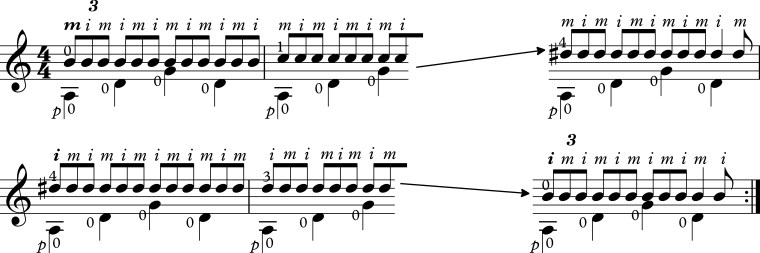
Step 4 – Play the following triplets using the following right hand fingerings: im, am, ai, pi, pm, and pa. The most important fingerings to develop are im, am, and pi so prioritize there first. Like before, focus on maintaining a clear triple pulse and a consistent tone from note to note.

Scale Warmup 5.jpg

Step 5 – Time to coordinate those fingers. Challenge yourself to play patterns that emphasize a duple feel continuing to use the right hand fingerings: im, am, ai, pi, pm, and pa.

Pattern 1

Scale Warmup 5a.jpg

Pattern 2

Scale Warmup 5b.jpg

Pattern 3

Scale Warmup 5c.jpg

Good luck and go pluck.
Building Scale Speed

I was warming up this morning and thought I’d post one of my favorite ways to work on scales to both warm up and build speed. I like this sequence because you can set the metronome conservatively and build up as you play. It’s much like the the sequence in this post but applied to scales. I’ll go through this with im (mi) and am (ma) both rest and free stroke but sometimes find myself working on other patterns like pi, ami, ai, and whatever else I feel is going to help my fingers get into the zone. Depending on what’s on my agenda, I may do this for 20-30 minutes or a lot longer pushing myself to build comfort at higher tempos. I like knowing I have a bit more than necessary.

The Technical Workout for Classical Guitar, Level 2 – Speed and Flexibility workbook has a section very similar to this.

Here is the sequence:

Step 1

scale-warmup-1

Step 2

scale-warmup-2

Step 3

Scale Warmup 3.jpg

Step 4

Scale Warmup 4.jpg

Step 5

Scale Warmup 5.jpg

Step 6

Scale Warmup 6.jpg

Step 7

Scale Warmup 7.jpg

Step 8

Scale Warmup 8.jpg

Step 9

Scale Warmup 9.jpg

Step 10

Scale Warmup 10.jpg

Step 11

Scale Warmup 11.jpg

Good luck!

Problem Solving in Pernambuco’s Interrogando

I was working on Joao Pernambuco’s groovy Interrogando with an extremely young and bright student yesterday. Despite his ability to absorb new material at a pace that inspires me, he was having a difficult time making this little part sound fluid.

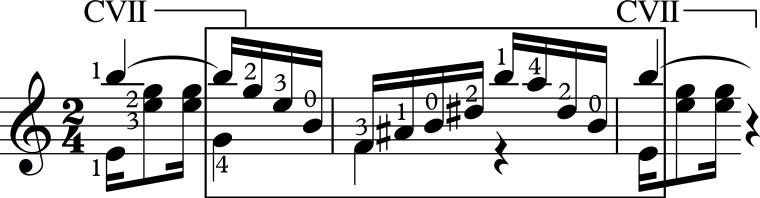
Interrogando 1.jpg

After a bit of analysis, we agreed that it was due to the lack of clarity in the right hand. So, instead of playing it over and over, which is often default behavior for most students confronting a tricky passage, we decided to break it down and come up with a list of steps to once and for all solve the problem. Here are the steps.

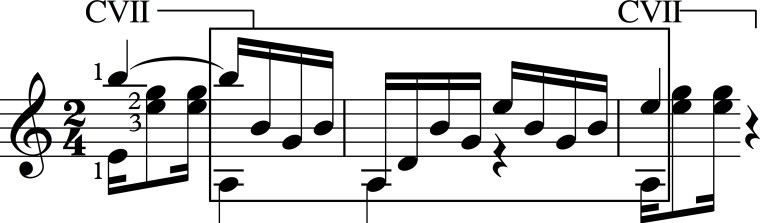
Step 1 – Write out strings.

Interrogando 2.jpg

Writing out the strings as numbers also helps see patterns if you process information better that way (i.e. 5232 5423 1232 ).

Step 2 – Choose the best right hand fingering options. See this post for more about choosing the best options: Conde Claros, Scales, and String-Crossing.

Interrogando 3.jpg

We came up with two solutions. The top one was chosen by the student because his technique was more suited to it. I preferred the second solution given to my preference for aipi instead of amim.

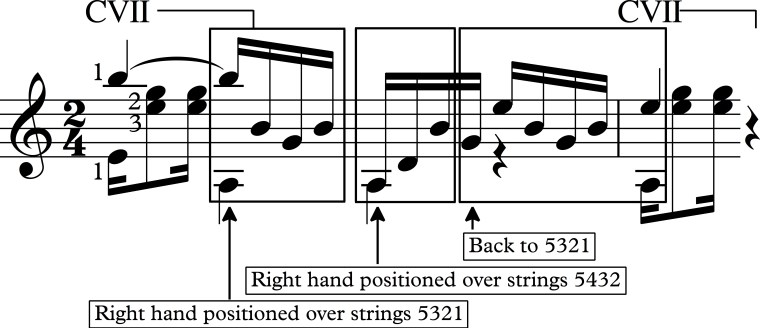
Step 3 – Analyze where the right hand position change happens (if at all).

Interrogando 4.jpg

Step 4 – Practice the last box from Step 3 using right hand alone with a focus on rhythm.

Step 5 – Bring left hand into the game for that box only (right hand now does it correctly and proficiently and left hand has to catch up is a much better option than both hands struggling and doing it somewhat incorrectly).

Step 6 – Check in with the right hand alone again.

Step 7 – Go back to Step 4 and Step 6 with the second to last box. Add to last box.

Step 8 – Go back to Step 4 and Step 6 with the first box. Add to both boxes.

Step 9 – Do a few minutes of focus, take a mental rest, and go back for several more sets (building mental muscle!).

Step 10 – Check tempo and set tempo goals.

Not only could the student whip through the passage after doing this, his skills at identifying any confusion improved. Lots of “Oh!” and “Now that feels easy!”.

Problem solved!

Technical Workout – Speed and Flexibility

I’ve just published another workbook entitled A Technical Workout for Classical Guitar: Level 2 – Speed and Flexibility.

Like A Technical Workout for Classical Guitar: Level 1 -Base Buildingit expands some basic building block movements to help the guitarist develop a strong technique through the use of rhythms, extensor movements, and fixed fingers.


Miracle Right Hand Warm Up Sequence

Here is a warm up sequence that I used to do every morning. It is useful for building right hand endurance, finger alternation, speed, pulse, rhythm, and legato. The idea behind it is simple. Set the metronome to a very slow beat, somewhere (50-70). Throughout the whole sequence, the beat remains constant but with very slight and precise increments we increase the number of notes between the beats.

I would go through all 13 steps (using free stroke) and then go through the whole thing two more times using different right hand fingerings am and ai. So, that’s 39 steps. I actually would go all the way up to fret 12 (3 cycles) and often would use a diminished 7th chord or some left hand variation to keep it interesting. Vary what you need. As you will notice, I’ve been more detailed in the first 3 steps and little by little have resorted to short hand as the basic sequence becomes evident.

Give it a whirl and let me know what you think.

Step 1

Right Hand Warm Up Sequence 1.jpg

Step 2

Right Hand Warm Up Sequence 2.jpg

Step 3

Right Hand Warm Up Sequence 3.jpg

Step 4

Right Hand Warm Up Sequence 4.jpg

Step 5

Right Hand Warm Up Sequence 5.jpg

Step 6

Right Hand Warm Up Sequence 6.jpg

Step 7

Right Hand Warm Up Sequence 7.jpg

Step 8

Right Hand Warm Up Sequence 8.jpg

Step 9

Right Hand Warm Up Sequence 9.jpg

Step 10

Right Hand Warm Up Sequence 10.jpg

Step 11

Right Hand Warm Up Sequence 11.jpg

Step 12

Right Hand Warm Up Sequence 12.jpg

Step 13

Right Hand Warm Up Sequence 13.jpg

Phew! Go back for more. You know it’s good for you.

Ricardo Gallén on Technique

I just came across some newly posted videos of Spanish guitarist extraordinaire, Ricardo Gallén, performing Leo Brouwer’s Sonata Nº4 Sonata del Pensador. The piece is dedicated to Ricardo and whether or not this is the premier or not, it is a fabulous performance.

Then, as often happens, I find myself watching more videos than I really have time for. There is too much to learn. In the next video, Ricardo gives a masterclass with demonstrations and a tremendous amount of insight. Some of the topics he discusses relate to using percussive practice in the left hand when playing fast, drawing on the metaphor of the difference between walking and running. When we walk, our feet plant fully as we balance to lift and take the next step. When we run, we are pounding lightly a bit more percussively. Translated back to guitar, if the left hand holds down and luxuriates on the fret, energy is lost and tempo slows. Ricardo plays an excerpt of Villa-Lobos Etude Nº2 to demonstrate (around minute 17). The key point is that because the left hand is acting more percussively when playing fast, part of the sound comes from the left hand, so that the right hand can relax, aiding in speed.

Another point he makes (around minute 19) is the unbalanced nature of playing guitar. Instinctually our hands want to act together (thought on this in a recent post about neural coupling), squeeze together, let go together. When playing softly or piano in the left hand but the right hand plays loudly or forte we must practice compensating for the discrepancy in energy between both hands. These are brilliant points to ponder. Undoubtably, there are more insights but I’m dying to go practice…

A Technical Workout for Guitar

Quick Update!

In addition to the kindle format, my  A Technical Workout for Classical Guitar – Base Building is now available in print via Amazon:

Stay tuned! I’ll be posting some videos to supplement the book soon.

A Technical Workout for Classical Guitar

Thought I’d let you all know that I’ve published the first of a series of technique workouts for classical guitarists. This first book, A Technical Workout for Classical Guitar, Level 1 – Base Building, is all about developing a strong foundation with a focus on the most common movements necessary for technique development in both hands. It is suitable for all levels – beginners trying to develop their own routine or advanced players looking for a systematic way to approach technique development. I wish I had had this when I was a young guitarist! It is available on kindle for now with more options soon. Stay tuned for videos going through some of the movements, supplemental publications, and more advanced workouts!

Legato and Dissonance

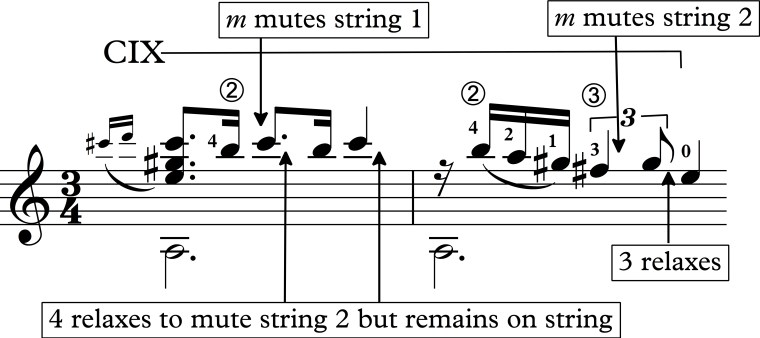
Creating a beautiful melody on the guitar is challenging due to the fact that every note you pluck decays from that moment on. If you play two consecutive melodic notes on one string, the touch requires extreme precision to give the impression of legato. At certain times, it is easier to achieve a sense of legato by using cross string fingerings. But there is a fine timing line between achieving beautiful legato and dissonance with cross strings and it requires the use of controlled damping – sometimes with the left hand and sometimes with the right.

Here is a great example from Leo Brouwer’s beautiful piece Un dia de noviembre. For a benign light passage there is a lot to think about musically.

Dia de Noviembre Ex.1.jpg

Notice that in the example above muting occurs the moment after the new melodic note turns on. This is a great way to exploit the resonance of the guitar. Of course, there are many variations on this, including one where you would turn off the notes simultaneously with the entrance of the new note but this would achieve a less legato line.

Coming soon, I’m going to post a workout based on Leo Brouwer’s Axioms!