Featured Artist Profile and Interview: Tomasz Radziszewski

The Polish guitarist, Tomasz Radziszewski, has garnered a lot of attention recently for his brilliant performances and his dynamic interpretations. In addition to performing and teaching, Tomasz is passionate about personal growth and sharing his approach to practice. Between his busy schedule of performing, arranging, and practicing, he sat down with Six String Journal to share some of his discoveries on everything from practice to performing and some of his life philosophies. Enjoy.

When did you start playing, and why? What drew you to the guitar initially? 

My journey with guitar was not love at first sight. I started to play at the age of 7. My mom signed me up for music school for guitar against my will. I wanted to be a pianist! We had a piano in the kindergarten and my hobby was to play some melodies by ear like Ode to Joy and others which I don’t really remember. But I was always passionate about music thanks to my father, who played in a local band on an acoustic bass guitar and a keyboard. Although he preferred some rock/metal or electronic music, I was always only into classical music. Of course, that changed over the years, but I have memories from when I was 6-10 years old and loving only Mozart and Beethoven. The other music, pop, jazz, rock, made me feel awkward as a child. 

What repertoire do you enjoy playing the most? 

Nowadays I am much more open. With years of discovering music I fell in love with many different kinds. If I am totally honest, I love to play film music the most of all. It’s both the joy of arranging and performing something really emotional. I love to perform what people know and can enjoy with me. I like to arrange pieces from different instruments to give the public my new vision of them. From the standard repertoire, I am really into baroque and classical music. Mostly Bach, Sor, and Giuliani. From the XX century, my absolute favorites are Villa-Lobos and Rodrigo, because they offer some nice harmonies. I am not so much into performing contemporary repertoire, although I compose myself and I’ve had a few compositions written for me. 

What guitar or guitars do you perform on? Strings?

I like my guitars how I like my wines: perfectly aged and in great condition. I hardly ever like new instruments. In my small collection (that’s really too big word for five instruments, but I cannot find a better one) I have three old instruments: José Ramirez 1979, Salvador Ibañez ~1900 and Jerome Thibouville Lamy 1890 (romantic guitar from Mirecourt). The sound of those is so charming and yet so different, one from another. Ramirez is perfect for any kind of repertoire and allowing me to play with huge expression due to its volume and color range. The Ibañez is my absolute favorite for playing late romantic music (Tarrega, Barrios, Chopin). Lamy is wonderful for Sor, but also I really like it in baroque music, too. 

I’ve played many kinds of strings in my life. I like different styles depending on the instrument and my mood, but now I’ve settled for Savarez Cantiga Premium Evolution. They give me a perfect balance of tension (1 string is nylon, the rest carbon), which cooperates perfectly with my Ramirez. They last really long and have this bright color. It’s also easier to keep intonation in high positions with the 2nd and 3rd carbon string (Ramirez has 664mm scale and it gets really crazy in high positions). Personally, I much prefer the color and vibration of nylon strings and I used D’addario EJ45 for their lovely tone but my hands get really sweaty sometimes and those strings did not last very long. I remember a few recording sessions when they were done after 3 hours (and I changed them just before playing). I also had a period using John Hope strings but I think this brand doesn’t exist anymore. Hopefully I’m mistaken, because those were also very nice.

Which guitarists/musicians have had the most influence on you?

1. Sergio Assad – the few classes with him changed not only how I play, but also who I want to be, how I want to shape my vision of music and how to listen to myself. He never says “play like this” or anything similar. He’s always asking and listening, looking for the best musical solutions. 
2. Cassie Martin – she made me realize how important and beautiful the relationship with the public can be. I neglected that a lot before. Now it’s become the purpose of my playing. Cassie made me understand many more things, not only about music – she influenced my life the most by becoming my wife. It’s really wonderful to share passion and life with someone who is so passionate herself. 
3. Łukasz Kuropaczewski – he motivated me to practice hard and helped me prove to myself that dreams come true. Without him I’d never achieve my present technical level 
4. Ryszard Bałauszko – from him I learned that playing fast and loud is not the goal. He showed me how to play beautifully and how to operate with time in music.
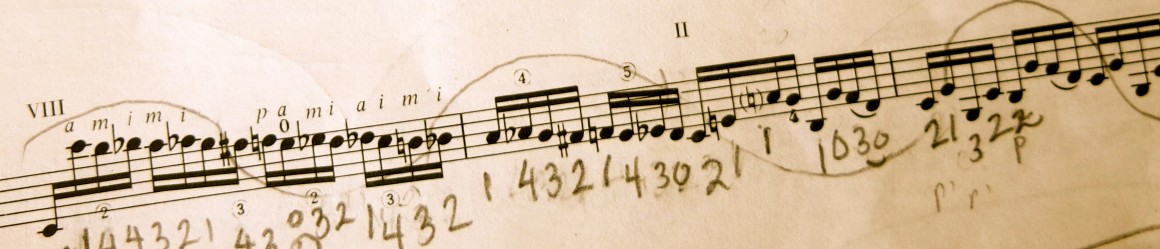
5. Mateusz Kowalski – he showed me how to take risks and why it is important. Also, I learned totally unconventional solutions for fingerings (like apoyando a-m-i, for example).
6. Listening to Vladimir Horowitz – helps me find many reasons to play how I want. Particularly in Bach. 
7. Listening to Julian Bream – my greatest guitar idol. His approach to colour is a priceless lesson. 

What recording(s) are you most proud of? 
Are there any recordings that you consider to have the finest recorded sound for guitar?

I consider my recordings the documented steps of my journey. It’s hard to tell what I am most proud of, because usually a month after the recording, I want to improve more, change the vision of the piece, and I stop being a fan of the previous approach. I wouldn’t say my recordings provide the finest guitar sound or interpretation, but I rather focus on delivering something new, interesting in terms of both: arrangements and performances. I usually like my own recordings, because I play the way I like to listen. So far, I am really proud of my newest CD with Mateusz Kowalski “Orchestral Echoes” which will be released soon and the videos below of Sor, Rodrigo, and my arrangement of Ysaye.

What are some up-and-coming projects (recordings, concerts) you are excited about?

I am actually incredibly excited about new chapter in my life: I finally garnered enough courage and confidence to share what I know. I wrote a book “The Ultimate Classical Guitar. Technical Guide Not for Beginners” where I share the best exercises and motivations that I found/developed/invented. This is my way of saying thank you to all the people who support me while helping those who need it. I was one of them myself and haven’t got anything similar to progress, but had to figure it out all myself. And it took me 10 years. I include solutions to 15 of the most common technical problems with almost 50 exercises, which I’ve learned over the course of ten years. I hope it helps others. It is available on my website: www.tommusic.art for free. 

Besides the book release, I also started to publish some content on YouTube, seeing how much guitar world needs common education. It is really important for me to provide as much positive impact on our guitar community as possible; to help guitar players make progress and enjoy their passion even more and to help them overcome their technical barriers and make the music more accessible. 

I also launched the online course, Guitar Mastery Path, for advanced and professional classical guitarists. It’s inspired by my own desire to improve. I decided to put all my experience into a precisely tailored journey to help others achieve the same transformation that I experienced some time ago. Changing the of mindset of needing a magical solution, a trick or hack, to play better, to adopting the midset of, as Alex Hormozi says, “being extraordinary is doing ordinary things for an extraordinary period of time”. Hard work is not really exciting and most of the time, it is super boring. I learned that it’s just nicer to work with someone else doing the things that I do. That’s why my course has the idea of guided practice sessions, where the student plays exactly the same as me in real time. 

I am also focused on designing some new repertoire for my next CD. I’d like to record an album solely with my compositions and arrangements. This year I completed my first sonata for solo guitar, some other compositions, and finally scored my favorite arrangements of Chopin’s Mazurka op. 17, no 4, Valse op. posth. no 19, Bach’s Prelude from BWV 1007, and others.

Technique and Performance

How much do you practice? And do you structure your practice in any particular way?

The way any musician practices depends on their situation and knowledge, developed by their experience during years of practice. I remember when some teachers of mine or friends used to say that you need to practice 8 hours or that they practice 12 hours per day and that’s why they’re so good. So I was doing that, too. I had a period when I was practicing 6-9 hours every day. And the results? Nice, but really not enough. Not what I expected. That’s why I started to wonder HOW to practice.

Imagine a chef cooking mediocre food in a food truck. Some people pass by, try it, hate it, don’t even finish it, and never come back. And the chef doesn’t care about it, he makes TONS of mediocre food. And he is left with plenty of burgers, hotdogs or whatever else – crap, which no one wants to even touch. His input then was totally wasted: he produced food, which will not be used. 

What if he saw the feedback? The food is not good enough. So he repairs the QUALITY first: “I’ll make the BEST fast food in the whole state or even the country!.” Then people would absolutely love it, come back for it, recommended it to others, and finally the chef would have so many people coming, he would have could increase the QUANTITY of his production. 

All guitarist, musicians, performers, and everyone who wants to be good at something, should think that way if they want to improve. Quality comes first and then, and only then, when your quality is fixed, your standards are high, then you repeat the quality work. Because what on earth is the point of repeating some nonsense multiple times? 

Unless there is an emergency, I practice every day. If I don’t have to prepare for any concert or project, I play warm-ups depending on my mood and goal, and then after, I just play some fun stuff and give myself new challenges. I like to come back to studies by Villa-Lobos, Carcassi, Rodrigo’s Aranjuez, and other pieces, which I want to keep in my repertoire for years. It takes me no more than 1.5-2 hours. Not a lot. But every single day. 

If I prepare for concert, I practice a bit more warm-ups to help me precisely with the problems in the particular repertoire of the upcoming project. Often, the warm-ups are fragments of the pieces turned into exercises. Then I practice every piece of the concert in a very specific method (if it’s less than a one hour recital) or split practicing into two parts (half of the concert during first half of the week and the other one during the 2nd half of the week). 

I developed a method which works perfectly every time, though it took me ages to develop, thanks to which I have a clear pattern of how to work. I choose the right fingerings, apply preparation technique, apply speeding methods, and then repeat until it is boring, and repeat more after that.
I’ll be posting a video discussing this method in the context of Villa-Lobos’s Etude Nº7 soon.

If you do these four things with everything you do on the guitar, there is no chance you’ll have any confusion. Of course, we can draw this path with much more detail, but those general rules cannot change. This is all how I practice and since I discovered that, there is nothing which I am worried about in my practice. 

Are there aspects of guitar technique or performance that you struggle with or that you find you are still working on?

I struggle all the time with so many aspects of it! I recently started working on some uncommon solutions, like applying apoyando a-m-i to scales into pieces I play (like Rodrigo’s Aranjuez or Villa-Lobos’s Etude Nº7). I also started playing scales with tremolo fingering. I’m not yet prepared to publish something on that, but I will, because this unlocks a totally new level of speed. I work on arrangements of film music which are hardly playable on guitar – recently I made an arrangement of Pirates of the Caribbean soundtrack and the Star Wars main theme in the original key. Practicing those arrangements made me realize that I know very little about real playing. People in orchestras play such difficult things. Compared to the complexity of orchestral pieces, Giuliani’s Rossinianas seem like studies for babies. It really humbled me to realize how my ideal vision of these pieces differs from what I can present with my current technique.

Every video I publish also gives me reflections on my own practice and helps me to solve some of my own problems, or to go one step further at least. I find it really inspiring, that by sharing, I am also learning all the time and I’m able to provide better and more accurate education. 

Do you deliberately memorize music or have a technique that helps assimilate music into memory?

One of the consequences of learning in the method I follow is accidental memorization. I never think of learning the piece by heart. I know, that if I practiced well, I’ll understand the music, understand the movement of my fingers, be conscious of it and memorize it automatically. When I teach to my youngest beginning students how to play a simple song. We learn it phrase by phrase, slowly, repeating each phrase a few times. There’s no way they don’t remember it after 15-20 minutes. Why do they always remember it? Because they understand it. And when they understand it, they don’t think that they need to learn by it heart. They can do it. This is good quality work repeated enough times. 

Have you published any editions, or do you plan to publish any editions in the future?

I am about to publish new compositions and arrangements on my website which should be available later in June. I’ve always been passionate about arranging and composing. I finally have the courage to share my work. 

Do you have a favorite drill or set of exercises you use to warm up?

Yes, scales in intervals. You can see precise analysis of this warm up here.
Sometimes I use also different methods of practicing arpeggios to warm up on Villa-Lobos’s Etude Nº1 or Giuliani’s Etude, Op. 48, Nº5. I’m fascinated by arpeggios! 

Do you have any pre-concert rituals?
Yes. I call it the four steps. I do them just after walking on stage and sitting with my instrument, after making sure it’s properly tuned: I relax, take time, take a breath, and prepare the first note.

It sounds cheap and easy. But it’s deeply physiological. I studied therapy after I graduated in music and took classes on Alexander Technique. Wes Howard, who happened to be a former classical guitarist and is an absolute master of AlexanderTechnique, inspired me to observe and control my reaction to stress. I know I cannot control my heartbeat directly, right? But I can train my consciousness. And these steps are making me more present on stage: what I do is not just randomly driven by emotions and risking all for the sake of luck. I’m consciously thinking to calm down and take time, and asking myself whether my shoulders are relaxed or whether I feel comfortable. Take a breath, take time again, think of music, and then going. When I am that conscious and present, I am prepared. It has improved my stage performance by at least 50% and I’ve started to enjoy what I play for people. 

Advice to Younger Players
What single most important piece of advice about practicing would you offer to younger aspiring players?

Work hard. It can be boring, unpleasant, and uncomfortable, but that’s why success feels so good. 

If the work were easy, light and exciting, everyone would be successful. Either in guitar or life, it is not luck or talent that makes people brilliant players, it is focus and the ability to say no to distractions and focus on the one thing you’re doing. Again, “Being extraordinary is doing ordinary things for an extraordinary period of time”. It is hard and it’s okay to have some hard moments in life, at least we will be better people and not too spoiled! 

The price for your dream outcome is your comfort today. To motivate myself I often think about death or about observing my life from the perspective of a different person (an exercise from Anthony de Mello’s book Awareness). When I observe myself practicing from the perspective of another person, I realize that I could do it better. When I think of my own funeral, I think of what impact I want to leave on the world, what did I accomplish in my life and are other people happy with it? Or when I am dying and reviewing my life whether, will I have regrets? Definitely not that I did some new arrangement or practiced some new piece to perform and inspire people. But definitely yes – wasting time on Instagram or sleeping too long just because it’s nice to have a free day. I could use it to make something good for the world. 

What repertoire do you consider essential for young/conservatory students to assimilate? Why?

I’d say to first understand the classics. The queen of music is opera. Guitar can be such a vocal instrument and in order to sing on the strings, we need to understand singing. What is the difference between portamento and glissando? What is mezzo voce? Understanding that changing the color in the middle of the phrase makes absolute sense! If you have objections to this idea, just listen to how Pavarotti does it at the beginning of the second verse of Una furtiva lagrima. Singing gives the guitar the opportunity to charm. Fernando Sor understood this and he composed two operas. Giuliani knew it, too, and he was constantly making variations and fantasias on opera themes. 

Then, second, deep dive into baroque music. On the surface this music can come across as boring. How can you make it interesting and yet respect the style or philosophy of that music? That’s something very individual I think. This is why so many performances of baroque music are wrongly deemed controversial. Let’s say they’re individual. The fact that Kazuhito Yamashita plays Bach’s BWV 1012 a certain way doesn’t insult the music or anyone, it’s just the way he likes it. There are people who like their steaks well-done. Let’s not judge them. Same with how people like their music, or wine, or even love. Baroque music teaches us a lot about expression of our deep selves. At least it is teaching me this. 

And thirdly, study a variety of repertoire. In the age of studying, it’s good to try what you like and what you don’t. Don’t avoid a composer because you think it is too difficult. If it’s difficult, work on it until you like how you play it, and then see if you enjoy the music or not. I was having trouble liking contemporary music. But when I started to play it, oh, it was so exciting! Ultimately I just prefer other kinds of music, but only because the day is 24 hours long. If I had more time, I’d play all of the Takemitsu in the world! 

Recordings that every young guitarist should be familiar with and why?
Every guitarist should go and see performers playing live. Recordings do not always give the full experience. Go watch how Aniello Desiderio plays Gaspar Sanz. This is what I said about baroque music being individual. Watch Pavel Steidl playing classical music. He understands opera like no one else I know. Go see Duo Assad playing anything. They are just the most inspiring guitar experience of my life. Here’s a list of recordings that have inspired me.
1. Julian Bream and his version of Aranjuez with Gardiner. And it’s not only because of Bream’s playing which for me is extremely inspiring in terms of color, but also because of the outstanding orchestra and conductor. It’s an amazing cooperation and interpretation of the piece. 
2. Nicola Hall and her performance on prize-winners concert of Silesian Guitar Autumn. I wish I knew anyone being able to play with such a charisma and character and keeping the music on such an incredible level. 
3. Kazuhito Yamashita and his recording of La Catedral. So beautiful and calm 1 at movement, 2nd movement really deep and 3rd full of dynamic and energy. Lovely. 
4. And the must see Yamashita playing in duo his arrangement of Scheherazade. I’d say 4th movement goes beyond what is possible in playing guitar. It’s unimaginable how they do that. And this is a live concert recording. I am really inspired to do crazy things in life, which seem impossible, and that is thanks to this arrangement. I tried to play it. But after reading the score I doubted myself. Festival in Bagdad is something truly special.

Are you accessible as a teacher?
Yes, teaching is my true passion and mission. I love to share all I know. Although I always prefer to have live contact with my students because it imparts a higher level of understanding, inspiration and motivation. 

Tangent
What is the last book that you read? Favorite author/s?

Dead Poets Society. Incredible book. Life is an art. Let’s live every moment and not waste any second! One before that – Zorba the Greek by Nikos Kazanakis. Life-changing. 

Do you try to stay healthy? Exercise? Have a favorite pre-concert food? 

Absolutely. I was having some health problems (sleeping, sugar problems, I was overweight). I went on ketogenic diet for few months, it completely transformed me, not only how I look but also how I feel and play. Also, when I moved to France, I improved my eating habits simply by the quality of products and ingredients. I cook for myself a lot, I absolutely love that and for me the quality is incredibly important. I go to buy fresh meat, fish, vegetables just from the farmers, who have their market downstairs. Amazing stuff. Now in my everyday life I value much more a healthy lifestyle over a comfortable one. 

My favorite pre-concert food is none. My ideal day has one meal only. I prefer to eat after concerts. I stay much more focused this way. I do eat twice a day sometimes, too, in this scenario I’d eat some piece of incredible meat or scrambled eggs. 

Do you meditate in any way? 
Not really, but I am a big fan of Wim Hoff. He is educating people about a way of breathing. It’s very inspiring and it’s helped me deal with stress in general. 

What is your favorite way to spend time when not practicing?
I organize wine masterclasses from time to time at my place. It started when I was working in a wine bar and afterwards in a wine-importing company. I fell in love with wine. To me this is art. To be able to express the taste of the land you’re growing a fruit on, influence it with your own wine-making methods and create something unique. Wow. So I started to educate myself about it. I don’t have a wine degree but maybe I’ll get one someday. But I love to organize the meetings with friends or sometimes even strangers. I cook a tasting menu paired with wine, and talk about the region, grape, producing, the differences between the wines, and how to evaluate wine. It’s my huge passion. 

I love to work on myself, development is some primal purpose in me. I try to improve everything I do. I’m arranging new pieces, try to compose new music, I’m gathering new ideas for future projects and recording content. 

Besides that, I consume a lot of knowledge about having a business, since I am starting mine now (the course and scores on the website). I listen to the fantastic podcast The Diary of a CEO and also get more inspiration from Alex Hormozi for marketing strategies.

Anything else you’d like to add?
Enjoy your life like you’d know that you’ll die tomorrow. Don’t postpone your dreams. Life is much shorter than we want. Only we usually realize it when it’s too late.


Tomasz book: The Ultimate Classical Guitar Technique Guide

Artist Spotlight and Interview: Patrik Kleemola

Photo credit:Tuomas Kourula

Hailing from Finland, guitarist virtuoso Patrik Kleemola recently sat down with Six String Journal to share some insight about his artistry and his journey with music. An active performer, educator, and chamber musician, Patrik is immersed in many projects, from recording whole cycles of etudes to concerts dedicated to one composer. His wonderful YouTube channel highlights his affinity for 19th century music; all performed on exquisite period instruments. His recordings of guitar repertoire across the centuries are wide-ranging though and are just as magically musical and engaging. Hope you enjoy this interview as much as I did.

PERSONAL
When did you start playing and why? Or, what drew you to the guitar initially?
There was my father’s semi-acoustic guitar in our house while I was growing up and before I entered for the guitar lessons in the city of Valkeakoski’s Music institute I knew some basic chords and how to play the main riff of Roy Orbison’s Pretty Woman. My grandfather from my mother’s side was in his youth an accordion player playing gigs professionally around the time of the 2nd World War and the war between Finland and Russia. Otherwise I’m the first professional musician in the family.

What repertoire do you enjoy playing the most?
To me probably the best thing in being “a classical musician” is the great variety of styles throughout the centuries and having a chance to dig in deep to the different styles, musical langueages and the culture. Whether it’s the French baroque style of Lully and De Visée, playing early romantic guitar repertoire by Sor and his contemporaries with an original Lacote guitar, playing Tárrega transcriptions of the great romantic piano literature or commissioning myself new pieces from contemporary composers, the great variety is the most rewarding thing.


What guitar or guitars do you perform on? Strings?
This past summer was a special one as I performed many concerts on an original René Lacote (1839) and Jose Luis Romanillos (1979). With Lacote I have done already some video recordings on my YouTube channel (more coming soon!) and I’m looking forward to do new recordings with Romanillos in 2025 and share those with followers of my channel. I also have played for ten years with a Rinaldo Vacca guitar made for me in 2014 and with this I have done many recordings and concerts. I have played a long time with Savarez strings and also have had a good experiences with Thomastik trebles which I use regularly. When playing with Lacote one has to be well aware of the maximum tensions of different strings in order to use them safely on the guitar. I usually use Ambra 800 by Aquila strings on my Lacote. I also try to experiment with gut strings but it’s challenging when playing with nails. However in the early 19th century many played with nails including Aguado, so it should be possible so I keep searching for the best gut strings that work with nail-playing.

Which guitarists/musicians have had the most influence on you?
In my early teens the Julian Bream’s Guitarra video series was a fascinating documentary on the history of the Spanish guitar with passionate and colourful performances by Bream through-out the series. Later on the many great pianists such as Arrau, Cherkassky and Lupu interpretating the incredible repertoire written for piano have been an inspiration. Although now as I have been more involved in the research of the early 19th century guitar repertoire, its technique and general approach, I have realized that the improvisational approach and ornamenting the repeats, for example, have been a vital part of the performance practice of the musicians at the time. In general these great pianists, as prime examples of the great musicians of the last century, didn’t dare to touch the “sacred texts” of the great composers. However this wasn’t the way Liszt, Hummel or Sor approached their performances in the early 19th century. I try get closer to this early 19th century tradition although I feel I’m still in the beginning of the journey.


What recording(s) are you most proud of?
There are two CD solo recital recordings that I did on the works that I commissioned from the Finnish and Italian composers Perchitarrasola (2012) and Through Green Glass (2015) by Pilfink Records and I’ve also been on other commercial recordings as well. The change in record business industry during the last decade have made me, and many other musicians, to think the reason to put out new commercial recordings. In the meanwhile I’ve released many video recordings on my

YouTube channel including series of pedagogic guitar literature including the complete set of Estudios sencillos by Leo Brouwer, 25 Studies by Carcassi, Sor studies op. 6 and op.35 and selection of 12 Studies by Aguado. During the COVID-19 period I did 18 works by Tárrega, a Baroque selection and rarely performed Sor masterpieces played on Louis Panormo (1838) guitar. I’ve done recordings of Sor duos with my former teacher Timo Korhonen. As an artist I think it’s important to document one’s activity (commercially or not) and the YouTube channel has now over 7000 subscribers so it has gained some following.


What are some up-and-coming projects (recordings, concerts) you are excited about?
I’m going to do more Sor recordings on my René Lacote (1839) and later on I will include also other composers from the period. Looking forward to record some of the great 20th century repertoire on the Romanillos in 2025. All these I will be released on the YouTube channel, free for everyone.

The past Autumn has been very hectic with concerts of different programs including solo recitals, chamber music with strings, Concerto by the great Finnish composer Mikko Heiniö for guitar and choir and premieres of contemporary music. Besides playing a lot in Finland I’ll be playing in Italy in December and returning there in March to play in Rome which follows concerts in Germany and Japan. There will be other concerts abroad as well to be confirmed so 2025 will be internationally quite active year for me.

I’m also going to start performing “Soirée Sor” concerts with my Lacote in 2025. Focusing a whole concert to just one composer will be an interesting challenge for me. I’ll be playing works by Fernando Sor from the early Spanish period to the last ones written in Paris. I’ll also talk about the incredible life of this fascinating composer which indeed had it’s dramatic turns, more than once.

TECHNIQUE AND PERFORMANCE
How much do you practice? And do you structure your practice in any particular way?
Some hours everyday, more or less. At the moment I’ve one year scholarship from the Finnish State so I have one year off from the Turku Conservatory where I work as a lecturer. This means I don’t have to teach so much, so I’ve even more time to expand my repertoire, be active on chamber music and playing concerts. I also try to give some time in my practice sessions to focus on refining the technique. There’s almost always some work I’ve commissioned from a composer so I’m active working with them which is very inspiring, trying to find out technical and musical solutions to textures that are not written by a guitarist.

Photo credit:Tuomas Kourula

Do you deliberately memorize music or have a technique that helps assimilate music into
memory?

I still strive to play pieces by heart when playing solo recitals although expecially with contemporary works the score is sometimes needed. I don’t trust just to the muscle memory when memorizings works. If I can play the whole piece in my head without the instrument (concentrating mostly to the left hand movements), I’m confident playing the work in public.


Have you published any editions or do you plan to publish your own editions in the future?
I’ve been very involved in the prepration of the published works that I’ve commissioned from the composers from the pedagogic literature to solo works, chamber music and concertos. If it’s pedagogic literature (like Etudes by Markku Klami, see the YouTube playlist) then it’s good to have more fingerings in the score. If it’s very demanding contemporary work, then it’s probably approached only by professionals and these cases the less is more when it comes to fingerings.

I have done arrangements of works by Tsaikovski, Sibelius, Satie, Bach and others. I’m thinking to publish these, hopefully soon, with video performances on my YouTube channel.

Do you have a favorite drill or set of exercises you use to warm up?
I have certain patterns for both hands taking from here and there that I do if I have just 20 minutes for warming up. If I have more time I might take some of the many technique books I have and do something from there just for the fun of it.


Do you have any pre-concert rituals?
The rest is very important so I try have good amount of sleep the night before. I like to have a proper warm-up session on the concert day. I might go through the program during the day, but very lightly and not necessarely all of it. Usually I try to work quite hard the day(s) before and then just let it happen on the concert day.

ADVICE TO YOUNGER PLAYERS
What single most important piece of advice about practicing would you offer to younger
aspiring players?

Playing guitar is work of a long-distance runner. The talent is not enough and it’s also a talent to be able to work consistently and regularly.


What repertoire do you consider essential for young/conservatory students to assimilate?
I think in the early 19th century repertoire there are the main technical things that one needs in playing the guitar. However from my experience as a teacher it’s not always the most inspiring material for the young students. Also reading music on the guitar is not the easiest task for young students and often this is also slowing things down. So good mixture of interesting repertoire from the classical tradition and new pedagogic literature that perhaps reflects more closely the music kids hear in their everyday life.


Are you accessible as a teacher?
I teach as a lecturer in the Turku Conservatory and I’m available also for lessons online, although the latter I have to do according to my schedules which varies quite a bit.

Photo credit:Tuomas Kourula

TANGENT
What is the last book that you read? Favorite author/s?
I just ended Madame Bovary by Gustave Flaubert. As I’ve been recently doing a research on Sor and the early 19th century guitar, it has inspired me to read a few books by the early 19th century French authors such as Balzac and Flaubert. Often music that I’m working open doors to choose the literature. Finnish composer Harri Suilamo wrote for me recently two guitar works inspired by the Austrian author Thomas Bernhard and I ended up reading a few books of this fascinating contemporary author.


What is your favorite way to spend time when not practicing?

Spending time with my family including our six-year-old son who is such an light of the day.

A Curated List of Recent Recordings: Villa-Lobos Complete Works

As students begin to get serious about developing their concert repertoire, I like to recommend recordings to study and listen to with the score. So instead of scribbling on their score, I thought I would start to post suggestions on Six String Journal.

This week, I’ll suggest a few recordings of the works of Heitor Villa-Lobos. Villa-Lobos’s Five Preludes, Twelve Etudes, Brazilian Suite, and his Choro Nº1 are some of the guitar’s most beloved solo repertoire. Villa-Lobos uses the guitar so indulgently and exploits resonance brilliantly.

Julian Bream, Manuel Barrueco, and Alvaro Pierri’s recordings of these works are wonderful. But there are other recordings that really stand out to me. The first and probably my favorite is Fabio Zanon’s recording of the complete works. Zanon’s playing is beautiful, his guitar sounds heavenly, and the engineering (I think it was the legendary John Taylor) is excellent.

Another great recording is Jose Antonio Escobar’s recording of the Five Preludes, 12 Etudes, and a Modihna. I love the sound of his guitar (Paco Santiago Marin XXX) and the recording is sonically perfect.

Here is a link to Alvaro Pierri’s recording of the Choro, Five Preludes and 12 Etudes. This recording made me listen to what can be done interpretively with these great works. Pierri has a special take on these.

And last for now, here is Norbert Kraft in a recording of the Twelve Etudes. Solid from the first note to the last.

Here are a few great videos of the Five Preludes.

I know I’ve left many videos and recordings out. There are so many. Any favorites that I missed?

Two Pieces by Agustín Barrios Mangoré

I recently recorded several of my favorite pieces by Paraguayan composer, Agustín Barrios Mangoré. Here are two of them, well-loved and well-known to most of you. Julia Florida was the first Barrios piece I learned decades ago and I still love playing it. And, of all of Barrios’s waltzes, his Vals Op.8, Nº3 is probably my favorite. Thank you to Stefan Nitschke for such a beautiful sounding guitar.

Thanks for listening!

New Publication: Mallorca by Isaac Albéniz

Over the years, I’ve heard many great guitarists interpret this piece. Fortunately, many of them have also published arrangements. So when I finally decided to learn it this summer, I consulted the piano score and read through as many guitar editions as I could get my hands on: Segovia, Pepe Romero, Abel Carlevaro, David Russell, Rafael Andia, Paulino Garcia Blanco, Stanley Yates, among a few others. I listened to many players as well: Julian Bream, Marcelo Kayath, Jose Antonio Escobar, Alicia de la Rocha, to name a few. There are many great performances on YouTube as well. Each edition and player has something interesting, some way of doing something that is clever or that works well. Some simplify difficult passages and some editions are more or less “guitaristic” than others. And all of those editions work well. But I cannot help trying to find my own way of doing it. The edition here is the way I play it now. You can find the score here on my payhip page.

Artist Spotlight and Interview: Jason Vieaux

A consummate soloist, chamber musician, recording artist, and teacher, Grammy Award-winning guitarist Jason Vieaux recently sat down to share some of his thoughts and insights with our readers. Hope you enjoy reading this interview as much as I did and check out Jason’s new recording, Bach Volume 2: Violin Works.

photo: Tyler Boye

Personal

When did you start playing and why? Or, what drew you to the guitar initially? 

Initially I was drawn to the guitar and drums through listening to my parents record collection, which was mostly my mother’s soul, R&B and rock records. Seeing the Bay City Rollers on TV as a 5-year old, eg, was a very exciting thing to me, and I regularly drew pictures of drum kits and guitars as a kid. Seeing Roy Clark and Buck Owens on TV regularly at 3-4 years old, Owens’ red, white, and blue guitar is an iconic image for me. I was also a big fan of The Beatles music from age 3, and I heard a lot of my Dad’s jazz records. This keen interest prompted my mother to buy me a 3/4-size classical guitar one day when I was 5; she might have known it as a “Spanish Guitar”. The Buffalo Guitar Quartet did an outreach program at my school when I was 7, and my mother’s secretary work happened to be in the school library during that time. So that summer I began classical guitar training with Jeremy Sparks.

What repertoire do you enjoy playing the most? 

I don’t really have a preference for the style or period; just particular pieces that I’m working on at the time. It’s such a luxury for me when I get to actually work on something with any kind of regularity, since I professionally have always dealt in “volume”, if you will. With the way my career developed professionally, I don’t usually get to choose what or when, unless I’m preparing a recording. I just try to dive as deeply as I can into whatever I’m working on for live performance at the time – and I’ve enjoyed that rhythm or process. I’m very much geared/wired toward live performance, and so I feel blessed to have either performed or recorded some 60-70 hours or so of stuff. I perform a lot of pieces just once or twice every year, or every 5 years, like Castelnuovo-Tedesco Quintet, for example.

But Bach is the most satisfying when everything is going well, I’m almost always working on his music for something. And I never tire of playing Rodrigo Concierto de Aranjuez – mainly because I keep getting better every year at the passagework. Aranjuez is probably like Pebble Beach or Augusta National for a professional golfer, I suppose.

What guitar or guitars do you perform on? Strings?

I only have one concert guitar, my hope is to acquire another. My guitar is by Gernot Wagner, who is based in Frankfurt. And I like Augustine Regal strings.

photo: Tyler Boye

Which guitarists/musicians have had the most influence on you?

As far as the guitar corner of things, the classical guitarists that had the biggest influence on me are probably Julian Bream, David Russell and Manuel Barrueco, mainly because I got to hear them live, although Bream’s records I enjoyed the most as a kid. And prior to age 15, “non-classical” guitar players like Eddie Van Halen, Jimmy Page, Andy Summers were influences, mainly because you couldn’t really escape Van Halen, The Police, Led Zeppelin on the radio or TV then, especially if you were a drums-and-guitar fan like me. And every kid then had a clock radio to wake up to, so many guitar solos from the Top 40 in the 80s are burned into my memory.

But even more so, it’s specific pieces or albums that were impactful before age 20: Bach Chaconne, 3rd Cello Suite, Villa-Lobos etudes, “Drei Tentos” by Henze, all Fernando Sor, Beethoven Symphonies, Rimsky-Korsakov, Stravinsky, Copland, Ravel, Debussy, so many Spanish and Latin American guitar pieces. Getting to know Stravinsky’s “Rite of Spring” especially was a real experience (and temporary obsession) for me.

Hearing Cleveland Orchestra often in college at CIM, and being exposed to way more live orchestral and ensemble music had a big impact, particularly latter 19th C, and tons of modern music (Erb, Carter, Ives, Varese, Stockhausen, Glass, Reich, Sessions, Boulez). Also certain early hip-hop albums (Public Enemy, ATCQ), certain albums by Miles Davis, Weather Report, Joni Mitchell, Beatles, Steely Dan, Pat Metheny. Attending Cleveland Orchestra performances of Strauss “Metamorphosen”, and Mahler 2nd Symphony, eg, were kind of life-changing experiences for me.

What recording/s are you most proud of? 

I’m kinda enjoying my latest Bach recording. It’s nice to hear what I was doing at the time (2019) with the ornamentation, and how my Bach playing is less stiff/stuffy on this record. It’s a more accurate representation of what my live playing is like.

But it’s nice to see how particularly the Images of Metheny (2005), Ponce Sonatas (2001), Albeniz (2003), PLAY (2014), the 1996 Naxos CD, and the previous Bach record have been so well-received by people, and not just by guitar players. I’ve read so many notes over the years from people and musicians about how those records were influences or references for them.

I’m also really glad I got to make those ensemble and chamber recordings over the last 20 years with regular collaborators, like Gary Schocker, Julien Labro, Yolanda Kondonassis, the Eschers, and all the “one-offs”, like recording the Ginastera Sonata, Jeff Beal and Jonathan Leshnoff concertos, etc.

Are there any recordings that you consider have the finest recorded sound for guitar?

I don’t listen to many guitar records, unless I’m researching something, and that’s only because I’m always so “inside” of my own playing and musical work as a professional musician. And really I just prefer ensemble music or solo piano anyway, when I get free time to just listen for pleasure. But I have to say, especially since David Russell is now a label-mate on Azica Records, I recently heard his latest CD at their studios, and it sounds absolutely terrific – in my opinion, Azica has really captured the majesty of David’s sound. I did hear some early Bream Westminster LPs on a friend’s good stereo about 10 years ago, and that was kind of a revelation, the recorded guitar aspect. It’s like Bream playing in your living room.

What are some up and coming projects (recordings, concerts) you are excited about?

I’m looking forward to getting my re-tooled BWV 1001 and 1007 on the road again. The pandemic halted what was just starting to really cook. Also my new record with violinist Anne Akiko Meyers is out this May, so we’re hoping to play that material over the next 2 years. My next San Francisco residency concert will be with mezzo Sasha Cooke at Herbst Theater. We’ve been trying to play together again live for a few years. Also, Avner Dorman is making a concerto version of his quintet that I premiered in 2016, “How To Love”, and I’m performing that with Gerard Schwarz and the EMF (Eastern Music Festival) Orchestra this July. We’ve always done a guitar concerto together every summer at my guitar program there, really due to Maestro Schwarz’s efforts and support – that’s a really great thing for the guitar. (link?) And playing concerts with the great Escher Quartet is always a blast, we’re good friends.

Technique and Performance

How much do you practice? And, do you structure your practice in any particular way?

I’d love to practice 4 hours a day, but it’s just not possible with all the other responsibilities. I get about 2 hours most days, sometimes 3 in a day.

Are there aspects of guitar technique or performance that you struggle with or that you find you are still working on?

Not really. The experience and hours of different challenges and situations in all the repertoire I’ve played ended up adding aspects to my technique, mechanics, performance comfort, etc., that I wouldn’t have had if I were just playing solo pieces. We’d all like to have faster scales and arpeggios, etc. We all want more. I actually have gigs where I wish I was more nervous, where there’s no nerves at all, and still some where I wish I was more relaxed.

photo: Tyler Boye

Do you deliberately memorize music or have a technique that helps assimilate music into memory?

Memorization came fairly easily to me, although once the repertoire crunches came, I was able to teach students how I made up the deficits in time through visualization techniques, repetition strategies, fingerings, etc.

Have you published any editions or do you plan to publish your own editions in the future?

Not really, mainly because I’m often discovering new things and thus changing fingerings, every time I come back to those core repertoire pieces. My fingerings are often “weird” anyway, which is why I prescribe (and demonstrate) 2-4 different fingerings per questionable passage to my Curtis and CIM students. I don’t hand out a score photocopy with fingerings on it to a student. We work on them together, guitars on laps, playing.

Do you have a favorite drill or set of exercises you use to warm up?

I mainly use passagework from approaching deadlines, that works great to develop your technique over time. The more puzzles you put in front of your hands and brain, the better.

Do you have any pre-concert rituals?

I used to have no rituals for the longest time, because it was so often a disappointment to not be able to keep the ritual, if things went wrong or were disorganized beyond your control. So my takeaway from that in the early days was to have little to no ritual. I learned that from Gary Schocker. Nowadays, it’s better, more folks allow me to have some personal time. As long as I can have 90-120 minutes on everything I’m playing that evening, I’m happy.

Advice to Younger Players

What single most important piece of advice about practicing would you offer to younger aspiring players?

Practice as much as you can, without burning yourself out, because you have to WANT to do this, for yourself; not for anyone else.

What repertoire do you consider essential for young/conservatory students to assimilate? Why?

19th century stuff, especially Sor. He was the best musician we know of in that century that played guitar, except maybe Regondi, and he wrote almost entirely in parts/voices. His music is solvent, and it really isn’t all that “idiomatic” in terms of ease. So it prepares you for everything else written by a proper composer, except ornate Baroque transcriptions, or modern/dissonant textures. But when I hear guitarists joke about “easy Sor studies” it makes me laugh. Most guitarists play Sor very poorly, because you have to play his music with your ears, not your fingers. Your fingers have to follow.

Recordings that every young guitarist should be familiar with and why?

OK, this is a long answer. Classical Guitarists seem like they are already very familiar with Dyens, Morel, Assad, which is great, and important, but they should also at least familiarize themselves with player-composer-arranger-improvisers like Rabello, Yamandu, Lagrene, etc. And in jazz you can’t go wrong with Christian, Green, Montgomery, Pass, Hall, Bertoncini, Benson, McLaughlin, Metheny, Scofield. I lost track of almost all of the newer “cats” due to my professional and family life, but Rosenwinkel, Kreisberg, Hekselman, Monder – heavy. I love it.

In classical playing, can’t go wrong with the usual suspects, but it’s important to hear their best stuff: Segovia, Barrios, Díaz, Yepes, Presti, Bream, Ghiglia, Williams, Starobin, Barrueco, Russell, Fernandez, Galbraith, Holmquist, Tanenbaum, Isbin, Fisk, etc etc (maybe leaving out like 20-30 players). 

For me, Galbraith and Barrueco were crucial players for me to hear conceptually, and quite possibly had the biggest impact on me as a guitar player right now, even though many would rightly say I sound nothing like them at all. As many know already, my favorite contemporaries that are well-known are Micheli, Dukic, Dylla, Vidovic, Gallen, Desidrio, Azabagic, maybe some others I can’t remember now. But too many people are absolutely sleeping on Colin Davin, Petra Polackova, JiYeon Kim (Jiji), Hao Yang, and Jordan Dodson.

photo: Tyler Boye

Tangent

What is the last book that you read? Favorite author/s?

The autobiography of Larry Rivers, “What Did I Do?”, the Keith Richards autobiography.  

Do you try to stay healthy? Exercise? Have a favorite pre-concert food? 

I try. Getting better each year. I walk a lot. My weight is optimal, but I have to remind myself to strengthen my core. No real pre-concert foods (again, the road plus my background sort of taught me to not get too particular.)

Do you meditate in any way? 

In some different ways, even if it’s for 30 seconds. It’s like practicing an instrument, it’s often better to practice 45 minutes 6 times a day than to practice 4.5 hours in one stretch. Same with meditation. Unless you’re independently wealthy.

What is your favorite way to spend time when not practicing?

Walking long distances in our neck of the woods or on the road. Watching sports, especially NFL, NHL, MLB, NBA, PGA – in that order (I almost never get to do this anymore). Being with my kids, helping them with school work, answering questions, board games, listening to their stories/musings. I take them to the park a lot on the days I’m home. Listening to music, although that’s mostly now during making school lunches and/or breakfast at home. That’s about it. I really need to see that Beatles “Get Back” Peter Jackson thing.

Any things else you’d like to add?

Bach Volume 2 is finally out. Go to live concerts if you love music; there’s no comparison between live and virtual, just like anything else in life. Don’t kid yourself.


Bach Volume 2: Works for Violin is now available on most music streaming and purchase services!
Spotify: buff.ly/3IXMTJd
Amazon: buff.ly/3iWqHok
Apple Music: buff.ly/3tYaxAV

Artist Profile and Interview: Julia Trintschuk

If you have not heard the brilliant young guitarist Julia Trintschuk you are in for a treat. Hailing from Germany, Julia has been on stages all over the world and performed Joaquin Rodrigo’s Concierto de Aranjuez at age 16 to launch her career. With a seemingly endless amount of technical skill, a refined and elegant sound, and a natural musicality, her interpretations transcend the guitar. Fortunately for Six String Journal readers, Julia recently took some time to share some of her experience, tips, and advice! Enjoy.

Julia Trintschuk

Personal

When did you start playing and why? Or, what drew you to the guitar initially?

Actually I first started playing piano at the age of four. As my mother was teaching me the piano and my father was always playing the guitar, soon I also became interested in playing guitar and started having the first guitar lessons with my father at the age of four as well. From then on I continued playing both instruments.

What repertoire do you enjoy playing the most?

In general I’m only choosing pieces I enjoy playing and working on, to join my repertoire. But it also depends a lot on my mood and the piece itself. What I like a lot is to have a big contrast and variety between the different pieces, for example a couple of technically very demanding and virtuosic pieces, some musically difficult pieces and a few very beautiful and simple piece.

What guitar or guitars do you perform on? Strings?

Mostly I’m playing on my guitars by Fernando Mazza with a cedar top and my Antonio Marin with spruce and satin wood. It’s a very colorful guitar and makes it easy to create a tender way of making music and not focusing on the technical issues too much. Apart from that I like to use my other guitars with a cedar top for a more powerful repertoire or chamber music.

As for the strings I am very happy to be a part of the Savarez family since 2017 and I’m using the Savarez 510 MJP Cantiga Creation Premium High Tension.

Which guitarists/musicians have had the most influence on you?

My teachers Prof. Mario Sicca, Martin Wiedmann, Mateus de la Fonte and Prof. Joaquin Clerch definitely had the biggest influence on me. Musically speaking also my long-term piano teacher So-Ryong Chuoa had an immense influence on me and led me to two of my biggest inspirations Evgeny Kissin and Sergej Rachmaninov.

Are you planning to record a cd? What are some up and coming projects you are excited about?

There are a few projects ahead, that I’m excited about, but they’re still in the process of making, so I’ll be happy to share them soon, when things will get more precise.

Technique and Performance

How much do you practice? And, do you structure your practice in any particular way?

Usually I practice around six hours a day, sometimes more, sometimes a bit less. But structure in the practice is one of the most important things in my opinion. I think it is very important to have an overview on all projects that are going on and to set deadlines.

Another benefit that structuring your practice brings, is that with the time you get to know how much time and which precise steps it requires for you to refresh old pieces, which can be a big help, when you have several programs you have to prepare. All in all I believe a structured practice plan is the key to a good time management that saves you from wasting both time and energy in the wrong way.

What has to be included in every practice plan in my opinion is a warm-up/technique session, a few sessions for working on new repertoire, and one session where you refresh old pieces or keep current pieces “alive”. The most important is to separate these blocks by breaks, in order to keep focused and be able to go through all of these parts daily.

Are there aspects of guitar that you struggle with or that you find you are still working on?

As we change our perspectives and points of view constantly during the process of development, I don’t believe it is ever possible to achieve the state of an absolutely controlled, constant total perfection and be “completely done” with the work with the instrument. It’s just that the focus on what you want to improve, lies on different aspects in the different phases on top of the basic feeling of a general comfort with the guitar.

Do you deliberately memorize music or have a technique that helps assimilate music into memory?

In most cases the memorization comes while I’m practicing the piece, but sometimes if I want to support or accelerate the process I like using the technique of mental practice (without guitar) and also to analyse the harmonic progressions.

Have you published any editions or do you plan to publish your own editions in the future?

I have done a few arrangements, that I didn’t publish yet, but I’m definitely planning to do that in the near future.

Do you have a favorite drill you use to warm up?

My favourite parts from my usual warm-up routine are minor and major scales through all tonalities and the 12 etudes by Heitor Villa-Lobos. Apart from that I also like warming up on the piano by practicing different technical exercises, before practicing the guitar.

Do you do anything to your nails or shape them in a particular way?

Apart from the usual filing and smoothing with a common nail file and nail papers I don’t use any specific products.

Advice to Younger Players

What single most important piece of advice about practicing would you offer to younger players?

Practice slow with a lot of patience and love what you’re doing.

What repertoire do you consider essential for young/conservatory students to assimilate? Why?

Apart from the classical “competition repertoire” that every ambitious guitarist goes through, in my eyes the 12 Etudes by Villa-Lobos and the 20 Etudes simples by Leo Brouwer are essential, because it doesn’t only include all technical difficulties that one learns to master during the process of learning these pieces, but these pieces also give a perfect fundament for deepening the understanding of harmony and finding a personal way of applying music to at first glance seemingly technical studies.

Recordings that every young guitarist should be familiar with and why?

I believe especially in a young age it is very important to get familiar with the recordings of the most important, diverse legends of the guitar such as Paco de Lucia, Andres Segovia, Julian Bream, Manuel Barrueco, going through all generations and “schools”, to be able to understand and develop your own taste and style. In order to evolve a personal style of musicality in my opinion it is even more important to listen to meaningful other instrument, chamber music and orchestral recordings.

Tangent

What is the last book that you read? Favorite author/s?

The last book I read is “The Prophet” by Khalil Gibran. Among my favorite authors are Paulo Coelho, Jane Austen and Bernhard Schlink.

Do you try to stay healthy? Exercise? Follow a particular diet? Have a favorite pre-concert food?

I like to stay active in my free time and try to do different activities and I do some home exercises and yoga. I also like cooking a lot, but I don’t follow a specific diet. Everything just has to be fresh and tasty 🙂

Do you meditate in any way?

To me focus and concentration, mental health and spiritual development are very important, so I try to keep it up in different personal ways, also including meditation.

What is your favorite way to spend time when not practicing?

I love searching for inspiration, when I’m not practicing. That doesn’t only include all the activities that are connected to being a musician like listening to music, reading, playing other instruments, but also visiting theaters, art galleries, dancing, spending time with family and friends, meeting interesting people, cooking, trying different activities, visiting saunas and spas, enjoying the beauty of nature – so shortly: discovering all the beauties of life itself. 🙂

__

Julia on Facebook

Julia’s website

Julia on Instagram

Artist Profile Interview – Alberto Mesirca

Italian guitar virtuoso, Alberto Mesirca has headlined across the globe with his passionate, supreme musicality. His interpretations of music from Domenico Scarlatti to Benjamin Britten not only display a dazzling technique but more compellingly invite the listener to imagine with him a musical landscape that is expansive, dreamy, and sometimes, unchartered. Between performances, masterclasses, and lectures, Mesirca has a list a mile long of collaborations with other musicians, composers, and publishers. Amid his rich musical life, he sat down to share a bit about his journey with guitar in this interview. Enjoy!

Alberto Mersica photo 1.jpgphoto credit Serban Mestecaneanu

Personal

When did you start playing and why? Or, what drew you to the guitar initially?

I started playing when I was 8 years old, I wanted to play music as I loved music much earlier. My dad was a big music fan, specially of jazz. My aunt had a guitar at home and that’s the instrument on which I started playing.

What repertoire do you enjoy playing the most?

I like all kinds of repertoire that touch me in a special way or permit me to express inner feelings, to sing with the instrument. They can be from the renaissance or from our time.

What guitar or guitars do you perform on? Strings?

I have a guitar built by Giuseppe Guagliardo and a guitar by John Gilbert, both in spruce, with D’Addario and Savarez Strings

Which guitarists/musicians have had the most influence on you?

I have an infinite admiration for Julian Bream, who devoted himself to the re-discovery of the old British repertoire, to the request of compositions to the great composers of our time, and to establish for the guitar a position which could have been easily compared to the piano or the violin, as a major chamber music instrument. This due to his tenacity, extremely big talent, intelligence, and capacity. Plus I love his way of playing and his sound.

What recording/s are you most proud of?

I think I still like very much the one dedicated to Domenico Scarlatti. I have also a deep attachment to the first one I did, “Ikonostas”, dedicated to guitar music inspired by mysticism, and with a few important first world recordings: “Errimina” by Padre Donostia, discovered by Angelo Gilardino in the Segovia Archive in Linares, and his own “Ikonostas” and “Annunciazione” and “Sefer Torah” by Gianmartino Durighello.

Are there any recordings that you consider have the finest recorded sound for guitar?

Like said, I love Julian Bream’s recordings, especially the one dedicated to the British repertoire of the 20th Century (Walton, Smith Brindle). I also still love Segovia’s recordings, especially the Deutsche Grammophon recording of his incredible rendition of Ponce’s Concierto del Sur. It is still for me the best one.

What are some up and coming projects (recordings, concerts) you are excited about?

Now I am preparing a few concerts: recitals, a promotional series of concerts dedicated to the Chaconne (playing Dusan Bogdanovic’s wonderful Chaconne), and preparing a recording dedicated to Italian contemporary composers, having a few dedicated pieces by very interesting composers, like Filippo Perocco and Edoardo Dadone.

Alberto Mersica photo 3.jpgphoto credit Serban Mestecaneanu

Technique and Performance

How much do you practice? And, do you structure your practice in any particular way?

I tend to warm up with a few technical exercises, scales, slurs, stretching, and then start focusing on the pieces. I love playing, and understood this even more since I started to have many obligations which kept me a  far from the instrument than when I just had to practice, so it doesn’t bother me at all to work on the guitar all day, if I can.

Are there aspects of guitar that you struggle with or that you find you are still working on?

I think it is a never-ending process, one tends to improve all the time, both technically and especially musically. I feel like I never managed to arrive at a point in which I can say: this is the definitive version. Otherwise I think I’d stop playing much earlier, as the vital and interesting aspect in making music is, for me, the search.

Do you deliberately memorize music or have a technique that helps assimilate music into memory?

I tend to memorize pieces easily, but it gets more difficult if the amount of music one has to perform is constantly growing.

I think that there are many memories and each one is helpful for a stable and safe performance: memory of the positions of the left hand, of the music itself, of the movements, of big passages etc. I think that a good exercise for memory is trying to play without the instrument, imagining the notes from the beginning until the end, which is not easy at all.

Have you published any editions or do you plan to publish your own editions in the future?

I did a few, and the very last one is an interesting one: the Chanterelle Guitar Anthology, for SCHOTT – 40 Classical Guitar Miniatures from Sor to Segovia. I am very happy because it is the result of a friendship with one of the eminent figures in the Musical Research and Publishing for the Guitar, Michael Macmeeken, with whom I previously worked for the publication of a previously unknown piece by Giulio Regondi (Feuillet D’Album) and together with the great Marc Ribot for the Complete Works of the Haitian composer Frantz Casséus.

I made also the recording which is attached, with a beautiful guitar by Donatella Salvato, a talented Italian guitar maker.

ECH_2724-Mesirca.jpg

Do you have a favorite drill you use to warm up?

I tend to play scales, in apoyando and tirando, slurs, stretching, etc.

Do you have any pre-concert rituals?

Frankly not, but I prefer to play in the hall before entering on stage for the concert. This way I get used to the acoustics and dimensions of the hall.

Do you do anything to your nails or shape them in a particular way?

Not really, I tend to keep them round and not too long, shaping them with a file and then using this special paper with wax on it.

Advice to Younger Players

What single most important piece of advice about practicing would you offer to younger players?

Keep the love for what you’re doing and never forget the passion that drives you for creating music. If you have a lot of talent, especially at a young age, when competitions are routine, they can distract you from music by the mere search for technical perfection.

What repertoire do you consider essential for young/conservatory students to assimilate? Why?

I think Fernando Sor and Dioniso Aguado are still wonderful for students because they write in a polyphonic way, also the “easier” pieces, and thus one starts from the beginning to think the guitar as a polyphonic instrument, in which we are forced to lead voices independently.

Recordings that every young guitarist should be familiar with and why?

I think that guitarists should listen to more music, and not just guitar. Listening to recordings of great violinists, pianists, orchestras, and of compositions which are contemporary to the works they are studying can provide many more musical ideas than they would normally have if they didn’t listen to music. It is like expanding the possibilities, and playing according to the style of the time, rather than being influenced by the hands, by the technical difficulties.

Alberto Mersica photo 2.jpg

Tangent

What is the last book that you read? Favorite author/s?

I just finished reading Shirley Jackson’s “Paranoia”. Wonderful! I love Franz Kafka.

Do you try to stay healthy? Exercise? Follow a particular diet? Have a favorite pre-concert food?

I do yoga, and love it, and feel much better since I started, my back is very thankful! I don’t follow a particular diet but I try not to be excessive with anything, No favorite pre-concert food, but I try to stay light.

Do you meditate in any way?

Well I think that yoga somehow helps me to get back to the human breathing, which I must admit I tend to forget when in stress.

What is your favorite way to spend time when not practicing?

I love to travel, read, and take walks with my wonderful wife.

Artist Spotlight and Interview with Colin Davin

Praised for his deeply expressive musicianship, his musical intelligence, and virtuosic technique, Colin Davin seems to have it all. Colin is an active international soloist, chamber musician, recording artist, and teacher, with projects and performances from Aspen to Afghanistan to the Alhambra.

Colin took some time recently to sit down and share some of his insight, philosophies, and advice with Six String Journal. Hope it inspires you all.

When did you start playing and why? Or, what drew you to the guitar initially?

My study of the guitar began fairly early – I was 7 years old, and my father, himself an amateur guitarist, signed me up for lessons. In a way, it was not so different than the many other things I was doing as a kid, like little league or cub scouts. Taking advice from an interview with the folk-rock guitarist and singer-songwriter Richard Thompson, it was determined that classical guitar would give me the best chance at being able to play a wide range of styles. And while I’ve since branched out from time to time, at that early age, classical struck a chord with me, and I’ve never lost that enthusiasm.

What guitar or guitars do you perform on? Strings?

I play a guitar by Andrea Tacchi, from Florence, Italy, his model “Coclea Thucea”, made in 2004. For those who don’t know Andrea’s instruments, they are both of the highest quality in sound and craftsmanship, and a bit unusual. The name Coclea Thucea refers to the inner ear (coclea), both for its obvious connection to hearing music, and for its spiral design, in the ratio of a Fibonacci sequence. Andrea incorporates aspects of “sacred geometry” connected to this ratio in his design and construction. And the “thucea” is a portmanteau of the Latin names for spruce and cedar, as the top is a three-piece construction using both materials (two outer panels of cedar with a central panel of spruce). For years I’ve played Hannabach Silver 900/200 trebles, med-high tension…a perfect balance of warmth, color, and clarity, in my opinion. I have less devotion when it comes to basses, but most often settle on high tension Augustine or D’Addario.

Which guitarists/musicians have had the most influence on you?

My influences have been pretty wide ranging over the years, but early guitar heroes of mine were Julian Bream, John Williams, Stevie Ray Vaughn, B.B. King, and Django Reinhardt. When I was 10, I heard Jason Vieaux play for the first time, and that pretty much cemented my desire to make music my life. A few years later, I was Jason’s student, and now I’m his colleague on the faculty at the Cleveland Institute of Music!

What are some up and coming projects you are excited about?

I play in a duo with the brilliant harpist Emily Levin, and we’re planning a live-concert recording in New York this February. The combination of guitar and harp is absolute magic, and deeply under-explored (they might be the two most intimidating instruments for composers, which explains the lack of repertoire). We’ll be recording transcriptions of ours of de Falla’s “El Amor Brujo” in its entirety, Ravel’s “Ma Mère l’Oye” (Mother Goose) and Philip Glass’s “Etude no. 6”, originally for piano. In addition, we’ll feature world premiere recordings of works we commissioned, by Dylan Mattingly and Will Stackpole.

Practicing and Performing

How much do you practice? And, do you structure your practice in any particular way?

Practice hours are variable day to day, and week to week. Such is the nature of a performing and teaching musician – the lack of a consistent schedule presents unique challenges to getting in the hours. I’d say I reliably get in 20-25 hours a week, possibly in a steady stream of 3-4 hours a day, possibly in a disjointed alternation of heavy days and light days. Because of this irregularity, it has become very important for me to structure my practice with specific goals in mind. I always start with some light warmups, then slurs, arpeggios (often selections from the Giuliani 120, or Villa-Lobos’ Etude no. 1), tremolo, and scales. I always have an eye on what projects are coming up, and try to balance my repertoire practice so that I stay on top of the varied things I have coming up at any given point in a season.

Do you deliberately memorize music or have a technique that helps assimilate music into memory?

The way I approach learning a piece, with an extremely deliberate approach using metronome charts and lots of repetitions, often results in memorization by default. That said, I do sometimes get hung up on a passage, or even an entire section….typically in music that is either very rhythmically complex (and thus requires a different approach than the typical metronome work), or music that is rather easy that I end up learning a bit too fast! For the former, I often break the piece down into digestible sections, trying to memorize, say, one line of music in a day. The next day, I’ll work on the next line, reviewing the previous day’s memory work, and seeing if I can string the two together…and so on. For an easier piece, I use some off-guitar techniques like visualization, singing/solfège, as well as forcing myself into practicing the piece in small- to medium-sized sections, more than I might think I need in order to successfully execute the piece.

Do you have any pre-concert rituals?

On concert days, I do try to keep a certain routine. The night before, I actually try to get a little less sleep than usual – for some reason, being just a little tired works for me, combining with natural performance adrenaline (what some might call “nerves”) to bring me to a nice level of focus and calm. Late morning or early afternoon, I tend to go for a walk; easier to do in certain locations and certain times of year than others! And I general try to eat light throughout the day. I arrive at the hall a little over an hour before showtime, play on stage for about 10 minutes, then head to the dressing room where I’ll intersperse light practicing/warmups with a snack (usually a banana) and some herbal tea (usually turmeric). I think everyone should establish some kind of consistent practice on concert days, whatever might work for a given individual; it really helps put your mind and body into the right space, focusing the energy toward inhabiting the performance space.

Advice to Young Players

What single most important piece of advice about practicing would you offer to younger players?

Be patient, and be thorough. The easiest way to practice is to run through pieces in their entirety, as best you can, flubbing through the hard parts, but kind of getting through it. But this merely reinforces bad habits, and gets you nothing but extra repetitions of mistake-filled playing. More repetitions will bake in those problems, the same way that repetitions of clean, musical playing will bake that in! So, take your time when learning a piece, don’t rush through the process; be deliberate, thoughtful, and careful. When all that early work happens, the final product will be far superior, easier and more enjoyable to play, and far more satisfying for your audience.

Recordings that every young guitarist should be familiar with and why?

There’s a whole library of Julian Bream recordings everyone should know. “Popular Classics for Spanish Guitar”, and “Twentieth Century Guitar I (from the Julian Bream Edition)” are two favorites of mine. Beyond that – I always tell students to listen well beyond the realm of the guitar. Some of my best musical lessons have come from listening to non-guitarists, classical or otherwise. A random assortment of influential artists: Toumani Diabate, Punch Brothers, Rachel Podger, Hilary Hahn, Mitsuko Uchida, Alfred Brendel, Joanna Newsom, Leonard Cohen, Roomful of Teeth.

Tangent

What is the last book that you read? Favorite author/s?

I tend to read a mix of fiction and non-fiction. Probably my favorite author is the late Portuguese novelist Jose Saramago. His “Death with Interruptions” is among my favorite books; a fable that is funny, sad, and sweepingly beautiful. I’m also a devoted reader of the New Yorker magazine, especially the long-form investigative pieces, profiles, short stories, and arts writing. And of course, the cartoons.

What is your favorite way to spend time when not practicing?

When I’m not in the midst of working on music, I honestly just enjoy “being” wherever I am. Hiking is among my favorite activities (though the elevation changes in Northeast Ohio are a bit mild to qualify anything here as “hiking”); and it’s the ultimate in doing something that is very nearly doing nothing: walk, climb, look, smell, listen. Beyond that, I enjoy cooking, coffee, and the occasional night out with a good game to play; lately, I’ve been working on my pool game, though I have a long way to go before anyone would accuse me of actually being good!

***

For more information on Colin Davin visit his website: www.colindavin.com

Artist Profile and Interview – Tal Hurwitz

ta-hu-01-0070b.jpgIsraeli guitarist extraordinaire, Tal Hurwitz, recently sat down to share some of his thoughts, philosophies, and experience through an interview for Six String Journal readers. From his thoughts on practicing and recording to his influences, this is a fascinating glimpse into the world of a true artist.

Tal is available for lessons via skype and can be reached at talhurwitz@yahoo.com.


Personal

When did you start playing and why? Or, what drew you to the guitar initially?

There was always music in the house as I grew up. My father was a big rock fan, he used to play amateur bass and sing, and when I was 9, he took me to a concert of the legendary band Deep Purple. It left a huge impression on me. That is when I started taking guitar lessons. Every kid wants to be a rock star. I, too, was counting on becoming one. I also played a lot of jazz music as a kid until one day a friend said he had a free ticket to a classical guitar concert.

The performer was Aniello Desiderio. That concert completely blew my mind. The next day I started taking classical guitar lessons and since then, it has become an inseparable part of me.

What repertoire do you enjoy playing the most?

I enjoy playing a variety of styles, but if I have to choose one, I go for Bach. We have to feel extremely lucky to have Bach as part of our repertoire. Unfortunately most of the great composers did not write for the guitar, or it is not possible to make descent transcriptions to their music, but the greatest one of all, Johann Sebastian Bach, is very playable and that is a blessing.

What guitar or guitars do you perform on? Strings?

Over my career, I have played and owned many guitars: Paco Santiago Marin, Daniel Friederich, Simon Marty, Jose Romanillos, Andreas Kirmse, and Andrea Tacchi. Since last year I am playing a beautiful Andrea Tacchi made of Birdseye maple back and sides and a gorgeous piece of cedar top. The quest after the perfect guitar is a journey of a lifetime. As a matter of fact, there is no perfect guitar, but the ongoing search always fills me with enthusiasm. I have always played Savarez strings. I use a mix of them: 1st string nylon, 2nd and 3rd carbon. All trebles I use normal tension, while the bases are high tension. I really like the balance this combination makes.

Which guitarists/musicians have had the most influence on you?

Wow, I could count so many names, but I’ll try to keep it short. Very naturally some of my teachers have had a great influence on me, Marco Tamayo, Carlo Marchione, Ricardo Gallen, Joaquin Clerch and Costas Cotsiolis and my composition teacher, Adam Stratyevsky. All of them are amazing musicians and have influenced me greatly in different ways.

From the non-guitarists, I think about two very special musicians to me. The violinist Leonidas Kavakos and the pianist Grigory Sokolov. Both make you completely forget that they are playing an instrument, they become music, and that should be the goal of all of us.

My great friend, Ariel Mann who is one of the most diverse musicians I have ever met. We grew up together in Israel, and since we were kids, were pushing each-other and explored music day and night. Today he is living in California and is composing music for Walt Disney.

I could think about at least 200 more names but I think we better stop here.

Being influenced by others is a most important thing. It helps you build up your own character, and if you are smart, you can take all this influence and make something original out of it. This ´something’ is you!

What recording/s are you most proud of?

To be honest, I am never really happy about my recordings. I always think to myself, “Oh, if I had another chance I would do this or that better.” This is just my nature. I feel that the fantasy in my head is always better than the outcome.  I prefer live concerts. What I am trying to say is, when you make a recording, you have to accept that in the eyes of your listeners, this is who you are – for good! You can’t change that. I love changing constantly my interpretation and that makes it difficult to live in peace with recordings.


Technique and Performance

How much do you practice? And, do you structure your practice in any particular way?

I rarely practice more than 1.5 hours a day.  I believe that when a guitarist has explored the instrument enough to understand its anatomy and the relation between body-fingers-guitar,  namely developed a good technique, he should not over practice. In fact, over practicing can harm one’s development and eliminate the joy of making music. Music is a mirror of the soul of the artist, and should express feelings. If someone sits down to practice between four walls, eight hours a day, he can’t have much of a life outside of that room. If there’s not much living, there’s not much to express.

Also, I rather spend quality time with my guitar and give every note I play full attention and love. If I do that 8 hours a day, I don’t think I could focus my mind the same way. We as performers, have to educate our mind and fingers to always execute with full commitment, so that in a concert situation, we will feel just like any other day. If someone is used to practice without full attention, he should not expect a miracle to happen come concert day.

One of the worst ways to practice is in front of a TV!! My students know that it is absolutely forbidden. Practicing without focus will make you play concerts out of focus.

It is important for me to clarify that as a kid and as a music student, I used to work much more every day. I wanted to play cleaner, faster and just to push myself. However, as I grew older, I realized, I could never be the cleanest player on earth, nor the fastest… but what I could do the best, is be myself. Bring out my expression which is unique to me, the best I can. This concept lowers your stress levels and allows you to be a happier person and actually a better artist.

I do however spend much time with the score (no guitar at hands). This helps me to understand the music better and to develop an interpretation. It also definitely increases a musical fantasy. I think that in general, we guitarists, are too preoccupied with the fingers, and too less with the mind. The music comes from the mind and not from the fingers.

I also spend much time thinking of the music and visualizing my repertoire, while on trips, a flight, a train, and also before falling asleep.

Do I structure my practice? I used to do it as a student. Actually writing a diary, and write down times that are devoted to any material I was working on at the time, for example: warm up, scales, arpeggios, and individual phrases that I had trouble with.

Today I can tell you with all honesty, I haven’t practiced anything like scales or arpeggios for more than 10 years. I rather devote my time to the interpretation. I sit down with the score, read it once or twice, thinking on how I would like to play it, visualizing it in my head, and then I take the guitar and try find ways to execute ideas. That procedure really saves time, and make you more confident in your interpretation.

Do you deliberately memorize music or have a technique that helps assimilate music into memory?

Basically there are three main ways to memorize music. Fingers (muscle memory), inner hearing (hear the music in your head) and photographic memory. I try to devote time to each, and each of them is kind of a back up plan for the other. If you work on all of them, you are basically covered.

Have you published any editions or do you plan to publish your own editions in the future?

I haven’t published any editions. If someone is curious or interested enough in my opinion, they can always take lessons with me [Tal teaches over skype and can be reached at talhurwitz@yahoo.com]. However, some of my own music as a composer, is published by Berben editions.

Do you have a favorite drill you use to warm up?

When I am at home, sometimes before starting to play, I’ll do a a very short warm up, that includes very slow rasgueados. And single notes for the left hand with vibrato. All in a slow tempo, just to get the blood flowing into the fingers. That does not take more than 2 minutes.

For concerts, I do need more than that of course. Before concerts I perform an exercise I learned from a pianist friend. He claims that this exercise was invented by Franz Liszt. It is practicing on extremely slow and consistent movements of each of the joints on each finger. I imagine that a weight is tied to my finger and I have to lift it in an upwards movement. On the down movement, I imagine that the finger has to push a heavy weight down. This is an amazing warm-up exercise, that takes quite long to complete, but when I am done with it, I feel fire in my fingers.

Do you have any pre-concert rituals?

I do actually. Like many other musicians I find it very difficult to go on stage without having a banana before. It calms down my mind as well as my stomach. I also do half an hour of the Liszt warm up mentioned above. I have another habit that is quite terrible: over-polishing my nails until they are too short!

Do you do anything to your nails or shape them in a particular way?

Each of us has different nail form, different technique, and different sound preference. That means that each guitarist has to find his or her own nail shape that suits him or her better. With that said, I am following the tradition of creating some kind of a ramp on the left side of the nail. That allows a point of grabbing the string, sliding a bit on it like a bow, and then the point of releasing the string. I do try to give attention to both sides of the nail, and use the qualities of both of them. An important rule of thumb for me is not to have them too long to play rest strokes OR not too short for free strokes. It is a delicate balance!


Advice to Younger Players

What single most important piece of advice about practicing would you offer to younger players?

Train your mind, at least as much as you train your fingers. Don’t let your fingers lead you, the fingers are your servants not your boss.  Be more curious about the music you are working on. And most importantly, Practice with full concentration and passion. Once you feel you are not at your best, just take a break. More general advice would be: choose your teachers carefully. There are no excuses. In this era, we can even study  with teachers from other continents. I teach guitarists from different parts of the world on Skype and it is very useful.

What repertoire do you consider essential for young/conservatory students to assimilate? Why?

I consider the music from the classical period, like Giuliani and Carcassi, well suited to learn and develop one’s guitaristic abilities. These composers offer a bit of everything: melodic lines, simple tonal harmony, arpeggios, scales, a little bit of polyphony, and so on. The music from that period is usually very idiomatic to the instrument, too. Music from the Baroque period, for example, is often too complicated for beginners to establish a healthy connection to the guitar. However, I think it is also important that the pupils are attracted to the music they learn, so that they want to put the effort and the work into it.

Recordings that every young guitarist should be familiar with and why?

Every guitarist should know the historic recordings of Segovia, Bream, and Williams. From the modern guitarists, just to name a few, I like the recordings of Carlo Marchione, Marco Tamayo, and Ricardo Gallen. I think it is more important to focus on recordings from the great pianists, violinists, orchestras, and opera. Learning from them will be the only way to raise the classical guitar to the level of true classical music.

ta-hu-01-0504a.jpg