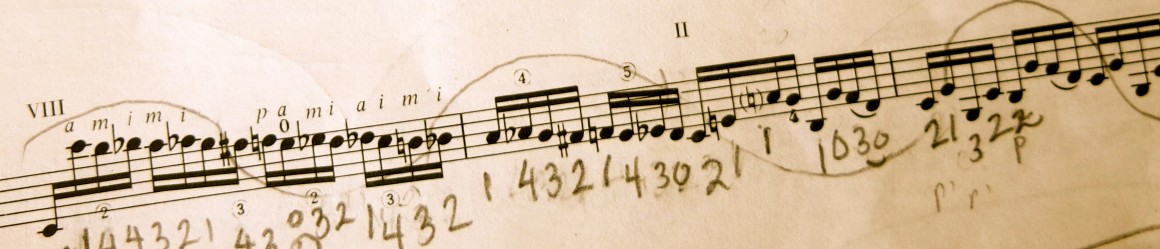
Heitor Villa-Lobos Etude Nº1, Part 2

images-1.jpgThe image I hold while playing Heitor Villa-Lobos’ Etude Nº1 is one where I am sailing above the canopy of the amazon rainforest as if it were an endless gentle green ocean. Putting this image into practice presents many challenges for the guitarist but simply having an image helps to move the fingers smoothly and with little resistance. Commanding the right-hand to execute the arpeggio to comfortably create the waves of this amazonian ocean, the crescendos and decrescendos, requires some persistence, though. And to truly master the image, it is equally important to investigate how the left hand moves from harmony to harmony, how softly we transition from chord to chord, and how the right hand waxes and wanes over the strings. Ocean waves have an inherent softness to them. To approach this quality in both hands, I’ve brainstormed a bit to list some key tips that I’ve focused on over the years:

LEFT HAND

  1. Release the finger responsible for the first note of the next harmony either at the fourth quarter note or last eighth note of the previous measure.
  2. Practice the transitions from the end of each measure into the following measure. For example, practice the last 4 sixteenth notes of a measure with the first four sixteenth notes of the following measure.
  3. Do not think block chords! Instead, imagine the left hand placing fingers more subtly. When possible, prioritize the left hand finger placement in the order that the notes are plucked.
  4. Work on avoiding finger noise in the second part of the etude by lifting slightly or shifting on the softer parts of the fingertips.
  5. Release pressure on inactive fingers to keep the left hand light.

RIGHT HAND

  1. In order to build endurance for the right hand, practice it alone while visualizing the left hand. What does it feel like to play the arpeggio with rhythmic precision 48 downloadtimes? This is the amount of times you would play it in the Etude before getting a break with the slurs.
  2. Once the right hand feels locked in, bring the left hand back. Are there pauses to adjust for the left hand?
  3. Think of the right hand in eighth notes, quarter notes, half-notes, and whole notes.
  4. Practice bringing out upbeats.
  5. Explore dynamic schemes to develop your own interpretation.
  6. Use aural refocus to think in larger gestures.
  7. Use rhythms to develop a thorough understanding of the patterns, transitional strengths, and transitional weaknesses.
  8. Practice planting from the beginning and then a quarter note after it is played for right hand stability.
  9. If you use the standard right hand fingering, try planting both and a.
  10. Use other right-hand fingerings to extract more insight from this wonderful etude!

Hope this helps.


David Russell Interview

Marcelo Kayath’s project, The Guitar Coop, once again publishes a wonderful interview in two parts. This time with guitar hero, David Russell. They talk technique, transcriptions, interpretations, ornamentation, guitars, and more.

Have a good weekend!

Yuri Liberzon plays Piazzolla

Another amazing video from Guitar Salon International capturing Yuri Liberzon performing one of Manuel Barrueco’s arrangements of Astor Piazzolla’s Tango Etudes for flute. Aside from the masterful, crisp, and articulate playing, this performance is particularly compelling given the beautiful 1912 Manuel Ramirez guitar he is playing.

I’m very excited to hear his soon-to- be-released CD ¡Acentuado! featuring all of these Etudes and more Piazzolla! Stay tuned.

How to Improve Coordination – Chromatic Octaves

Studio content
This article continues inside the Six String Journal Studio, where members have access to in-depth repertoire walkthroughs, practice guidance, and performance-focused writing.

Join the Studio

Artist Profile: Denis Azabagic

“Denis Azabagic demonstrated his unbelievable guitar playing skills, sincere love for music, professionalism and passion…” – CHICAGOTRIBUNE.COM

A GFA winner, seasoned concert artist, accomplished chamber musician and recording artist, Bosnian guitar great Denis Azabagic, needs no introduction to the classical guitar world. But, what often escapes even the most devoted afficionados may be the hidden gems among the pile of guitar videos on youtube.

I recently came across Denis’ Mastering Guitar Technique Series [scroll down a bit after linking]. Though you have to pay for each video, the lessons range from slurs to tremolo to scales and in my opinion are worth hundreds time what he is charging ($1.99!). Each video has a tremendous amount of insight and practical advice. If you’ve not heard Denis play, check out the video below of him playing brilliant renditions of standards by Sor, Bach, and Asencio, and then check out his technique series!

Recuerdos de la Alhambra Study Score

Studio content
This article continues inside the Six String Journal Studio, where members have access to in-depth repertoire walkthroughs, practice guidance, and performance-focused writing.

Join the Studio

Problem Solving in Pernambuco’s Interrogando

I was working on Joao Pernambuco’s groovy Interrogando with an extremely young and bright student yesterday. Despite his ability to absorb new material at a pace that inspires me, he was having a difficult time making this little part sound fluid.

Interrogando 1.jpg

After a bit of analysis, we agreed that it was due to the lack of clarity in the right hand. So, instead of playing it over and over, which is often default behavior for most students confronting a tricky passage, we decided to break it down and come up with a list of steps to once and for all solve the problem. Here are the steps.

Step 1 – Write out strings.

Interrogando 2.jpg

Writing out the strings as numbers also helps see patterns if you process information better that way (i.e. 5232 5423 1232 ).

Step 2 – Choose the best right hand fingering options. See this post for more about choosing the best options: Conde Claros, Scales, and String-Crossing.

Interrogando 3.jpg

We came up with two solutions. The top one was chosen by the student because his technique was more suited to it. I preferred the second solution given to my preference for aipi instead of amim.

Step 3 – Analyze where the right hand position change happens (if at all).

Interrogando 4.jpg

Step 4 – Practice the last box from Step 3 using right hand alone with a focus on rhythm.

Step 5 – Bring left hand into the game for that box only (right hand now does it correctly and proficiently and left hand has to catch up is a much better option than both hands struggling and doing it somewhat incorrectly).

Step 6 – Check in with the right hand alone again.

Step 7 – Go back to Step 4 and Step 6 with the second to last box. Add to last box.

Step 8 – Go back to Step 4 and Step 6 with the first box. Add to both boxes.

Step 9 – Do a few minutes of focus, take a mental rest, and go back for several more sets (building mental muscle!).

Step 10 – Check tempo and set tempo goals.

Not only could the student whip through the passage after doing this, his skills at identifying any confusion improved. Lots of “Oh!” and “Now that feels easy!”.

Problem solved!

Guitar Talk with Yuri Liberzon

Studio content
This article continues inside the Six String Journal Studio, where members have access to in-depth repertoire walkthroughs, practice guidance, and performance-focused writing.

Join the Studio

New Editions of Bach and Nárvaez

Little by little, I’ll be posting new editions of pieces I’ve played over the years. From Bach to Barrios to Technical Workouts and a Technique Book, stay tuned. The first two are finally up…

BWV999 Graphic.jpgGuardame Vacas graphic.jpg

https://sixstringjournal.com/music/