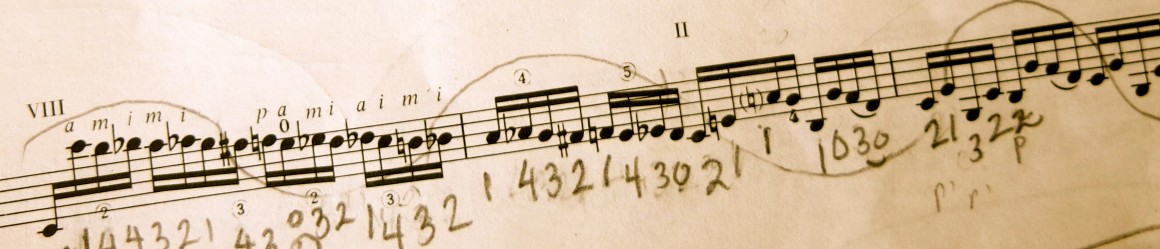
A few months ago I edited a new edition of Mauro Giuliani’s Variations on Las Folias de España, Op. 45 and have just made it available. Since I recently posted an article on the value of practicing chromatic octaves to build left hand coordination, I thought I’d post the 4th variation from Giuliani’s great work for all of you to test your abilities!
Young Turkish guitarist, Celil Refik Kaya, is taking the guitar world by storm. He has won numerous victories in some of the most important international guitar and concerto competitions with displays of stunning musicianship and brilliant technique.
In addition to playing some of the most demanding repertoire with what seems like a magical touch, Celil is a prolific and gifted composer as well, and equally at ease playing with top notch orchestras as he is playing solo.
In the interview below he shares some insight and tips with Six String Journal readers about his musical journey so far…
When did you start playing and why? What drew you to the guitar initially?
I started playing guitar when I was six years old because my father used to play classical guitar and many other instruments. He has been professionally playing Rebab which is a traditional Turkish bow instrument. My father was my first teacher and when I heard him play, the sound of the guitar was magical to me and not comparable to any other instrument. The year that I started playing guitar I wanted to be like Andres Segovia and John Williams who were my childhood idols. Besides playing classical guitar, I play many other traditional Turkish instruments such as Rebab and Oud which I learned from my father.
What repertoire do you enjoy playing the most?
I enjoy playing 20th and 21st century South American composers as well as 20th century Spanish composers. Besides those, I enjoy playing my own compositions.
What guitar or guitars do you perform on? Strings?
I have guitars made by Garreth Lee and Glenn Canin. Both are phenomenal guitar makers. I play both of my guitars depending on the setting of the concert. In fact I recorded my first album Jorge Morel Guitar Music from Naxos, with Gary’s double top guitar which has incredibly beautiful warm sound. I recorded my second album with Glenn’s guitar and it features the music of Carlo Domeniconi which will be released by Naxos. For both of my guitars I use D’Addario EJ46.
Which guitarists/musicians have had the most influence on you?
As a performer I was influenced by Andres Segovia, John Williams, Alicia de la Rocha, Maria Callas, Itzhak Perlman. As a composer I admire Puccini, Rachmaninoff, Ponce and Tedesco.
What recording/s are you most proud of?
To me every recording has its own unique quality.
Which recordings do you consider have the finest recorded sound for guitar?
Recordings that I have done with producer and guitarist Norbert Kraft were the finest I would say. When we listen to all of the Naxos guitar recordings that Norbert recorded, they all sound phenomenal.
What are some up and coming projects you are excited about?
I will be recording the last two volumes of Agustin Barrios Mangoré which I am very much looking forward to. Starting from September 2017, I will be a fellow of Harvard’s Dumbarton Oaks in Washington D.C. I was recently invited for this prestigious fellowship program and I am looking forward to my performances in D.C. as part of my fellowship program.
Technique and Performance
How much do you practice? And, do you structure your practice in any particular way?
How much I practice really depends on my schedule and what is coming up. I practice as much as I need to which can really change according to the importance of the concert or difficulty of the new piece that I include in the program. When I competed in competitions, I practiced about 8 hours a day which I divided as 2 hours arpeggios and scales and 6 hours repertoire. For concerts I practice 2 to 3 hours a day.
Are there aspects of guitar that you struggle with or that you find you are still working on?
Not in terms of technique. In terms of musicality every dedicated musician grows musically until the end of their lives.
Do you deliberately memorize music or have a technique that helps assimilate music into memory?
I memorize the pieces naturally very quickly. Therefore I don’t have a specific method that I use for myself. For my students I recommend them to read the music from the end to the beginning or sometimes making them play specific passages of the piece only. Because most of the time, guitar players play with the muscle memory rather than really knowing what notes or fingering they play and this can cause many problems such as memory slip and lack of control.
Have you published any editions or do you plan to publish your own editions in the future?
My transcription of Valses Poéticos by Enrique Granados was published by FDP publications in Austin and my original works such as Sonatina, Longing, Suite of the Witches and Dream were published by d’Oz publications in Canada. I am working on the next projects for publishing including some of my solo guitar pieces and chamber works.
Do you have a favorite drill/routine you use to warm up?
I generally warm up with playing passages slowly from the pieces that I am going to play in my concerts.
Do you have any pre-concert rituals?
I usually eat a banana and chocolate before performing. It significantly helps the energy and concentration.
Advice to Younger Players
What single most important piece of advice about practicing would you offer to younger players?
Practicing consciously and slowly. Whatever they are practicing, awareness of every single note and its quality should be the goal. Sometimes when a young player practices, they continue playing even if the passage is not perfect. It is very beneficial to have a self critical mind in that sense.
What repertoire do you consider essential for young/conservatory students to assimilate? Why?
I am always a fan of traditional classical guitar repertoire rather than only new works. There are many composers that young players don’t play anymore and I consider them the core of the guitar repertoire. Turina, Tedesco, Ponce, Torroba and many others are fantastic composers who wrote the skeleton of the guitar repertoire. Their works are not only challenging both musically and technically but they are also audience favorites. If a person hears classical guitar for the first time, it is very likely that they will like 20th century Spanish composers. What these composers achieved with the emotional expressivity of their works is not replicable.
Recordings that every young guitarist should be familiar with and why?
Every young guitarist should be familiar with the recordings of Andrés Segovia, John Williams, and Julian Bream. Today, the level of guitar playing is so much higher than before, but the foundation of the guitar technique and soul is hidden in those recordings. To understand rhythmic stability and inner pulse they should listen Williams. Although the aesthetic of musical interpretation has changed significantly, Segovia’s playing conveys great musical expressivity. Listening to these artists provides a great foundation. Besides listening to other great guitar players, learning harmony, counterpoint, music analysis, listening to orchestral recordings, chamber works, and great instrumentalists (non- guitarists) will transport young players to another level. After a certain point it is important to listen to more non-guitar recordings.
Tangent
What is the last book that you read?
The last book I have read was “A Composer’s World” by Paul Hindemith.
Do you try to stay healthy? Exercise? Follow a particular diet? Have a favorite pre-concert food?
I don’t follow a particular diet but I am trying to eat everything in balance. Since I am Turkish, the majority of the time I eat Turkish food and my wife loves it, too. Before concerts, I don’t have a particular pre-concert food as long as it is not too heavy.
What is your favorite way to spend time when not practicing?
I like to spend my time in coffee shops with my wife reading books and sometimes composing. Besides that, I also practice Wing Chun which is a branch of Kung Fu.
Known as Mexico’s “First Lady of the classical guitar”, Zaira Meneses, has been praised by the New York Times as “an arresting performer full of colorful touches” and has built a stellar reputation for her dark sound, powerful technique, and superb musicality. As a performer, she has graced the greatest stages of the world including New York City’s Carnegie Hall, Alice Tully Hall, Boston’s Jordan Hall, Salzburg’s Wiener Saal, and the Great Hall of the Shanghai Conservatory. As a recording artist, she has released the CD Latina and is releasing three new CDs on the Centaur label. Zaira is also active in the contemporary music scene and has had works dedicated to her by the great American composer, Robert Beaser, and by award-winning composer Stephanie Ann Boyd. Besides her collaborations with prominent musicians, like her husband Eliot Fisk, the flamenco virtuoso Grisha Goryachev, flutist Viviana Guzman, among others, Zaira is active as educator at the New England Conservatory’s Preparatory Division and as an outreach coordinator for the Boston Guitar Festival.
Here she is performing a beautiful voice and guitar piece followed by a stunning 3rd movement from Leo Brouwer’s Sonata.
When I mentioned featuring Zaira on Six String Journal, we thought it might be nice to add some personal details in a short magazine style interview so here it is:
What’s the most recent news in your guitar activities?I’ve become a baroque guitar soloist. I’ve also created a new guitar performance art approach with Latin American Collages where I combine guitar, poetry, acting, and singing. Another thing I’ve been enjoying lately is improvising with my requinto and jarana “jarocha” instruments from native Veracruz Son Jarocho music. I’ve also performed in some great venues this year: Carnegie Hall, Jordan Hall in Boston, and at the Mozarteum.
When did you start playing? At age of 7 years old.
What repertoire do you enjoy playing the most? Music that is rich in counterpoint, and that has interesting harmony, rhythms, and phrasing, such as Bach , Santiago de Murcia, Gaspar Sanz, and latin american music especially from Mexico and Cuba.
How much do you practice? It depends, if I have a performance coming up I don’t notice the time. On regular days I practice two to three hours.
Do you structure your practice? Yes. For concerts I prioritize memory reinforcement, sound projection, and how to connect with my audience.
Do you have a system or favorite drills you use to warm up? I start by playing the song I can’t wait to play because it will bring the best out of me. Then I practice the passages that I need to be improve.
Do you have any pre-concert rituals? I always meditate but before a concert I meditate to specific passages of the concert. I also do mind/rehearse [visualize] the music in the sauna and steam room a week before concert. Sometimes I run with the music I will be performing. I fall asleep reading the music. It really depends what performance I’m presenting but more or less I breath music as much as I can.
What is the last book that you read? Or the greatest book you’ve read this last year… Oh my gosh! I love the Austrian novelist Stefan Zweig. He’s a great writer and his books are full of imagination and detail. My favorite book is his short stories of “Forgotten Dreams”.
Any advice about practicing to younger players? Practice only if you want to practice. Practicing should come from your gut. Practicing is not a labor, it’s a need. It has to become your need otherwise its not worth doing it.
What guitar or guitars do you perform on? I use a guitar built by Stephan Connor and a Spanish baroque guitar.
Which guitarists have had the most influence on you? Oscar Ghiglia, Eliot Fisk, Joaquin Clerch.
Are there any recordings of guitar music that you think every young guitarist should be familiar with? Alirio Diaz’s Venezuelan Waltzes, Andres Segovia playing Spanish composers, any of Oscar Ghiglia’s Manuel Ponce recordings, Eliot Fisk’s playing Bach, Latin American guitar music, and his recordings of music by Robert Beaser.
Do you exercise? Do you think it helps your playing? YES absolutely! I run outdoors when it’s super cold and when it’s super hot. This helps me adjust my body to any hall circumstances.
What do you eat before a concert? If I can, my daughter Raquel’s best shake for performances: banana, almond milk, oatmeal, and chia seeds. If I’m in a hotel, I eat turkey or white meat and avocados. If I’m in hotels I also like to order Chinese steam ed vegetarian dumplings.
If you all were inspired (or recovered) from watching Ekachai Jearakul whip off Heitor Villa-Lobos' Etude Nº2, you may find this post helpful. While I was a student at the New England Conservatory, the second half of one of my degree recitals was simply Villa-Lobos' Twelve Etudes. While some of the etudes are manageable, others require relentless and careful practice, and they all have moments that can fill endless practice hours with frustration. To add to the matter, I was studying with the . . .
Studio Content This content is restricted to Six String Journal Studio Members only. Join for access.
This is the first Artist Spotlight piece where I hope to share a bit of news about very high level guitarists, highlight some of their videos, and point you in the right direction to explore their musical world.
The first artist I’d like to feature is Spanish guitarist, Ricardo Gallén. I met Ricardo briefly in 1999 at a guitar festival in Granada. He was teaching masterclasses as Eliot Fisk’s assistant and while I played for Eliot in that festival, I realize now that I missed an immense learning opportunity by not having taken a class from Ricardo!
Ricardo Gallén has been praised by countless great musicians, critics, and colleagues as a supreme virtuoso with an intense and wide-ranging musical intellectuality. The great Cuban composer and conductor, Leo Brouwer, has said that Gallén possesses, “great creativity and virtuosity that is felt only by looking at his hands.” Besides performing and teaching all over the world to high acclaim, he is becoming known for his recordings and performances of music by Johann Sebastian Bach and in particular, his lute suites.
For a long time, the standard recording of the great John Williams was the required listening as an introduction to these works but I would venture to say that Ricardo Gallén’s recording holds equal footing on many levels and perhaps even surpasses it in his highly nuanced and stylistic interpretations. Another strength that Ricardo possesses is his range in interpreting music from the great classical period guitar composers, Mauro Giuliani, Fernando Sor, to premiering new contemporary works by composers like Leo Brouwer.
Here is Ricardo’s webpage and his Facebook page for more current news on his musical activities. Below are some links to his recordings and a few beautifully filmed videos. Hope this inspires you all!
I thought I would take a moment to stress how important it is to know how to apply the principles from the last post to identify and problem solve mechanical weaknesses in repertoire you are working on. Because I am working on a lot of music by Agustín Barrios Mangoré (1885-1944), I thought I would use two examples of passages you all may be familiar with. I have played the music of the great Paraguayan virtuoso for decades and I still find it fun to work on. I especially enjoy his works with perpetual motion activity. Barrios’ Estudio de concierto, Las abejas, La catedral’sallegro, Danza paraguaya, and passages from his famous waltzes are perfect pieces to spend hours on. So, for this post, we’ll focus on using rhythms to strengthen our understanding and facility of the patterns in these pieces.
Estudio de Concierto
The following example illustrates 5 rhythms in which to work the arpeggio pattern for Barrios’ Estudio de Concierto. Begin by choosing the right hand fingering that most suits your technique. Whether you know the piece or not, practicing each measure in these rhythms will help develop the comfort of playing the arpeggio faster than if you were to only play in a straight rhythm, though it is necessary to do this as well (!).
Arpeggio Fingering Rhythm 1 Rhythm 2
Rhythm 3 Rhythm 4 Rhythm 5
Vals Op. 8, Nº4
Here is the campanella passage from one of my favorite pieces. This passage deserves more writing but for now I will limit myself to rhythms.
Because I know this piece well, I use rhythms to warm up and will often play through the entire section of the piece in as many as 16 rhythms. Here are four that I like to start with:
Rhythm 1 Rhythm 2 Rhythm 3 Rhythm 4
Do not feel obligated to go through the entire passage. Instead, spend some time repeating certain groupings in an attempt to make them feel natural and ultimately easy. You may find that you are better at some and that certain patterns remain sticky. Work on the sticky ones.
And, if you are not exhausted by this point, here are some additional groupings (notated in shorthand) rotating two eighth notes (represented by a space) through sixteenth notes:
pi am pi, pia mp i, pi ampi , p iamp i, pi a mpi
Or rotating a triplet of sixteenths with 3 eighth notes:
p i a mpi, p i ampi , p iamp i , piam p i
Or Using only one dotted eighth note (two spaces):
p iampi, pia mpi, piampi , pi ampi
I hope this helps. If there are any technical questions you are thinking about in your practice please leave a comment. I’m thinking about a post answering some common questions that I keep getting. And, in the future, I’m going to try to include a video to supplement the posts when I have the time. Until then!
Little by little, I’ll be posting new editions of pieces I’ve played over the years. From Bach to Barrios to Technical Workouts and a Technique Book, stay tuned. The first two are finally up…

 Young Turkish guitarist,


