Improve Your Right Hand Confidence, Part 1

The most important movements to confident right hand technique include alternation between pairs and groups of fingers and how these fingers move across strings. To that end, as part of your daily warm-up, try the next several exercises using various speeds and the most common right hand fingerings: im, mi, am, ma in both rest stroke and free stroke. If you have extra time, add in the following fingerings in free stroke: ia, ai, ami, pi, pm, pa.

Here are several key practice points:

  1. Strive to play with a sense of pulse, resisting the urge to play every note with the same intensity.
  2. Focus on the quality of sound and whether it is consistent from finger to finger.
  3. When not using thumb (p), rest it lightly on the lower string adjacent to the string that is played. Experiment with resting it two or three strings away and sense the subtlety of how it influences the alternating fingers.
  4. Stay close to the strings.
  5. Use a metronome. Record your progress in terms of tempo.

Exercise 1

Exercise 2

Exercise 3

Exercise 4

Miss the last posts?

Two of the Best Tremolo Exercises

Studio content
This article continues inside the Six String Journal Studio, where members have access to in-depth repertoire walkthroughs, practice guidance, and performance-focused writing.

Join the Studio

NEWS! Complete Technique Video Course Launch!

Studio content
This article continues inside the Six String Journal Studio, where members have access to in-depth repertoire walkthroughs, practice guidance, and performance-focused writing.

Join the Studio

Mastering Scales, Part 1 – Rhythmic Manipulation

Studio content
This article continues inside the Six String Journal Studio, where members have access to in-depth repertoire walkthroughs, practice guidance, and performance-focused writing.

Join the Studio

Nine Tips for Better Playing

I love the early stages of learning new repertoire because my ears, eyes, and fingers are most alert to discovery. My process of learning has evolved dramatically from when I first became afflicted with the classical guitar bug. For many beginners, the goal is simply to find a way to get the fingers to the right places and enjoy the results. As beginners approach basic fluency, the process of learning involves more and more layers of thought and reflection, of crafting and re-crafting, of listening and sculpting. As intermediate players reach a more advanced level, the amount of thought about what is going to occur on both a musical and physical level during the very early stages sets the stage for clean, efficient, and musical playing that seems seamless to the less experienced player.

Incorporating the following tips and principles will yield the best and most reliable results if they are incorporated in the early stages of the learning process. Exploring the ideas on repertoire that is already baked into your brain will take some careful and deliberate work to incorporate. Think of it like cooking a complicated dish, if all is measured carefully and timed precisely, the end result is wonderful. On the other hand, if you have forgotten to include ingredients in the baking process and attempt to salvage it by throwing in missing ingredients after the dish is done, the end result may not be as wonderful.

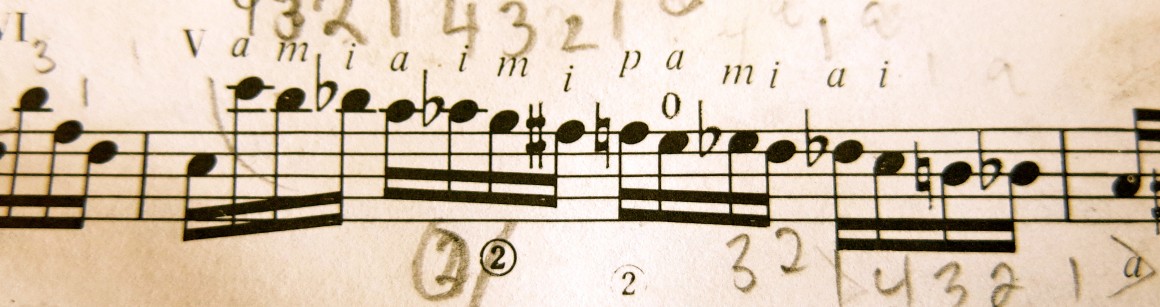
When learning a new piece, there is information absent from the score that if written in reminds you to weave them into your hand choreography when you practice. Below is a list that will help make both the left and right hands more efficient and two shots of a Scarlatti Sonata I just learned to illustrate how I label these items in a score. Assuming your basic fingerings are decided upon, incorporate the following ideas into your slow practice (and label them) to build a strong and reliable visual memory and choreography:

Right Hand

  1. Know when the fingers can plant or are laid out as an arpeggio (even though it may be the beginning of a scale passage).
  2. Know where your stability points are at all times. There should always be a right hand anchor in contact with the strings (usually p or a but possibly a combination).
  3. Insure string crossing is optimized and know when there are exceptions. See this early article for reference.

img_4902-1.jpg

Left Hand

  1. Know when two fingers can place at once (usually in descending melodic fragments).
  2. Know when a finger can remain in place as an anchor and for how long.
  3. Know exactly what and why you are barring. Is it a hinge, partial, tip, cross, full, etc… (maybe there’s content for another post here!)?
  4. Know when a finger must lift from active duty to align or migrate to a new fret or to relieve tension. This sometimes means that theoretically a note may not last it’s full value.
  5. Know when you are shifting and/or expanding or contracting out of a standard relaxed position and for how long.
  6. Know your guide fingers (never shift without a guide or ghost guide finger).

img_4901.jpg

Hope that helps you get to your musical goals sooner!

If you liked this article and would like more technique tips, check out Six String Journal’s publications! Please share, like, and comment!

Heitor Villa-Lobos Etude Nº1 – Rhythms

To continue with our video series on Heitor Villa-Lobos’ Etude N°1, I’ll explore how to use various rhythms to develop rhythmic precision, right-hand preparation, control, and clarity.

Hope this helps!

Heitor Villa-Lobos Etude Nº1 – Right Hand Fingerings

After repeated requests for more videos, I’m eager to share this post and upcoming video series on Heitor Villa-Lobos’ Etude Nº1. In this first part I’ll explore the advantages and disadvantages of the standard fingering that Andrés Segovia wrote in the published edition. I’ll then offer some options for practicing the Etude. In Part 2, I’ll go through some options to overcome the disadvantages and finally arrive at my preferred fingering.

For a reduction of this, check out my first post on Villa-Lobos’ Etude Nº1.


From the Archives: Miracle Right Hand Warm-Up Sequence

Studio content
This article continues inside the Six String Journal Studio, where members have access to in-depth repertoire walkthroughs, practice guidance, and performance-focused writing.

Join the Studio

Technique Practice on Albéniz’s Sevilla

Studio content
This article continues inside the Six String Journal Studio, where members have access to in-depth repertoire walkthroughs, practice guidance, and performance-focused writing.

Join the Studio

Jacob Cordover Interview

Studio content
This article continues inside the Six String Journal Studio, where members have access to in-depth repertoire walkthroughs, practice guidance, and performance-focused writing.

Join the Studio