If Mauro Giuliani’s works are in your repertoire, or those of any classical period composer, you will know that interval runs of octaves, sixths, and thirds are used to great effect. Think the fourth variation of Giuliani’s Folias Variations (Op. 45) or the grand finale to his 1st Rossiniana (Op. 119)! Interval runs are everywhere in our repertoire and it’s worth studying them either through repertoire or through scale practice.
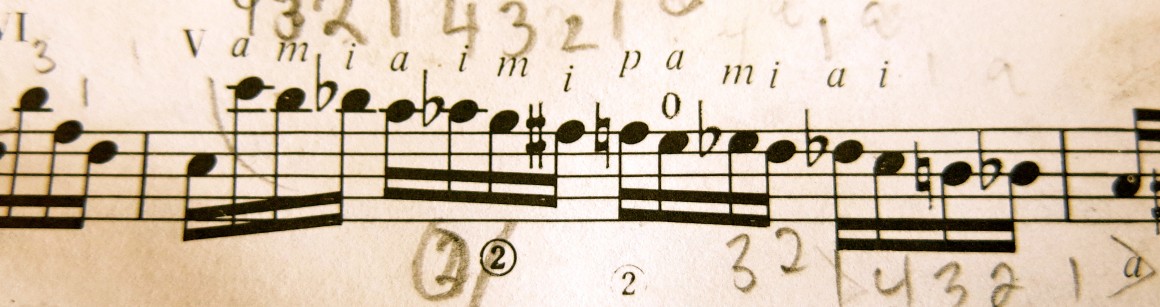
The two chromatic octave exercises below should get you started. They are useful for warming up, coordinating the hands, independence and opposing movement in the left hand fingers, and can even serve as a vehicle for right-hand development, too. Here are a few ways to focus on them:
Start very slowly and pluck both notes with simultaneously. No rolling!
Keep the wrist relatively still so that the fingers of the left hand are extending and contracting vertically (i.e. often moving in opposite directions from each other).
Keep the left hand fingers soft and close to the fretboard.
Use right-hand fingerings: pi, pm, pa, pmpi, pipm, papm, pmpa, papi, and pipa.
Once this feels comfortable and in control, explore some variations like the one below.
Use right-hand fingerings: pi, pm, pa, pm pi, pipm, papm, pmpa, papi, and pipa.
Let me know if you find this helpful. Part 2 coming soon!
Greater confidence leads to stronger performances. There is a great difference in the confidence of a runner who approaches the start of a marathon having done the bare minimum training and that of the runner who has trained with variety, intensity, creativity, and persistence (and supplemented that training with a healthy diet, careful recovery, and mental preparation).
As a concert approaches, vary your study approach, take notes, and explore as much as possible to gain a better understanding of what yields the best results on stage and what makes you perform at your best. Depending on how well I know the music, I may start preparing months ahead of time or a few weeks from the date. Here is a checklist of actions that start to occur during the preparatory stage that are true confidence builders:
Warm-up with a focus on relaxation.
Befriend your metronome. Play all your pieces at a very slow tempo (for example, the Allegro from Barrios’ La Catedral at 1 sixteenth note/second, or a tremolo piece 1 note/second). I pick a quarter of the program and make sure that by the end of 2-3 days, I’ve practiced everything at a VERY slow tempo. Manuel Barrueco thinks slow-practice may be the best way to practice.
Build a list of troublesome passages or excerpts that do not feel effortless. Practice right hand and left hand alone going from very slow to as far beyond concert tempo for repetitions, practice in rhythms, analyze the space between notes, watch youtube videos of someone wonderful playing them to glean possible modifications, exhaust your resources to make the passages in question effortless. Before increasing tempo, try to nail 5 repetitions in a row. Keep a record of tempo and tally how many repetitions you’ve successfully done. When focus fades, move on to a different excerpt or take a little brake.
Record yourself. I’m not a fan of this but sometimes you have to do what you have to do to improve. If you truly want to assess what you sound like, it is necessary.
Exit practice mode and enter performance mode by performing run-throughs. Play a run-through of each half of the concert at least once every two days over the course of the month preceding the actual concert. Two weeks from the performance, videotape the entire concert or perform it for a friend, a student, or colleague. Several full-length run-throughs always help to improve concentration. If you have time, experiment with performing run-throughs when you are tired, not warmed-up, or cranky. Perform it while the radio is on, perform it in the dark, etc… Learn to turn on your performance mode.
Break up your practice into several sessions a day. For example, instead of one large chunk of time (9AM – 1PM), try 9-11, another session 1-3, and then another 9-10. Don’t go more than 12-14 hours without touching that guitar.
Visualize the performance before falling asleep. Imagine the stage, imagine yourself on it, imagine every piece from the first note to the last. If you can’t ‘see’ what your fingers are doing, you probably do not know the piece as well as you think you do. If you have trouble visualizing, create a playlist of your favorite guitarist/s or of your best performance of the pieces and listen to it while you play along in your head. The music will serve as a bit of an anchor for your mind’s inner ear while you try to visualize along. Another technique is to watch someone play it and play along in your head.
Meditate often. A simple focus on your breathing for 5-10 minute periods throughout the day is a good start. I’ll write more on this in the future, but as a long time practitioner of yoga, pranayama, and other modes of meditation, meditation is one of a few things that always improves my day and centers my mind.
One of the easiest ways to improve right-hand arpeggio studies like Heitor Villa-Lobos’s Etude Nº1, Leo Brouwer’s Etude Nº6, or Francisco Tárrega’s Estudio Brillante, or the parts of pieces where arpeggios occur for an extended time is understanding when exactly the left-hand fingers must place or release to prepare for the next note or chord formation. Often, fingers are placed too early or too late, and both situations either overexert the fingers, the nerves, or worst of all, the musical intent. Arpeggios are, after all, broken chords. It is very rare that all fingers should place at once if they come in ‘broken’.
Sequential planting of the left-hand fingers is a skill that choreographs left hand movement to a deeper and more subtle level than simply grabbing at the next chord frantically at the start of a measure.
Here is a simple but effective exercise to help develop the principle of timely left-hand finger placement. The key is to time the placement of the new finger in relation to the meter and when it is due to enter and to avoid arbitrarily placing it at the beginning of the measure.
Go through each exercise a few times plucking every single note of the arpeggio. Once this feels comfortable and the timing is starting to feel synced with both hands, slur the entering note in time to develop a sense of pulse in the left hand, too.
Exercise 1
Exercise 2
Exercise 3
Exercise 4
There are infinite ways to expand this concept but one of my favorites is to move into cross-rhythms with accents. My idea of fun!
Exercise 5
Explore your arpeggio pieces to see if you can apply this concept and let me know if it helps!
Dutch guitarist extraordinaire, Enno Voorhorst, took some time out from his busy schedule to give Six String Journal readers insight into his personal and musical life. From eating bananas before a performance, reading García Márquez, to his upcoming project of recording late Roland Dyens’s Concerto Metis, hope you enjoy this as much as I did!
Personal
When did you start playing and why? Or, what drew you to the guitar initially?
I was thirteen when I got my first guitar and was immediately sold. I had played the violin for 6 years already, so the development went very quickly because of this advantage and that was of course very stimulating.
What repertoire do you enjoy playing the most?
My repertoire preference is music with nice melody lines. I see the guitar more as a melodic instrument than as a chordal instrument. A piano or harp can’t influence the sound after playing, nor do they have much the sound variety that a guitar has! This is the same like all other melodic instruments.
What guitar or guitars do you perform on? Strings?
I play a Simplicio model moderno copy from 1930. It is made by Federico Sheppard and it has a double soundhole on both sides of the fingerboard. I like the sound possibilities and the clear full bass. For that I use Savarez Corum hard tension.
Which guitarists/musicians have had the most influence on you?
Of course my first teacher influenced me the most, Hein Sanderink. He came from the school of Ida Presti and was very concerned with a good sound but he is also a fantastic and clever musician. After that, I studied with Huber Kappel and had masterclasses with David Russell who both influenced me a lot. Kappel because of his expression and Russell because of his mastery and open mindset.
What recording/s are you most proud of?
Every next recording I think is the better. My last recording is the most mature; Bach, Pärt, Desprez. I think here I played the most freely and expressively with a program that suits me well.
Are there any recordings that you consider have the finest recorded sound for guitar?
This is hard to say. As a musician I listen to the music first and when I like it I also like the recording but I know that I’m probably not objective…
What are some up and coming projects you are excited about?
In September 22-25 2017 there is a Camino Artes festival where I will perform a new duo with Laura Young. David Russell will also be there to celebrate the 500th concert in this series of concerts for the pilgrims walking towards Santiago the Compostela in beautiful old churches. After that I will record a CD of Roland Dyens’s music consisting of many solo pieces and his Concerto Metis with one of the best string orchestras of the Netherlands. I’m really looking forward to this as a tribute to this great person, friend, and unique composer.
Technique and Performance
How much do you practice? And, do you structure your practice in any particular way?
Yes I practise a lot, still 4 hours a day or more. It depends on the concerts I have to play and the programs I have to prepare. I also play in two duos what I like very much for the repertoire; one with oboe and one with the viola. Great combinations!
Are there aspects of guitar that you struggle with or that you find you are still working on?
Technically, many problems have been solved over the years, but relaxation always remains an important issue. Of course relaxation of the whole body, but also of the fingers that have nothing to do. This gives the possibility to prepare the next finger movement. A well prepared finger is half the work!
Do you deliberately memorize music or have a technique that helps assimilate music into memory?
I like to memorize the music because it settles better in my brain that way. A memory is actually an association you make with notes, rhythm, harmony, movement, etc. The more associations you make the better it is, so a good understanding of solfège and harmony is important. Playing a piece from memory should be an automatism!
Have you published any editions or do you plan to publish your own editions in the future?
There have been some publications. At the moment I do not take the effort to have more transcriptions published because of a lack of time. But I’m happy to share them with anybody who asks me by mail. The guitar world is small and I like this feeling of connection with each other.
Do you have a favorite drill you use to warm up?
My warming up consists of some scales, slurs, and arpeggios. Furthermore, playing tremolo pieces relaxes and balances my right hand and helps the left hand find the strings more precisely.
Do you have any pre-concert rituals?
I eat one or two bananas.
Advice to Younger Players
What single most important piece of advice about practicing would you offer to younger players?
Never lose the joy in playing, so play the pieces you love. When you don’t feel like practicing something, first do what you desire to do. The guitar is your friend and not the opponent.
What repertoire do you consider essential for young/conservatory students to assimilate? Why?
The studies by Fernando Sor are definitely very important because of the quality of counterpoint, structure, and refined harmony and melody.
Recordings that every young guitarist should be familiar with?
Listen as much as possible the music you love over and over again. All music, not only guitar! I listened to Glenn Gould playing Bach very often or the duo Presti/Lagoya.
Tangent
What is the last book that you read? Favorite author/s?
The last book I read was Ida Presti Her Art about the life of Ida Presti. It is written by her daughter Elisabeth. It is very interesting to read how the guitar developed after the second World War. One of my favorite authors is Gabriel García Márquez with his magic realism…
Do you try to stay healthy? Exercise? Follow a particular diet?
I like to go running with my dog in the woods behind my house and that gives me energy. I think that good health is important to play an instrument on a high level, not only physically but also mentally.
Want to feel more accurate when playing through your pieces? Want speedy scales? Want fluid arpeggios? Want to be a guitar superhero? Work on basic movements. Hard work on the very basic movements of technique allows an inner exploration of our limits and abilities while giving us a bit of a roadmap for quantifiable and steady improvement.
Below are some very basic right hand drills that find their way back into my warm-up and finger routines often. It’s not that I need to practice them much anymore but rather they allow me to continually refine the most important movements necessary for pleasurable music making. They also allow me to set both short and long term tempo and endurance goals.
Try going through each of these three drills with the suggested fingerings. If you are more of a beginner, spend time on the bold faced fingerings, if you are more advanced, go through all fingerings in search for what does not work well, then focus your energy there. Don’t neglect the basics, though!
Follow these guidelines:
Use a metronome and start slowly (quarter = 50-60).
Go through each drill at least 3 times (I do 5 if I have time) with each fingering. Increase tempo slightly for each one.
Do not sacrifice clarity and movement efficiency.
Focus on the quality of the movements and the sound.
For patterns involving three fingers play three repeats to hit all permutations.
Exercise 1
Exercise 2
Fingerings
Play the following drills using free-stroke and by relegating each right hand finger group across the three strings (for example, with ima, place i on string 3, m on string 2, and a on string 1).
Play each of the seven movements for at least 4+ repetitions or set a timer for 30-45 seconds.
All free-stroke: ima, pim, pma, pia
Exercise 3
Try dedicating 60 days in a row (or with as much consistency as possible) to these movements and you will see results. Also, if you want a simple goal. Try to get each movement up to quarter = 126 over the course of the 60 days. Or, shoot higher! Why not?
David Russell is a guitar hero for many reasons but one of them is for his ability to make everything he plays look effortless. Here is another masterclass snippet where he provides insightful guidance on the importance of a proper warm-up routine. He makes the analogy to sports, where warming up the muscles for practice helps to refine the motion and muscles necessary to perform efficiently. If muscles are not warmed up, larger muscles take over causing imbalance and tension.
Even if you do not speak Spanish, you can follow David’s crystal clear and carefully conceived approach to warming up. Nevertheless, I’ll summarize a few key points:
Start with very simple movements in the left hand like ascending slurs with all the pairs of fingers (12, 23, 34, 13, 24, 14).
Move on to the right hand and work on perfecting a single finger free-stroke with each finger (i, m, a, p)
Go back to the left hand and work on descending slurs (21, 32, 43, 31, 42, 41).
Back to the right hand to work on alternation between pairs of fingers (im, mi, ma, am, etc.). During this time, focus on the effort and resistance it takes each finger to pull through the string. Adjust nails as necessary to create equal resistance. Otherwise, there is imbalance and this will compromise your fluidity. Also, moving from i to m may be easier than moving from m to i. Your job is to make both directions feel as equal as possible.
Move on to imi, mim, ama, mam, etc., then incorporate slight accents imi, imi, ama, ama, etc…
Back to the left hand to try compound movements (121, 212, 232, 323, 343, 434, etc…)
Back to right hand to work on imim, mimi, amam, mama, etc… then try doing these movements cross-string.
Then bring the warm-up to a close by spending 10+ minutes coordinating both hands with scale fragments: im with 12, 23, 34, 13, 24, 14, mi with 12, 23, 34, 13, 24, 14, etc…
I think I’ve now scoured most of Pavel Steidl‘s masterclasses on youtube. What a treasure trove of advice. I absolutely love him, his creativity, and his masterful ability to teach in such a fun way.
Here is a left hand technique progression that roughly matches what he demonstrates in one of his masterclasses. Pavel recommends at least 30 minutes a day of work for the fingers. Among his bits of advice and reflections, there is a moment in a masterclass where he talks about left hand choreography and how it is connected to the part of our brain that is responsible for, as he puts it, “fantasy and imagination.”
Here is the sequence to explore:
Step 1
Play the top voice as a continuous slur.
Move on to the next step or repeat with the remaining patterns:
02/1343, 03/1242, 04/1232 (slur/counterpoint)
Step 2
Now slur the counterpoint or fixed note as well.
Move on to the next step or repeat with the remaining patterns (see above).
Step 3
Add in a coordinating movement in the right hand (try something simple first).
Move on to the next step or repeat with the remaining patterns (see above).
Step 4
Explore a more challenging coordinating movement in the right hand (try pami on string 5).
Lately, when starting my practice I will start with an assortment of left hand movements. I go slowly with attention to the fluidity of the movements. While I do this, my ear starts to focus. The easy pace is ideal for adjusting tone and exploring left hand movement before moving on to arpeggios, scale fragments, and spots in pieces.
Here is a slur sequence I really enjoyed focusing on yesterday. It involves playing slurs with a pair of fingers, slurs to and from open strings, all while requiring the precise placement of the fingers to create tunnels so that adjacent strings remain unobstructed. Fun!
I immediately thought: BLOG POST!
Here’s the outline of the movement using fingers 12 but you should try all pairs (23, 34, 13, 24, 14). You’ll get more out of the exercises by repeated each slur many times and of course, play them across all strings and positions.
One aspect of Ángel Romero‘s edition of Joaquín Rodrigo’s Concierto de Aranjuez is that every single scale is fingered optimally for string crossing so that m almost always reaches towards a higher string when blazing through the scale passages (i.e. when going from string 2 to 1, it is fingered i m and not m i). And while you could employ slurs or shifts to maintain optimum string-crossing, if those solutions are not musically in the cards there is a finger standing on the sidelines waiting eagerly to help: a. Using a to switch from im alternation to mi alternation without skipping a beat is an important skill to develop for situations where you would want to maintain optimum string-crossing for the right hand. Here are a few exercises using a to develop this technique.
Keep the following points in mind when going through these.
Rafael Elizondo is a fabulous Mexican concert guitarist who has been making wonderful videos for his youtube channel. If you don’t speak Spanish, you may not be at too much of a disadvantage because he demonstrates everything very clearly. This instructional video below is a fine example of Rafael explaining how to use fixed fingers to establish stability and confidence in the right hand.
Here is another great one where he demonstrates 4 finger coordination patterns for the left hand:
Check out and subscribe to his channel. There are tons of great posts.
 any classical period composer, you will know that interval runs of octaves, sixths, and thirds are used to great effect. Think the fourth variation of Giuliani’s Folias Variations (Op. 45) or the grand finale to his 1st Rossiniana (Op. 119)! Interval runs are everywhere in our repertoire and it’s worth studying them either through repertoire or through scale practice.


