The Best Guided Warm-Up for Your Left Hand, Part 2

I’m in the process of creating a new series of guided warm-ups for my students. Here is Part 2 for Six String Journal readers. In these guided warm-ups, I’ll go through some of the most important drills to help you establish a good routine for warming up before practicing your repertoire.

So go grab your guitar and get comfortable. In this second video, I’ve set the metronome for quarter = 60. We’ll go through the first part of my go-to slur routine. For the right hand, I simply use p for strings 6, 5, and 4, and then use i, m, and a for strings 3, 2, and 1. Follow along, stay aware of good form, stay relaxed, and stick with it until you can start to increase tempo with a good foundation.

If you’re a beginner, take it slowly and don’t wear your hand out. Pause occasionally for rest and let your hand catch up. It might help to just watch the first few minutes to get a sense of how it unfolds for the fingers.

Warm Up With Me!

I’m in the process of creating a new series of guided warm ups for my students. Here is part 1 for Six String Journal readers. In these guided warm ups, I’ll go through some of the most important drills to help you establish a good routine for warming up before practicing your repertoire.

So go grab your guitar and get comfortable. In this first video I’ve set the metronome for quarter = 60. We’ll string cross with single and pairs of fingers and go through a great slur routine with all the pairs of left hand fingers. For the right hand, I simply use p for strings 6, 5, and 4, and then use i, m, and a for strings 3, 2, and 1. Follow along, stay aware of good form, stay relaxed, and stick with it until you can start to increase tempo with a good foundation.

Six Tips to Master Tremolo

Over the years, I’ve posted several times about tremolo technique and even wrote the book Mastering Tremolo. Check it out if you haven’t yet! Nevertheless, there are times when I decide to spend a lot of time working on certain techniques to brush up, improve, try new approaches, revisit, and revise. I did this with tremolo this week and though I may have mentioned them in my book, some stood out to me. Here are a few entries I wrote in my practice notes:

  1. The movement from p to a is key – This is a feel thing. Think of snapping with p and a. As p articulates the bass note, a lands with some energy. It is almost like they are landing at the same time but not quite, allowing the melodic note on the higher string to vibrate justy a bit more.
  2. Nails – Each nail has to offer identical resistance to the string so that the quality of evenness is built in. If you are negotiating different stroke strength from finger to finger, it is too much effort.
  3. Proximity – Watch fingers closely and observe their distance from the string before the contact point and subsequent stroke. If there is too much discrepancy between the lineup, it can lead to galloping.
  4. Evenness – When practicing slowly, evenness is very important for both the attack and the silence or momentarily planting between notes.
  5. Left Hand Softness – Make sure the choreography of the left hand is worked out well. Abrupt motions in the left hand to make shifts can manifest in the right hand as accents. Keep the left hand as relaxed as possible.
  6. Right Hand Fingers – Sometimes increasing the perception of space between the right hand fingers seems to help me even out the notes. Try it.

Six String Journal’s Complete Technique Course on Sale

Have some time to work on your technique over the holidays? Through December, my course Complete Technique for Classical Guitar will be on sale through Six String Journal’s Podia page. Use this COUPONCODE for a 20% discount.

Six String Journal’s Complete Technique for Classical Guitar Course was developed for the advancing beginner with some experience, the advancing intermediate guitarist, and will even benefit those with lots of playing experience. Though music theory isn’t necessary, a rudimentary understanding of rhythm is helpful.

The course consists of primary movement videos where I will teach the foundational movements that you’ll need in order to master classical guitar. These videos cover topics such as free-stroke, rest-stroke, arpeggios, alternation, scales, hand coordination, slurs, and shifts. These are followed by several series of secondary videos where I’ll apply the techniques and movements in various ways to help you engrain them into your own practice. Stringing the secondary videos into a sequence will teach you how to form an effective practice routine that will maximize your results and get you closer to your musical goals.

Course Includes

  • Hours of focused technique lessons with an award-winning classical guitarist, the founder of Six String Journal, and sought-after educator. 
  • Over 50 extensively detailed but digestible videos demonstrating essential foundational movements, technique tips, exercises, routines, and how to implement them into your practice, carefully edited in small bite size videos for easy assimilation and viewing.
  • Printable PDF summarizing the entire course with a condensed visual of the material presented. 
  • Loads of bonus content from Six String Journal’s Mastering Diatonic Scales.

Four Essential Ways to Work on Tremolo

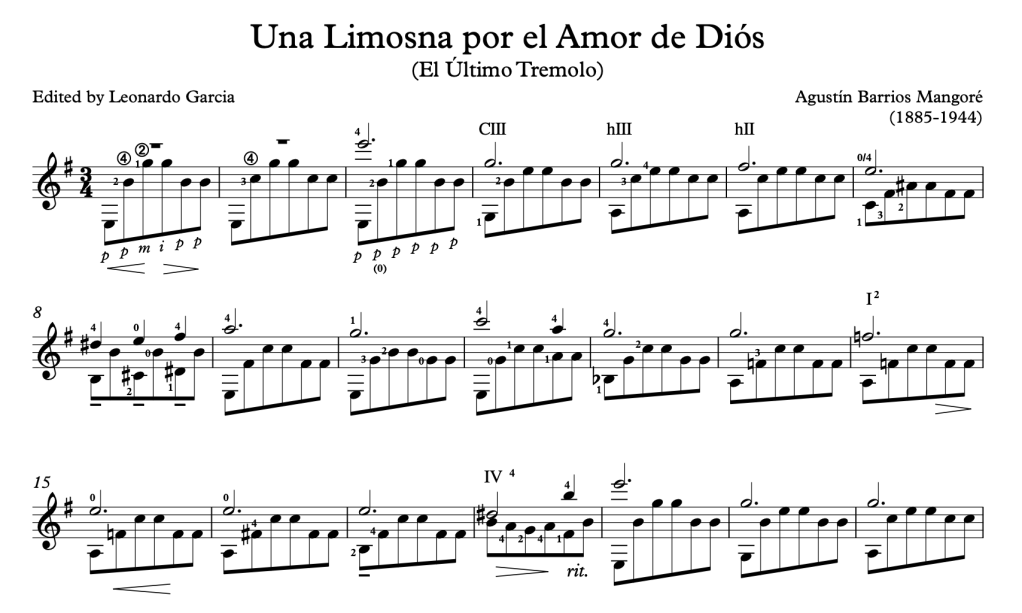
In the video below, I demonstrate four great ways to help your tremolo improve. Two of them I’ve outlined in my book Mastering Tremolo, which if you haven’t picked up, you should : ). But the last two I came across in Abel Carlevaro’s hand-written notes to himself in one of his editions of Agustín Barrios Mangoré’s Una limosna por el amor de Diós. Below you’ll find links to Mastering Tremolo and a NEW study score of Barrios’s Una limosna. Hope it helps.

Mastering Tremolo on Amazon

Mastering Tremolo on Podia

Una limosna por el amor de Diós (Agustín Barrios Mangoré) study score

Twelve Tips on Rolling, Shifting, and More

by Leonardo Garcia

I originally thought I would do videos to show some of the concepts below in practice but in anticipation of that I thought this might help some of my students so I’ll post it now. These are some recurring themes that I encounter in lessons that have solved a lot of little musical hiccups. Hope they help.

Chord Rolling

  1. When rolling chords where should the weight of the right hand fingers be distributed? I find that even though we tend to roll towards the a finger in a musical context that not ‘feeling’ the weight behind the i finger leads to a less rhythmic roll.
  2. Accompanying chords can sound really nice when subtly rolled. I recently listened to John Williams’s old Barrios recording and loved his playing of Choro de Saudade. He is very free with the harmonic background even when grooving.
  3. When playing an ornament with a bass note (like all over Capricho Árabe), I find that rolling the bass and first note of the ornament diffuses the rhythm a bit too much unless (maybe) it is a cadential ornament. Maybe not the best place to roll.
  4. Rolling p – Practice this to make it sound less like a guitar affectation and more like an organic roll. Or in the case of playing thirds in a piece like the Gran Solo (Sor), roll with the intention of it sounding like one note. Imagine both strings as one large string the thumb has to traverse in its stroke.

Shifting

  1. Shifting with a relaxed (or less rigid) left hand wrist always feel better and leads to less unintentional accenting when landing in the new position.
  2. Sometimes it helps to keep left hand finger pressure down before glissandos to minimize string squeaks.
  3. Always shift using a guide finger and always relax the left hand thumb away from the back of the neck prior to a shift.

Listening and Accountability

  1. As I play through repertoire, I find that shifting my aural focus to a particular voice can be disorienting sometimes because of the tendency to grow accustomed to ‘hearing’ the music unfold in relation to the melodic content most of the time. So I like to change it up by listening for the bass lines or by shifting my attention to the supporting voices or even to exaggerate (or exaggerate another voice) the melodic content to keep listening in new ways.
  2. Stop whenever something does not sound optimal and study that moment. Then place it back into context by a few notes or measures. Keep asking why and what. Why does it not feel comfortable? What do I want the phrase/pair of notes/background/melody, etc., to sound like? Can I make one note sound the way I want? Two? Why did it work? Can I replicate what is not working so I know how NOT to do that? If you keep playing something that you know doesn’t sound quite right, it is basically how you will play the piece. Don’t rely on luck, if you only nail it 1 out of 4 or 5 tries. Hold yourself accountable.

Speed

  1. Think of gestures especially during faster passages. Find groups of notes and tie them into one physical gesture that feels comfortable to do. Consolidate movements and placements to make many notes fall into one activity for the hands. This is why it is good to practice arpeggio formulas and scales in abstract.

Meter

  1. During scale runs, focus on hearing the main beat subdivisions. If you have 4 quarter notes worth of sixteenths, after working out the correct fingerings in both hands, spend some time listening and then aiming for the quarter beat or the half beat regardless of where the high point of the run is.
  2. Clarity in your playing is enhanced if you know where all the downbeats are in relation to your left hand (and right!). It sounds obvious but play though a piece and just think of downbeats and left hand. Try the same for downbeats and right hand.

Thanks for reading.

One-Time
Monthly
Yearly

Make a one-time donation

Make a monthly donation

Make a yearly donation

Choose an amount

¤5.00
¤15.00
¤100.00
¤5.00
¤15.00
¤100.00
¤5.00
¤15.00
¤100.00

Or enter a custom amount

¤

Your contribution is appreciated.

Your contribution is appreciated.

Your contribution is appreciated.

DonateDonate monthlyDonate yearly

33 Ways to Improve Ears, Fingers, and Fingerboard Familiarity

Moveable Scale Forms for Development

by Leo Garcia

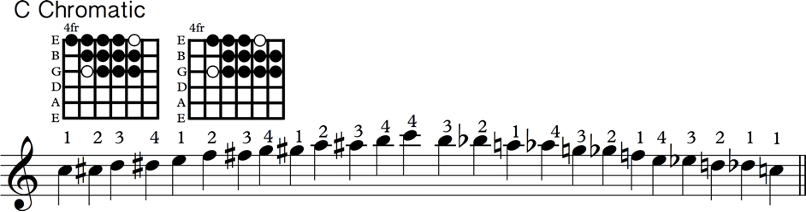
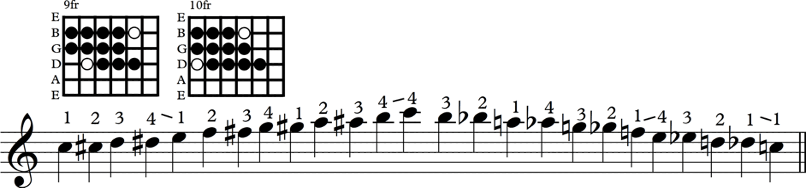
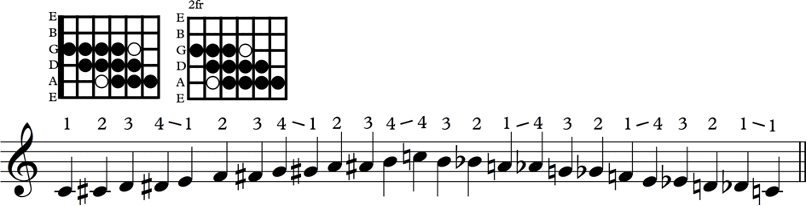
After watching Eliot Fisk demonstrate all of these, I thought I would write them out and share them with students. I have to confess that although I practiced scales religiously (and still do) I rarely ever went through modes. There are many reasons to work on these though: ear training, technique development, and for fingerboard familiarity.

The first form has the root starting on string 3, the second form has the root starting on string 4 and the third form works for both strings 5 or 6. Two-octave forms can easily be assembled by combining two forms. Scale diagrams have been included as I find them extremely helpful for visualizing the pattern as it falls on the fretboard.

There are 33 forms ahead, better get started. : )

For a pdf click here: Moveable Scale Forms


Here are some more resources for scale practice:


Leo’s Scale Book: https://sixstringjournal.podia.com/si…

More Guitar Publications: https://sixstringjournal.podia.com/

More Publications: https://sixstringjournal.com/music/

Leo’s YouTube Page: https://www.youtube.com/c/LeonardoGarciaguitar

One-Time
Monthly
Yearly

Make a one-time donation

Make a monthly donation

Make a yearly donation

Choose an amount

¤5.00
¤15.00
¤100.00
¤5.00
¤15.00
¤100.00
¤5.00
¤15.00
¤100.00

Or enter a custom amount

¤

Your contribution is appreciated.

Your contribution is appreciated.

Your contribution is appreciated.

DonateDonate monthlyDonate yearly

Pablo Garibay playing Villa-Lobos

Here is virtuoso guitarist Pablo Garibay’s wonderful and expressive interpretation of the famous and well-loved Prelude Nº1 by Brazilian composer Heitor Villa-Lobos. Pablo’s use of phrasing, dynamics, and colors really breathes life into Villa-Lobos’s richly textured prelude. Beautifully produced video!

Six Ways to Improve Your Romance

One of the most played pieces on the classical guitar, the Spanish Romance, is a wonderful piece for students to work on all sorts of musical and technical challenges. In the next two videos I demonstrate several ways to practice the Spanish Romance that will make it more musical and fun to play. Hope it helps!

One-Time
Monthly
Yearly

Make a one-time donation

Make a monthly donation TO Support Six String Journal

Make a yearly donation

Choose an amount

¤5.00
¤15.00
¤100.00
¤5.00
¤15.00
¤100.00
¤5.00
¤15.00
¤100.00

Or enter a custom amount

¤

Your contribution is appreciated.

Your contribution is appreciated.

Your contribution is appreciated.

DonateDonate monthlyDonate yearly

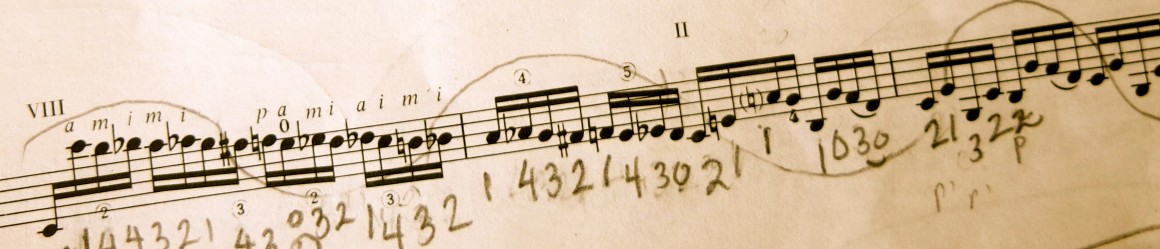
Guide Fingers in Leo Brouwer’s Etude Nº6

In this video I talk about using guide fingers to help choreograph the left hand. Guide fingers really make everything flow in the left hand by keeping it in contact with the strings. They also prevent the necessity to lift and place which can cause stress and tension in the left hand. Don’t forget to like, share, subscribe, and leave a comment if you have questions.