Pavel’s Left Hand Technique Fun

I think I’ve now scoured most of Pavel Steidl‘s masterclasses on youtube. What a treasure trove of advice. I absolutely love him, his creativity, and his masterful ability to teach in such a fun way.

Here is a left hand technique progression that roughly matches what he demonstrates in one of his masterclasses. Pavel recommends at least 30 minutes a day of work for the fingers. Among his bits of advice and reflections, there is a moment in a masterclass where he talks about left hand choreography and how it is connected to the part of our brain that is responsible for, as he puts it, “fantasy and imagination.”

Here is the sequence to explore:

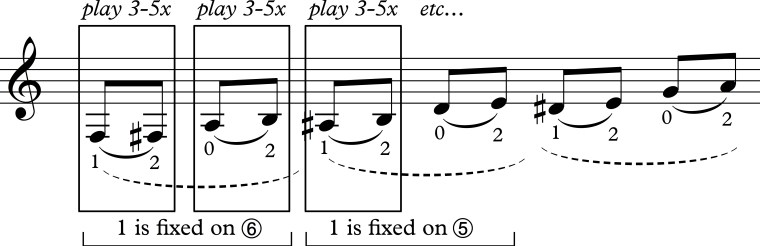
Step 1

Play the top voice as a continuous slur.

Pavel's Fixed Finger Slurs.jpg

Move on to the next step or repeat with the remaining patterns:

02/1343, 03/1242, 04/1232 (slur/counterpoint)

Step 2

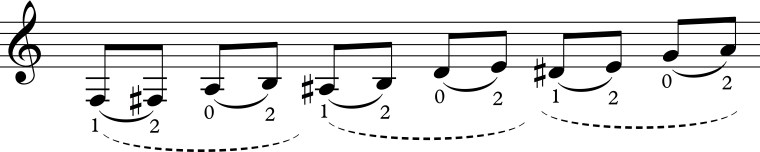
Now slur the counterpoint or fixed note as well.

Pavel's Fixed Finger Slurs 2.jpg

Move on to the next step or repeat with the remaining patterns (see above).

Step 3

Add in a coordinating movement in the right hand (try something simple first).

Pavel's Fixed Finger Slurs 3.jpg

Move on to the next step or repeat with the remaining patterns (see above).

Step 4

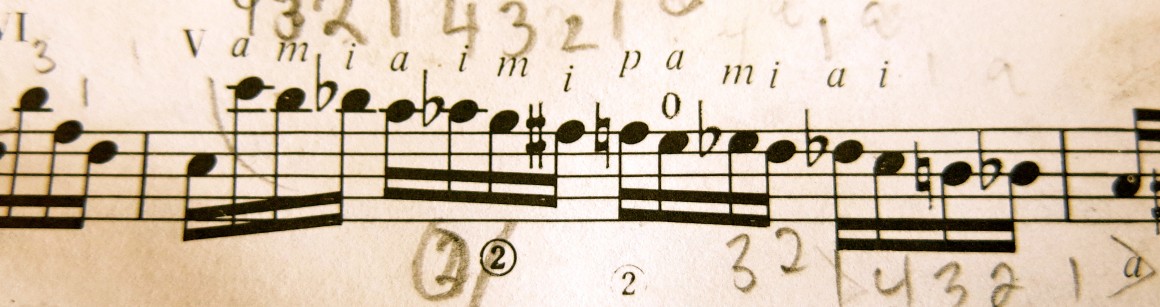
Explore a more challenging coordinating movement in the right hand (try pami on string 5).

Pavel's Fixed Finger Slurs 4.jpg

Be creative and have fun just like Pavel!

Pavel Steidl

We are in an era where from the comfort of your own living room you can watch hours and hours of the greatest guitarists on the planet conduct masterclasses. When I was in music school, masterclasses were always a treat because not only would you receive guidance about your repertoire, you could watch others receive guidance and insight on pieces you may have played or were perhaps on your bucket list of pieces.

If you have not heard Czech guitar virtuoso Pavel Steidl perform, you should. He embodies the pieces he is playing in a supernatural way and it is always clear from the first note of the concert that his music comes from a deep place. And, if you have not seen him teach a masterclass, you should. His ideas are wonderful and ear opening. Here is one where he talks about feeling intervals, displays some finger bending exercises, and even shows how he shapes his nails. True gold for those seeking inspiration and guidance.

Off to practice!

Artist Profile: Denis Azabagic

“Denis Azabagic demonstrated his unbelievable guitar playing skills, sincere love for music, professionalism and passion…” – CHICAGOTRIBUNE.COM

A GFA winner, seasoned concert artist, accomplished chamber musician and recording artist, Bosnian guitar great Denis Azabagic, needs no introduction to the classical guitar world. But, what often escapes even the most devoted afficionados may be the hidden gems among the pile of guitar videos on youtube.

I recently came across Denis’ Mastering Guitar Technique Series [scroll down a bit after linking]. Though you have to pay for each video, the lessons range from slurs to tremolo to scales and in my opinion are worth hundreds time what he is charging ($1.99!). Each video has a tremendous amount of insight and practical advice. If you’ve not heard Denis play, check out the video below of him playing brilliant renditions of standards by Sor, Bach, and Asencio, and then check out his technique series!

Best of YouTube: Judicael Perroy

Rising to fame in the guitar world after winning the Guitar Foundation of America‘s 1997 International Competition, French guitar virtuoso Judicael Perroy is now a much admired, loved, and sought-after concert guitarist and teacher. One listen to his playing and your interest is held by an infectious drive and energy few players can conjure. In most recent news, he will join the San Francisco Conservatory‘s faculty in the fall. That is news I love to hear as it’s an opportunity to perhaps hear and see more of this incredible musician for those of us who live nearby.

Here are is an interview of Judicael filmed by Tornavoz where he talks about being a classical musician, listening to music, and acquiring a wealth of perspectives to become a better musician.

This second video beautifully shot by the Paris Guitar Foundation shares some insight into Judicael’s life with footage of Judicael playing Scriabin and Ponce. Simply incredible!

A Way of Thinking of Tremolo

…or should I say, a way of thinking about tremolo? (sorry, couldn’t resist).

Another point Pepe Romero makes in his masterclass is to think of the tremolo pattern originating from a instead of p. This, he explains, is because the first note of the melody coincides with a.

Pepe Tremolo amip 1.jpg

…from my new book, Mastering Tremolo.

New Publication: Mastering Tremolo

After lots of hard work, I’m excited to announce to all of you the publication of my new book, Mastering Tremolo.

Here is a description: Leonardo Garcia’s Mastering Tremolo is an extensive guide for all aspiring guitarists wishing to develop solid tremolo technique. From a multitude of preliminary technical exercises and drills to develop a foundation for your tremolo and invigorate your technique, to more than a dozen active practice techniques detailed with musical examples to develop rhythmic precision, note consistency, tone, and speed, to the mental game of playing tremolo, this book will help improve your tremolo and playing regardless of your level.

It’s available in print and on Kindle.

Over the next few weeks I will post some content for Six String Journal readers!

Left Hand Warmup: Slurs, Fixed Fingers, Open Strings, and Tunnels

Lately, when starting my practice I will start with an assortment of left hand movements. I go slowly with attention to the fluidity of the movements. While I do this, my ear starts to focus. The easy pace is ideal for adjusting tone and exploring left hand movement before moving on to arpeggios, scale fragments, and spots in pieces.

Here is a slur sequence I really enjoyed focusing on yesterday. It involves playing slurs with a pair of fingers, slurs to and from open strings, all while requiring the precise placement of the fingers to create tunnels so that adjacent strings remain unobstructed. Fun!

I immediately thought: BLOG POST!

Here’s the outline of the movement using fingers 12 but you should try all pairs (23, 34, 13, 24, 14). You’ll get more out of the exercises by repeated each slur many times and of course, play them across all strings and positions.

Method of Practice

Fixed Finger Slur Exercise 2.jpg

Exercise 1 – Ascending Slurs

Fixed Finger Slur Exercise.jpg

Exercise 2 – Ascending Slurs 2

Fixed Finger Slur Exercise 3.jpg

Exercise 3 – Ascending and Descending Slurs

Fixed Finger Slur Exercise 2a.jpg

Exercise 4 – Descending Slurs

Fixed Finger Slur Exercise 4.jpg

Exercise 5 – Descending and Ascending Slurs

Fixed Finger Slur Exercise 5.jpg

Go give that left hand a workout!


Right Hand String Crossing Technique Tip

One aspect of Ángel Romero‘s edition of Joaquín Rodrigo’s Concierto de Aranjuez is that every single scale is fingered optimally for string crossing so that almost always reaches towards a higher string when blazing through the scale passages (i.e. when going from string 2 to 1, it is fingered i m and not m i). And while you could employ slurs or shifts to maintain optimum string-crossing, if those solutions are not musically in the cards there is a finger standing on the sidelines waiting eagerly to help: a. Using a to switch from im alternation to mi alternation without skipping a beat is an important skill to develop for situations where you would want to maintain optimum string-crossing for the right hand. Here are a few exercises using a to develop this technique.

Keep the following points in mind when going through these.

  1. Maintain a steady metric pulse.
  2. Keep your tone consistent.
  3. Practice rest-stroke and free-stroke.

Exercise 1

Using a to switch direction.jpg

Exercise 2 and 3

Using a to switch direction 2.jpg

Exercise 4 and 5

Using a to switch direction 3.jpg

Go a!

Rafael Elizondo’s Technique Videos

Rafael Elizondo is a fabulous Mexican concert guitarist who has been making wonderful videos for his youtube channel. If you don’t speak Spanish, you may not be at too much of a disadvantage because he demonstrates everything very clearly. This instructional video below is a fine example of Rafael explaining how to use fixed fingers to establish stability and confidence in the right hand.

Here is another great one where he demonstrates 4 finger coordination patterns for the left hand:

Check out and subscribe to his channel. There are tons of great posts.

More soon…


Technical Workout for Classical Guitar, Level 1 – Base Building, Part 2 (video)

Here is the second of Six String Journal’s series of technique videos to accompany my recent workbook, A Technical Workout for Classical Guitar, Level 1 – Base Building. This video corresponds to Left Hand Movements, Part 2.

This workbook is designed to help late beginners and intermediate guitarists develop a daily routine of movements to strengthen their technical base so that fingers can do their job properly when assimilating new repertoire. Always go slowly with the most control possible. Think of it as writing a program for your brain with no bugs.