NEW PUBLICATION! I finally published a study score of Agustín Barrios Mangoré’s tremolo masterpiece Un Sueño en la Floresta. I love a compact score! I’ve reduced what editors usually publish in editions of 12+ pages to 4. It is easier to see structure, to manage page turns, and to mark sections for work. There are detailed fingerings for the left hand, optional fingerings, and smaller indications about barring and guide fingers. I have found that these fingerings work best for me and my students. This edition is available through the Six String Journal Payhip store and is 50% off for the remainder of July!
Over the years, I’ve posted several times about tremolo technique and even wrote the book Mastering Tremolo. Check it out if you haven’t yet! Nevertheless, there are times when I decide to spend a lot of time working on certain techniques to brush up, improve, try new approaches, revisit, and revise. I did this with tremolo this week and though I may have mentioned them in my book, some stood out to me. Here are a few entries I wrote in my practice notes:
The movement from p to a is key – This is a feel thing. Think of snapping with p and a. As p articulates the bass note, a lands with some energy. It is almost like they are landing at the same time but not quite, allowing the melodic note on the higher string to vibrate justy a bit more.
Nails – Each nail has to offer identical resistance to the string so that the quality of evenness is built in. If you are negotiating different stroke strength from finger to finger, it is too much effort.
Proximity – Watch fingers closely and observe their distance from the string before the contact point and subsequent stroke. If there is too much discrepancy between the lineup, it can lead to galloping.
Evenness – When practicing slowly, evenness is very important for both the attack and the silence or momentarily planting between notes.
Left Hand Softness – Make sure the choreography of the left hand is worked out well. Abrupt motions in the left hand to make shifts can manifest in the right hand as accents. Keep the left hand as relaxed as possible.
Right Hand Fingers – Sometimes increasing the perception of space between the right hand fingers seems to help me even out the notes. Try it.
Have some time to work on your technique over the holidays? Through December, my course Complete Technique for Classical Guitar will be on sale through Six String Journal’s Podia page. Use this COUPONCODE for a 20% discount.
Six String Journal’s Complete Technique for Classical Guitar Course was developed for the advancing beginner with some experience, the advancing intermediate guitarist, and will even benefit those with lots of playing experience. Though music theory isn’t necessary, a rudimentary understanding of rhythm is helpful.
The course consists of primary movement videos where I will teach the foundational movements that you’ll need in order to master classical guitar. These videos cover topics such as free-stroke, rest-stroke, arpeggios, alternation, scales, hand coordination, slurs, and shifts. These are followed by several series of secondaryvideos where I’ll apply the techniques and movements in various ways to help you engrain them into your own practice. Stringing the secondary videos into a sequence will teach you how to form an effective practice routine that will maximize your results and get you closer to your musical goals.
Course Includes
Hours of focused technique lessons with an award-winning classical guitarist, the founder of Six String Journal, and sought-after educator.
Over 50 extensively detailed but digestible videos demonstrating essential foundational movements, technique tips, exercises, routines, and how to implement them into your practice, carefully edited in small bite size videos for easy assimilation and viewing.
Printable PDF summarizing the entire course with a condensed visual of the material presented.
Loads of bonus content from Six String Journal’s Mastering Diatonic Scales.
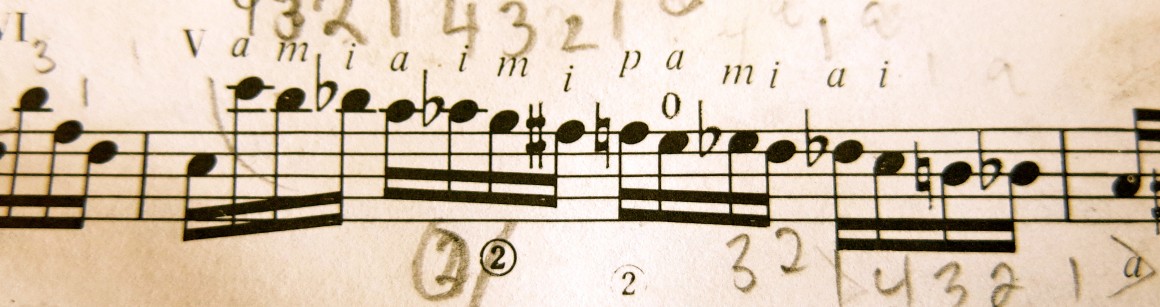
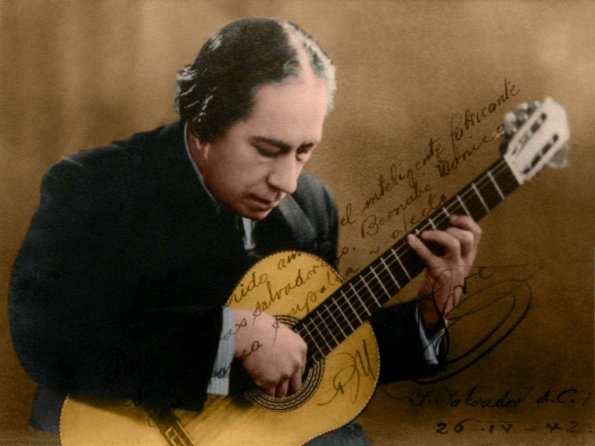
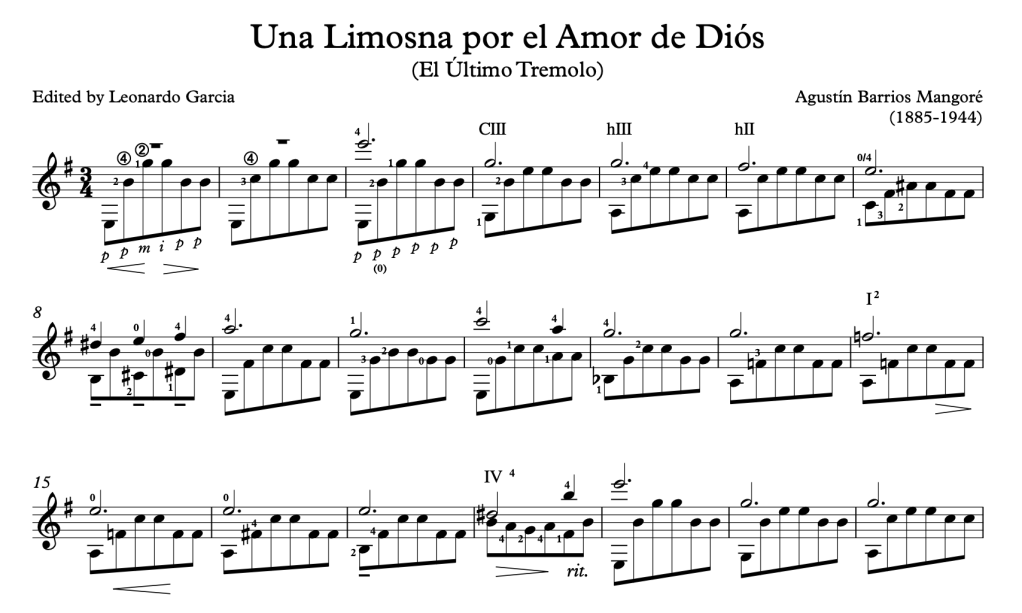
In the video below, I demonstrate four great ways to help your tremolo improve. Two of them I’ve outlined in my book Mastering Tremolo, which if you haven’t picked up, you should : ). But the last two I came across in Abel Carlevaro’s hand-written notes to himself in one of his editions of Agustín Barrios Mangoré’s Una limosna por el amor de Diós. Below you’ll find links to Mastering Tremolo and a NEW study score of Barrios’s Una limosna. Hope it helps.
The Best Right Hand Exercise You are Not Doing by Leo Garcia
If you’ve worked through both Part 1 and Part 2 to improve your right hand confidence, you can add this exercise to the bunch. I teach this one to students who are working on developing tremolo. But, it’s very useful for mastering the subtlety of string crossing with other right-hand fingerings. Use it to develop your basic right-hand fingerings im, mi, am, ma, ia, ai in both rest and free stroke, and pi, pm, pa for free stroke. Then try the basic pattern for tremolo pami or even go nutty with ami and ima. : )
Don’t forget to start slowly, with a metronome, and enjoy discovering which right-hand fingerings are your strongest and which ones need work.
Creeping Tremolo Exercise
One-Time
Monthly
Yearly
if you enjoyed this article please consider Making a one-time or monthly donation to support content creation on six string journal.
In Thomas Viloteau’s lesson on tremolo, he describes his method for working on and identifying irregularities in your tremolo. Your tremolo must serve the music you are playing and go beyond a technique. Otherwise, what should sound like beautiful music will instead sound like an exercise.
“The music is the most important thing. If you practice your tremolo as a technical thing, when you go to an actual piece it’s either not going to work or it’s going to make your music completely flat and lifeless.” – Thomas Viloteau
What is a good tremolo?
A good tremolo allows for three things:
A wide range of dynamics (pianissimo to fortissimo)
Different articulations
A range of different tempos (accelerando, ritardando, rubato…)
How to spot problems in your tremolo?
Get a smartphone or device that can film video at a high frame rate and play it back in slow motion. It’s the only way to SEE what your fingers are doing at such a high speed and HEAR if you are actually picking as regularly as the beat of the metronome. This will help you learn what you are doing wrong.
Once you know what to fix, practice on open strings with a metronome. Make sure the technique you are practicing at a slow speed is not just “good enough” to pass at a slow tempo – it needs to work at full speed. Try experimenting with expressive variations to test your control over the technique. As soon as your technique is ready, start practicing your tremolo within the piece and NOT in isolation, as just a tremolo exercise. It will only be great if it is MUSICAL and works within the piece!
What are the different types of tremolo?
These three approaches offer different qualities and fit different musical contexts. Experiment to find more. For all the exercises below, use a p-a-m-i plucking pattern, though in some situations a two-finger tremolo may be preferable.
Basic – Resting (a) ring finger on the string before plucking it to create stability for the hand and tell your fingers where the string is. Free stroke all the way through the string.
Legato – Never resting (a) ring finger on the string. Works well for piano sections and when the accompaniment is on the top. It also works well for portamento because it doesn’t silence the string.
Detached – Planting each finger firmly on the string before it plays. Mostly for use on the second or third strings. The finger comes more from ABOVE the string, in this technique, and may jump a little rather than remaining totally steady.
Bonus Tips
Tremolo is much easier on the first string than the second because there is more range of motion for your fingers. Take advantage of this when you make your fingering
Your forearm must be super relaxed and your hand very stable.
To minimize the sound of your nail hitting the string, you must make sure that your flesh is hitting the string before the nail.
It is easy for the middle finger to fall out of time. If this is happening, accent the middle finger’s plucking.
Though there is no shortage of ways to practice and develop tremolo, every now and then I’ll bump across another exercise that is worthwhile or ask a colleague to share insight especially if it sounds like they figured it out. So here are two great ways to practice your tremolo when you are feel like you are not progressing.
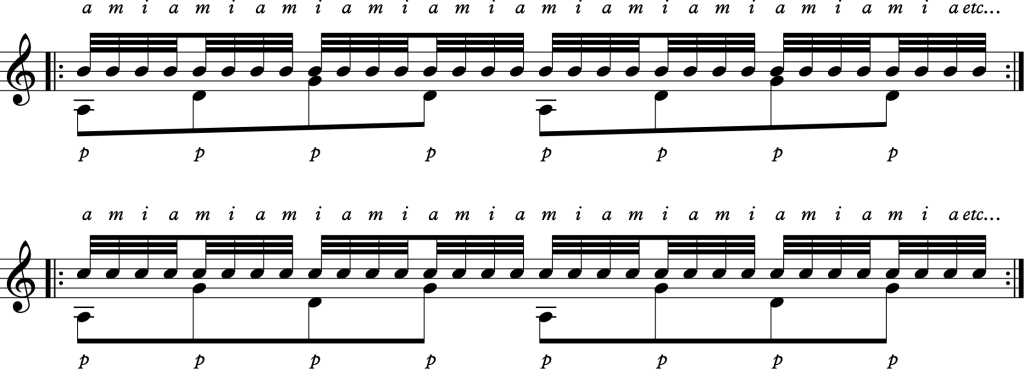
This first one helps develop both the independence of the right hand fingers and the evenness of the attack. I like to mess around a bit with a simple left hand addition once everything feels comfortable.
Exercise 1
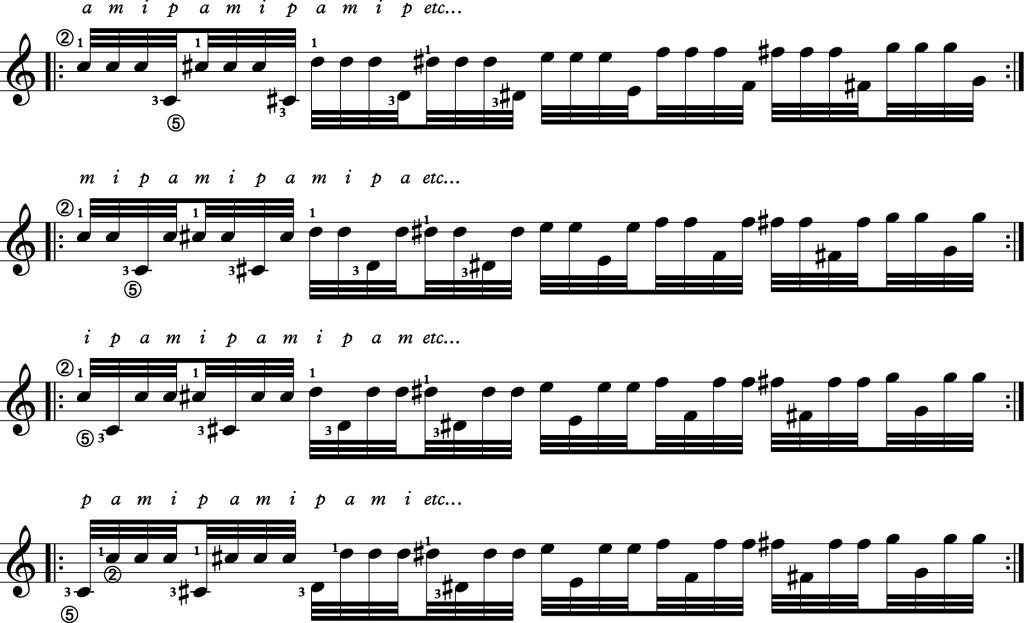
This second exercise comes from the wonderful Vietnamese guitarist. Thu Le. It is a great way to sync up both hands once the right hand is warmed up. I’ve placed it on the fifth and second strings to develop accuracy. As you improve, work on minimizing squeaks. You can also use fingers 2 and 4 to mix it up.
Exercise 2
For a multitude of methods to work on tremolo with detailed explanations, please check out Six String Journal’s publication Mastering Tremolo. It’s available on Amazon or on Podia.
One-Time
Monthly
Yearly
Make a one-time donation
Consider a donation To help develop content for Six string journal. : )
Happy New Year! If your New Year’s resolution is to improve your tremolo, you are in luck!
The Bolton Guitar Series just posted its workshop on tremolo with David Russell. Before summarizing it for those of you who like to see the main points listed as a reference, I thought I’d repeat what I expressed in the recent post about David Russell’s ornamentation workshop: the generosity in sharing absolutely everything he knows about his journey with guitar in such an enthusiastic and articulate way is extremely inspiring. David Russell is a great teacher, even through zoom!
Here is the video of the tremolo workshop:
David Russell Tremolo Workshop Main Points
Each finger/nail should feel and sound the same.
Tremolo is a good diagnostic technique for other technical issues.
Maintain a regular rhythm.
Bass should be balanced. Gentle bass/medium or strong treble.
Stiffness in the right hand fingers makes noise. Looseness in the right hand equals a less “clickly” sound. Straighter fingers also help with lessening the “clicky” sound of nails.
The a finger introduces a new tremolo/melodic note and requires attention.
Sympathetic motion between a and m can lead to rhythmic irregularities. Lengthen a finger duration to insure full value of note.
Shift metronome beats to each finger when practicing to “think” with each finger and especially a.
What you do musically with tremolo is at least as important as mechanical perfection.
Practice contrasting Slow/fast, dark/bright, soft/loud practice.
Certain pieces require slow tremolo, some require faster tremolo.
Tremolo pieces:
Recuerdos de la Alhambra and Sueño (Francisco Tárrega)
Zafra and Simancas from Castillos de España (Federico Moreno Torroba)
Una limosna por el amor de Diós, Un sueño en la floresta, Contemplación, Canción de la Hilandera (Agustín Barrios Mangoré)
Invocación y danza and Junto al Generalife (Joaquín Rodrigo)
Reverie and Air Varié (Giulio Regondi)
Now and Ever (Bejamin Verdery)
Shenandoah (Robert Beaser)
Capricho Diabolico (Mario Castelnuovo-Tedesco)
Variations on Las Folias (Manuel Maria Ponce)
Campanas del Alba (Regino Sainz de la Maza)
Tips from Questions and Answers:
Play with energy and the necessary tension but more than that is wasted energy and effort. Poise and posture to maximize energy.
Practice tremolo with two fingers (pimi, pmim, pama, pmam, etc…)
Do not bounce hand!
Planting a stops the tremolo. Join all the notes for a better tremolo.
Try playing paaa tremolo to assess tone, movement of a.
Finger movement remains mostly within the span of string space (i.e for tremolo on string 2, a, m and i do not extend beyond strings 1 or 3).
Raise your expectations of yourself. Do not accept bad playing!
Here is a recent home recording I did at the end of a practice day last week. The songs I have been revisiting these last six months all have the theme of conjuring places far away – in both geography and time. The great Spanish guitarist, Francisco Tárrega’s (1852-1909) wonderful tremolo piece, Recuerdos de la Alhambra, is magical in so many ways. It conjures the great fortress overlooking Granada with the illusion of a sung melody and it reminds me of its infinite mosaics, fountains, streams, and trickles of water echoing everywhere throughout.
This is an interesting technique that I have found truly helpful for developing speed and the correct rhythmic feel across whatever pattern you are practicing, and since I have not found any reference to it in the literature, I refer to it as aural refocus. Its purpose is to refocus your hearing on the larger beats within a pattern or movement, and then “feed in” the rest of the notes while retaining attention on the larger concept and rhythmic feel.
In theory, we want to perform the larger movements in time—but in practice we rarely do so because we feel limited by all the minutiae that a particular movement demands. With a lot of work, patterns that undergo the aural refocus treatment will get a boost in speed while retaining their rhythmic integrity and stability.
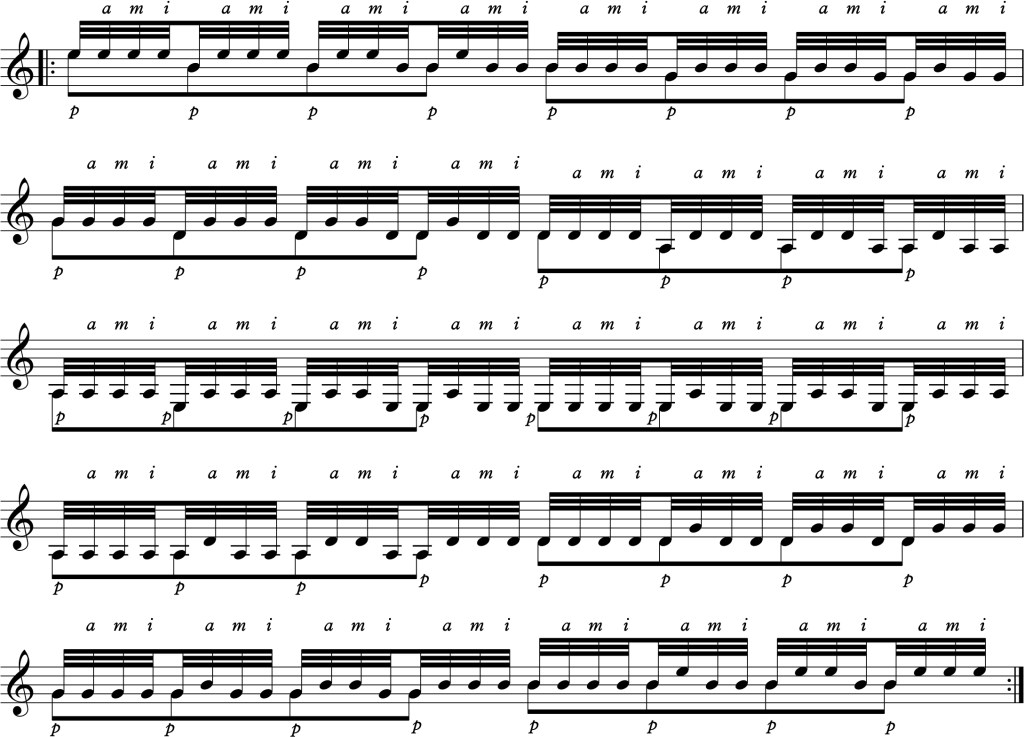
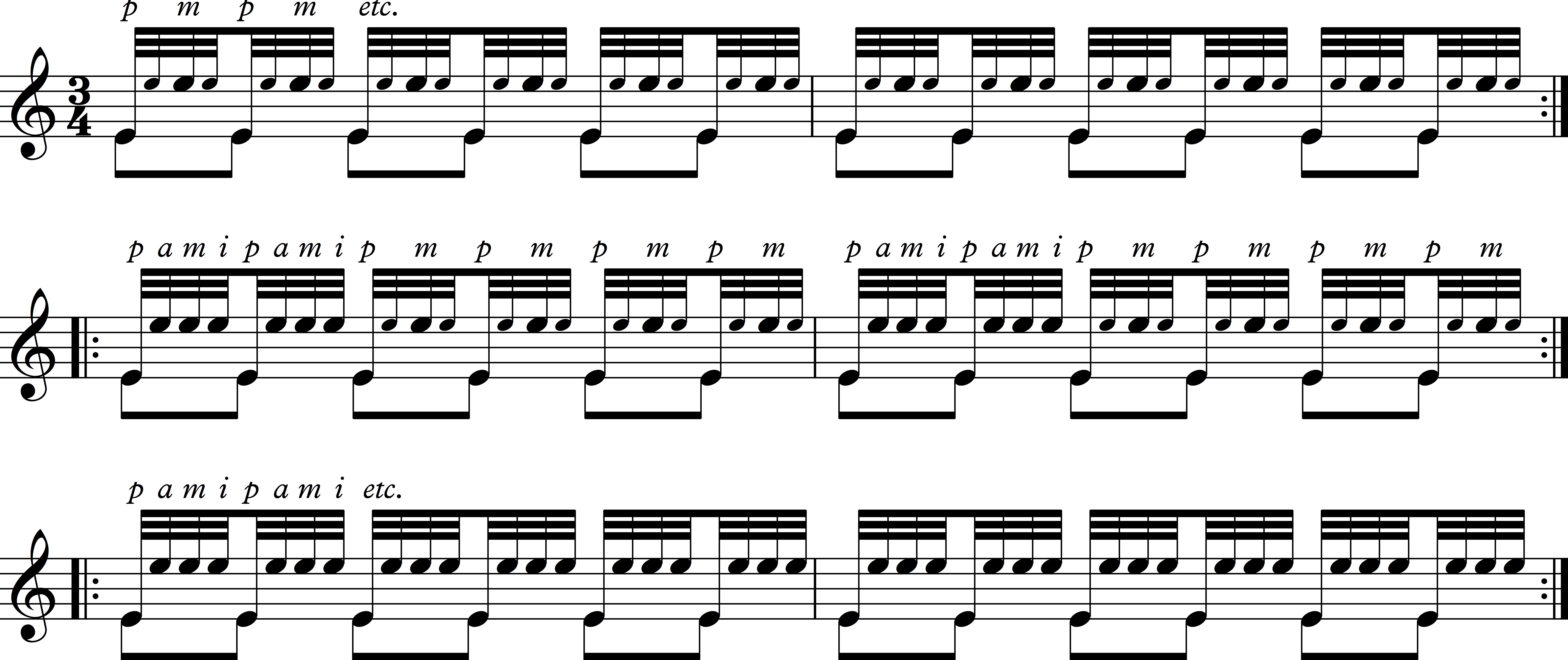
Here are three exercises for applying aural refocus to tremolo. Before you begin, set the metronome to an ambitious tempo (72–88+ bpm per half note) and keep it constant through each exercise. Play only the fingers indicated, do not play the small notes in the following exercises and feel the larger beat in the right hand. Play through each line for at least a minute. Then alternate freely between the lines, coming back to the first line often to reestablish the longer sense of pulse and technical ease.



 Six String Journal