Studio content
This article continues inside the Six String Journal Studio, where members have access to in-depth repertoire walkthroughs, practice guidance, and performance-focused writing.
Tag: guitar speed
From the Archives: Miracle Right Hand Warm-Up Sequence
Studio content
This article continues inside the Six String Journal Studio, where members have access to in-depth repertoire walkthroughs, practice guidance, and performance-focused writing.
Want Speedy Scales?
Want to feel more accurate when playing through your pieces? Want speedy scales? Want fluid arpeggios? Want to be a guitar superhero? Work on basic movements. Hard work on the very basic movements of technique allows an inner exploration of our limits and abilities while giving us a bit of a roadmap for quantifiable and steady improvement.
Below are some very basic right hand drills that find their way back into my warm-up and finger routines often. It's not that I need to practice them much anymore but rather they allow me to continually refine the most important . . .
Studio content
This article continues inside the Six String Journal Studio, where members have access to in-depth repertoire walkthroughs, practice guidance, and performance-focused writing.
David Russell Technique Talk
Studio content
This article continues inside the Six String Journal Studio, where members have access to in-depth repertoire walkthroughs, practice guidance, and performance-focused writing.
A Way of Thinking of Tremolo
Studio content
This article continues inside the Six String Journal Studio, where members have access to in-depth repertoire walkthroughs, practice guidance, and performance-focused writing.
Left Hand Warmup: Slurs, Fixed Fingers, Open Strings, and Tunnels
Lately, when starting my practice I will start with an assortment of left hand movements. I go slowly with attention to the fluidity of the movements. While I do this, my ear starts to focus. The easy pace is ideal for adjusting tone and exploring left hand movement before moving on to arpeggios, scale fragments, and spots in pieces.
Here is a slur sequence I really enjoyed focusing on yesterday. It involves playing slurs with a pair of fingers, slurs to and from open strings, all while requiring the precise placement of the fingers to create tunnels so that adjacent strings remain unobstructed. Fun!
I immediately thought: BLOG POST!
Here’s the outline of the movement using fingers 12 but you should try all pairs (23, 34, 13, 24, 14). You’ll get more out of the exercises by repeated each slur many times and of course, play them across all strings and positions.
Method of Practice

Exercise 1 – Ascending Slurs

Exercise 2 – Ascending Slurs 2

Exercise 3 – Ascending and Descending Slurs

Exercise 4 – Descending Slurs

Exercise 5 – Descending and Ascending Slurs

Go give that left hand a workout!
Slow Practice
I often try to convince students to practice ultra slowly by using various metaphors. How much more would you notice if you were to admire a great piece of art for an hour instead of a minute? How would your thoughts change if you read a complex paragraph quickly versus reading it slowly and contemplating the meaning of each word and sentence as it related to the whole? If metaphors don’t convince them they can go read this fabulous article for pianists written by pianist Graham Fitch about the slow practice that I think is spot on!
Hope you enjoy it as much as I did.
Right Hand String Crossing Technique Tip
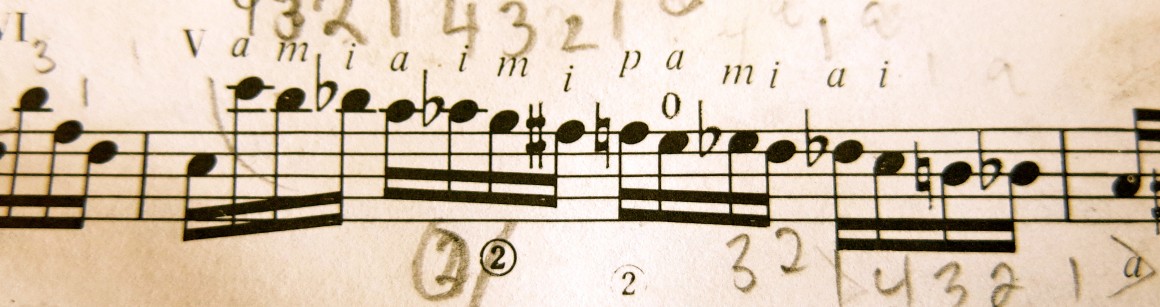
One aspect of Ángel Romero‘s edition of Joaquín Rodrigo’s Concierto de Aranjuez is that every single scale is fingered optimally for string crossing so that m almost always reaches towards a higher string when blazing through the scale passages (i.e. when going from string 2 to 1, it is fingered i m and not m i). And while you could employ slurs or shifts to maintain optimum string-crossing, if those solutions are not musically in the cards there is a finger standing on the sidelines waiting eagerly to help: a. Using a to switch from im alternation to mi alternation without skipping a beat is an important skill to develop for situations where you would want to maintain optimum string-crossing for the right hand. Here are a few exercises using a to develop this technique.
Keep the following points in mind when going through these.
- Maintain a steady metric pulse.
- Keep your tone consistent.
- Practice rest-stroke and free-stroke.
Exercise 1

Exercise 2 and 3

Exercise 4 and 5

Go a!
Technical Workout for Classical Guitar, Level 1 – Base Building, Part 2 (video)
Here is the second of Six String Journal’s series of technique videos to accompany my recent workbook, A Technical Workout for Classical Guitar, Level 1 – Base Building. This video corresponds to Left Hand Movements, Part 2.
This workbook is designed to help late beginners and intermediate guitarists develop a daily routine of movements to strengthen their technical base so that fingers can do their job properly when assimilating new repertoire. Always go slowly with the most control possible. Think of it as writing a program for your brain with no bugs.
Developing Coordination and Stroke Control
Studio content
This article continues inside the Six String Journal Studio, where members have access to in-depth repertoire walkthroughs, practice guidance, and performance-focused writing.